
For an impeccable winter garden in Canada, Calamagrostis ‘Karl Foerster’ surpasses Miscanthus thanks to its superior structural resilience against heavy snow.
- The plant architecture of Calamagrostis, with its thin and rigid stems, allows it to remain upright, while the hollow stems of Miscanthus become waterlogged and break under the weight.
- Choosing a grass for winter is not just an aesthetic choice; it is a structural decision that defines the skeleton of your landscaping during the long cold months.
Recommendation: Opt for Calamagrostis ‘Karl Foerster’ as the vertical pillar of your flowerbeds and complement it with dwarf conifers and Corten steel edging for a durable, maintenance-free winter structure.
The arrival of winter in a modern garden is often synonymous with emptiness. Once the autumn colors have faded, the eye desperately seeks structure—a presence that defies the monochrome white of the snow. The contemporary design enthusiast instinctively turns to ornamental grasses, promising graphic silhouettes and graceful movement. The usual advice is simple: do not prune them in the fall to enjoy their winter beauty. But in Canada, this advice omits a crucial variable: snow load. A single storm of heavy, wet snow can transform a majestic mass of grasses into a broken, shapeless heap until spring.
The question is therefore not only which grass looks pretty in winter, but which grass possesses the plant architecture to physically resist a Canadian winter. Two giants often battle in the minds of gardeners: Calamagrostis and Miscanthus. While Miscanthus charms with its scale and opulent plumes, it hides a structural weakness. The true key to an impeccable garden from November to March lies not in volume, but in resilience. This article goes beyond aesthetics to analyze plant mechanics and provide the keys to choosing and maintaining the true skeleton of your winter garden.
To guide you in creating a truly high-performance four-season garden, we will cover all practical aspects, from dividing these powerful perennials to pairing them with the right companions, as well as solutions for specific challenges like shade or container gardening on a balcony.
Table of Contents: Choosing the Perfect Structural Grass for the Canadian Winter
- When and how to divide a giant grass without breaking your shovel?
- Which flowers to plant with grasses to avoid the “hay field” effect?
- The mistake of cutting grasses in the fall and missing the winter spectacle
- Are there grasses that grow well in the shade of large maples?
- Which grass survives in a pot on a windy 10th-floor balcony?
- Which dwarf conifers keep their perfect ball shape without any pruning?
- Boxwood or Corten steel: which edging structures the vegetable garden in winter when everything is empty?
- Why replacing your lawn with native plants saves you 40 hours of maintenance per summer?
When and how to divide a giant grass without breaking your shovel?
Structural grasses like Miscanthus or Panicum are plants of impressive vigor. Their dense and powerful root system can quickly become an almost impenetrable block, making division necessary not only to control their expansion but also to rejuvenate the clump. Attempting this operation with the wrong tool or at the wrong time is a guarantee of a bent shovel and a sore back. The key is to act in the spring, just after the ground thaws but before new growth actively starts, generally between late March and late April in Canada. This is when the plant is still dormant but the soil is soft enough to be worked.
The technique and tools depend on the age and species of the grass. For a medium-sized clump, the method of using two spading forks inserted back-to-back in the center of the root ball is effective. By prying them apart, you can separate the base without much difficulty. However, for a well-established Miscanthus giganteus, whose core becomes extremely dense and woody, you need to bring out the heavy artillery. A robust handsaw, or even a well-sharpened axe, is often essential to cut through the rhizome. Regardless of the method, the goal is to obtain divisions from the periphery of the mother clump, as these are the youngest and most vigorous parts. A good division should have at least 3 to 5 buds to ensure successful regrowth. Conversely, the dead and exhausted center of the old clump should be composted. To ensure the vitality of your grasses, experts recommend dividing Miscanthus every 5 to 7 years.
Action Plan: Your Successful Spring Grass Division
- Timing: Wait for the ideal post-thaw moment in spring (March-April in Canada), before active growth begins.
- Tool Selection: Assess the density of the base. Prepare two spading forks for standard clumps or a handsaw/axe for very woody bases (old Miscanthus).
- Separation Technique: Insert your tools into the center of the root ball and use leverage to split it. Aim to obtain several good-sized divisions.
- Sorting Divisions: Inspect the pieces. Only keep healthy, vigorous divisions from the plant’s periphery, each with 3 to 5 buds.
- Integration and Follow-up: Replant the chosen divisions immediately in their new location and water copiously (10-15 liters per plant) during the following weeks to ensure rapid recovery.
Which flowers to plant with grasses to avoid the “hay field” effect?
One of the greatest challenges in using grasses is creating a harmonious composition that doesn’t slip into the neglected look of a “hay field.” The secret lies in the contrast of shapes, textures, and colors. You must marry the verticality and fineness of the grasses with plants that have well-defined structures. The goal is to create a visual dialogue where each plant enhances the other. Calamagrostis ‘Karl Foerster’, with its strictly upright habit, is a partner of choice for this stylistic exercise. Its rigid structure serves as a perfect backdrop for perennials with rounder or flatter shapes.
For a successful and lasting effect in the Canadian climate, pairing with native or highly adapted plants is a winning strategy. A proven combination, particularly beautiful late in the season, consists of planting Calamagrostis with purple coneflowers (Echinacea) and fall asters. The round, spiky heads of the coneflowers and the clouds of aster blooms create a striking contrast with the golden, vertical spikes of the grass. To extend interest into the heart of winter, adding a shrub with colored bark is a stroke of genius. The native dogwood ‘Arctic Fire’ (Cornus sericea), for example, offers flaming red stems that pierce through the snow and harmonize beautifully with the straw-blond of the dried grasses, creating stunning scenes even in January.

Another spectacular option is to use autumn sedums (such as Hylotelephium ‘Autumn Joy’). Their wide, flat inflorescences, which turn from pink to bronze and then black, offer a solid horizontal mass that anchors the lightness of the grasses. These robust flower heads persist all winter, catching frost and snow in a way that is just as graphic as the grasses themselves, ensuring continuous visual interest.
The mistake of cutting grasses in the fall and missing the winter spectacle
One of the most frequent mistakes, driven by a reflex for fall “cleanup,” is to prune ornamental grasses to the ground before winter. This deprives the garden of the very essence of their contribution: the winter spectacle. The dried foliage, whether blond, copper, or silver, catches the low winter sun in a way that no other plant can match. The spikes become covered in frost, creating ephemeral sculptures of delicate beauty. The sound of the wind rustling through the dry stems adds a sonic dimension—a living presence in the silence of winter. As one reader of the Laidback Gardener blog shares, “I love Karl Foerster grass… I love its look in the middle of winter, watching it from my living room window.”
Beyond aesthetics, there is a purely horticultural reason not to prune in the fall. The foliage left in place acts as a natural protection for the plant’s crown. It helps insulate the base from extreme cold and, more importantly in Canada, from the freeze-thaw cycles that can damage roots. Additionally, many grasses, such as Panicum virgatum (Switchgrass), produce seeds that are a valuable food source for birds that overwinter with us, such as Dark-eyed Juncos and Common Redpolls. Leaving your grasses intact is a simple gesture to support local wildlife.
The right time for pruning is at the very end of winter or the very beginning of spring, usually late February or early March, just before new green shoots emerge from the base. You then cut the dry clump back to about 10-15 cm from the ground. This late cut allows you to maximize the winter structure while clearing the way for the new growing season. To magnify the show, consider lighting: a simple spotlight directed upwards (uplighting) can transform a bed of frosted grasses into a luminous work of art on winter evenings.
Are there grasses that grow well in the shade of large maples?
Planting under a mature maple tree is one of the greatest challenges of gardening in Canada. The combination of dense shade and a soil riddled with fine, voracious roots creates conditions of extreme drought and competition. Most plants, including sun-loving grasses like Calamagrostis, fail miserably there. However, there are specialized grasses that not only survive but thrive in these difficult conditions. The key is to look toward species adapted to dry shade and, ideally, native to our woodlands.
The most elegant and durable solution is undoubtedly Pennsylvania Sedge (Carex pensylvanica). This native grass is the champion of root competition. It forms a fine, soft carpet, similar to a head of hair, which chokes out weeds and requires no mowing. It tolerates dry shade perfectly once established. For a touch of light, Hakonechloa macra ‘Aureola’, or Japanese Forest Grass, is a spectacular option. Although less hardy (Zone 5), its cascading foliage, yellow striped with green, illuminates the darkest corners. It requires slightly richer soil and consistent moisture to establish well. Another high-performing native is Deschampsia cespitosa (Tufted Hairgrass), which enjoys the spring moisture often present at the base of maples before their foliage fully unfurls.

To give your plants the best chance, the planting technique is crucial. It is not enough to just dig a hole. You must create a “planting pocket” by excavating an area wider and deeper than the root ball and generously amending the soil with compost. Consistent watering during the first season is essential to allow the grass to develop its root system before entering direct competition with the maple.
This table summarizes the best options for greening the competitive shade of your maples.
| Grass | Hardiness | Height | Special Features |
|---|---|---|---|
| Pennsylvania Sedge | Zone 3 | 20-30 cm | Native, tolerates dry shade |
| Hakonechloa ‘Aureola’ | Zone 5 | 30-40 cm | Bright golden foliage |
| Deschampsia cespitosa | Zone 4 | 60-90 cm | Native, loves moisture |
| Luzula nivea | Zone 4 | 30-40 cm | Evergreen, deep shade |
Which grass survives in a pot on a windy 10th-floor balcony?
Growing plants on a high-rise balcony in Montreal or Toronto presents much greater climatic challenges than at ground level. Constant wind dries out potting soil at lightning speed, and winter exposure is brutal. The golden rule of container gardening in cold climates is to choose plants hardy for at least one, or even two, zones colder than yours. Indeed, roots in a pot do not benefit from the thermal inertia of the ground. According to experts from the Laidback Gardener, the effect of wind and cold is such that a zone 5b in Montreal can be equivalent to a zone 4b, or even 3b, on the 10th floor of a building.
In this context, tall and rigid grasses like Calamagrostis should be avoided. Their long stems would catch too much wind, risking knocking over the pot or breaking. You should prioritize grasses with a lower, arching habit, which are naturally more flexible and resistant. Sporobolus heterolepis (Prairie Dropseed), a magnificent native grass with a fountain-like habit and a coriander-like scent, is an excellent choice. Schizachyrium scoparium (Little Bluestem), with its bluish hues in summer turning to copper in autumn, is also a very resilient and adapted option.
To ensure their winter survival, technique is essential. The “pot-in-pot” method is highly recommended. Place the nursery pot inside a larger decorative pot and fill the space between the two with insulating material: Styrofoam chips, mulch, dead leaves, or even crumpled plastic bags. It is also crucial to choose a pot with a good diameter (at least 30-40 cm) to provide enough soil mass to protect the roots. A heavy stone placed at the bottom of the outer pot will help weigh everything down and prevent tipping. Finally, regular watering, 2 to 3 times a week during the growing season, is non-negotiable to compensate for the drying effect of the wind.
Which dwarf conifers keep their perfect ball shape without any pruning?
To complement the vertical architecture of grasses, dwarf conifers provide evergreen mass and geometric shapes that structure the winter garden. However, the idea of constant maintenance to maintain a perfect shape deters many modern gardeners. Fortunately, plant genetics have produced extraordinary cultivars whose growth is naturally and perfectly spherical, without ever needing a pair of shears. These varieties possess what nurserymen call “determined globular growth.”
Among the most reliable for the Canadian climate, Picea glauca ‘Echiniformis’ (Dwarf White Spruce) and Thuja occidentalis ‘Danica’ (Eastern White Cedar ‘Danica’) are champions. They form dense, regular balls that grow very slowly, maintaining their shape year after year. A major advantage of these globular forms is their excellent resistance to snow load. Unlike pyramidal conifers, which can sometimes have their branches splay or break under the weight, the compact structure of these spheres allows them to support heavy, wet snow without damage. Their silhouette therefore remains impeccable all winter.
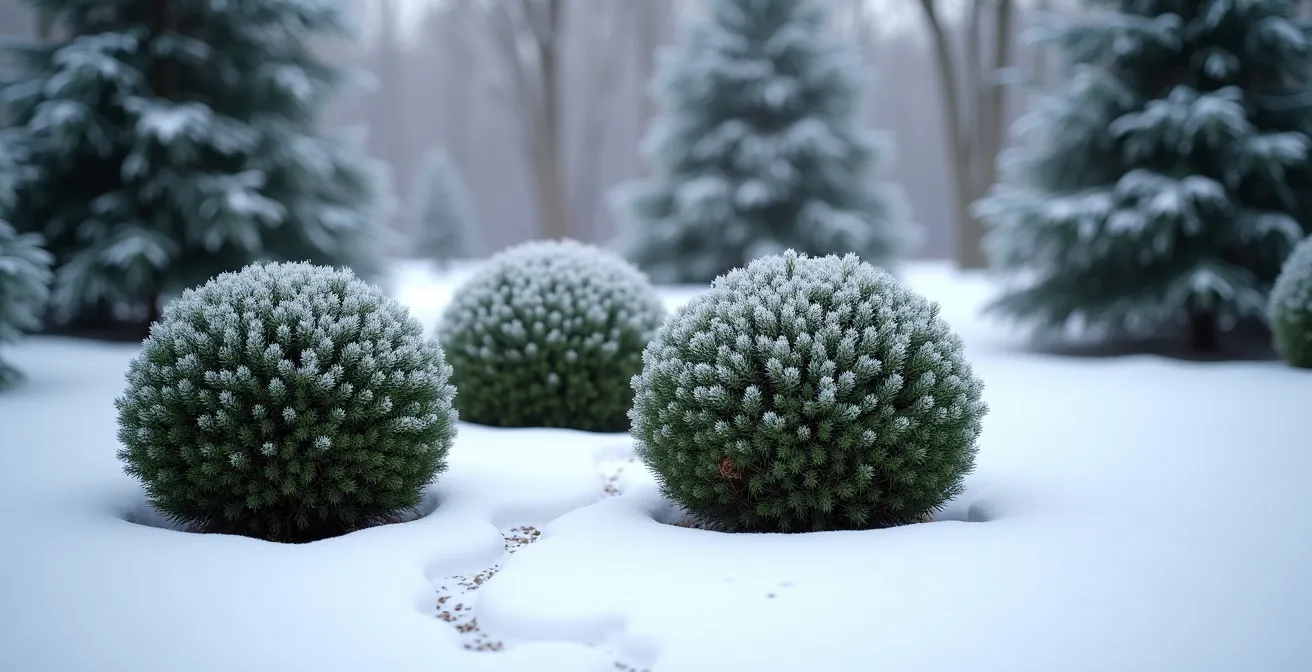
It is important not to confuse them with other dwarf conifers that require pruning to keep their shape or that can become misshapen with age. For example, the popular Picea glauca ‘Conica’ (Dwarf Alberta Spruce), while dwarf, has a conical shape and can sometimes develop reversions (branches that return to the rapid growth of the parent species). True globular conifers like ‘Danica’ or ‘Echiniformis’ are a “plant and forget” investment for permanent, effortless winter structure. They create strong visual anchor points in the flowerbed, contrasting with the lightness of the grasses.
Boxwood or Corten steel: which edging structures the vegetable garden in winter when everything is empty?
When the vegetable garden empties at the end of autumn, it can quickly become a sad, muddy area in the winter landscape. For a design-conscious gardener, it is essential to provide this space with a permanent structure that defines lines and brings interest even when everything is dormant. Traditionally, boxwood was used to create low, evergreen borders. However, in much of Canada, boxwood is a risky choice: it is prone to winter burn caused by sun and wind and is targeted by devastating insects like the boxwood moth. Its maintenance (pruning twice a year, winter protection) is also demanding.
Faced with these challenges, a modern alternative is gaining popularity for its durability, aesthetics, and total lack of maintenance: Corten steel. This steel alloy develops a protective surface layer of rust that stabilizes it and prevents further degradation. Its lifespan exceeds 50 years without any intervention. As an expert points out in the Quebec Winter Landscaping Guide, “Corten steel is the ally of 4-season design: its warm rust color contrasts beautifully with the whiteness of the snow”. This warm, textured hue provides a strong visual presence that carves out the space and dialogues perfectly with the blond tones of winter grasses.
The choice between these options depends on your maintenance tolerance and budget, but the trend clearly favors durable, hassle-free solutions for the modern gardener.
| Edging Type | Durability | Maintenance | Canadian Winter Resistance | Initial Cost |
|---|---|---|---|---|
| Boxwood | 10-15 years | Pruning 2x/year + winter protection | Low (burns, moth) | High |
| Corten Steel | 50+ years | None | Excellent | Medium-High |
| Local Stone | 100+ years | Minimal | Perfect | High |
Key Takeaways
- Calamagrostis ‘Karl Foerster’ is the superior choice for a vertical structure that resists heavy Canadian snow, thanks to its solid stems and upright habit.
- Corten steel offers a durable, maintenance-free, and aesthetically powerful edging solution to structure the garden in winter.
- Native plants like Pennsylvania Sedge are the most resilient solutions for difficult areas (shade, drought) and drastically reduce maintenance needs.
Why replacing your lawn with native plants saves you 40 hours of maintenance per summer?
The traditional lawn, often composed of Kentucky Bluegrass, is a cultural legacy that makes no ecological or practical sense in the Canadian context. It is a monoculture demanding water, fertilizers, and pesticides, requiring weekly mowing. Faced with increasingly strict watering restrictions in municipalities like Laval or Longueuil and growing ecological awareness, an alternative is gaining ground: replacing the lawn with groundcovers and native plants. This approach, far from being a mere compromise, represents an improvement on all fronts. According to estimates based on classic maintenance, replacing a Kentucky Bluegrass lawn with native groundcovers saves up to 40 hours of maintenance per summer.
Those hours are not the only savings. A mixed lawn composed of native plants adapted to our climate, such as wild strawberry, violets, native clover, and Pennsylvania Sedge, is naturally resistant to summer drought and local pests like hairy chinch bugs or white grubs. This intrinsic resilience practically eliminates the need for extra watering once the planting is established, reduces water consumption by more than 70%, and completely removes the need for pesticides and chemical fertilizers. It is a win for your wallet, your time, and the health of the local ecosystem.
Adopting a “freedom lawn” or an “ecological lawn” is not an abandonment but an act of intelligent design. It is choosing to work with nature rather than against it. By integrating these principles, you create a garden that is not only more beautiful and alive—attracting pollinators and birds—but also much more resilient and in tune with current climatic challenges. This frees up time to focus on higher-value elements, like beds of perennials and grasses that bring true structure and four-season interest.
Ultimately, building a modern and resilient garden in Canada is an exercise in structural design. Take action and rethink your landscaping by integrating these plant and material pillars for a beautiful, vibrant, and easy-to-maintain garden 365 days a year.