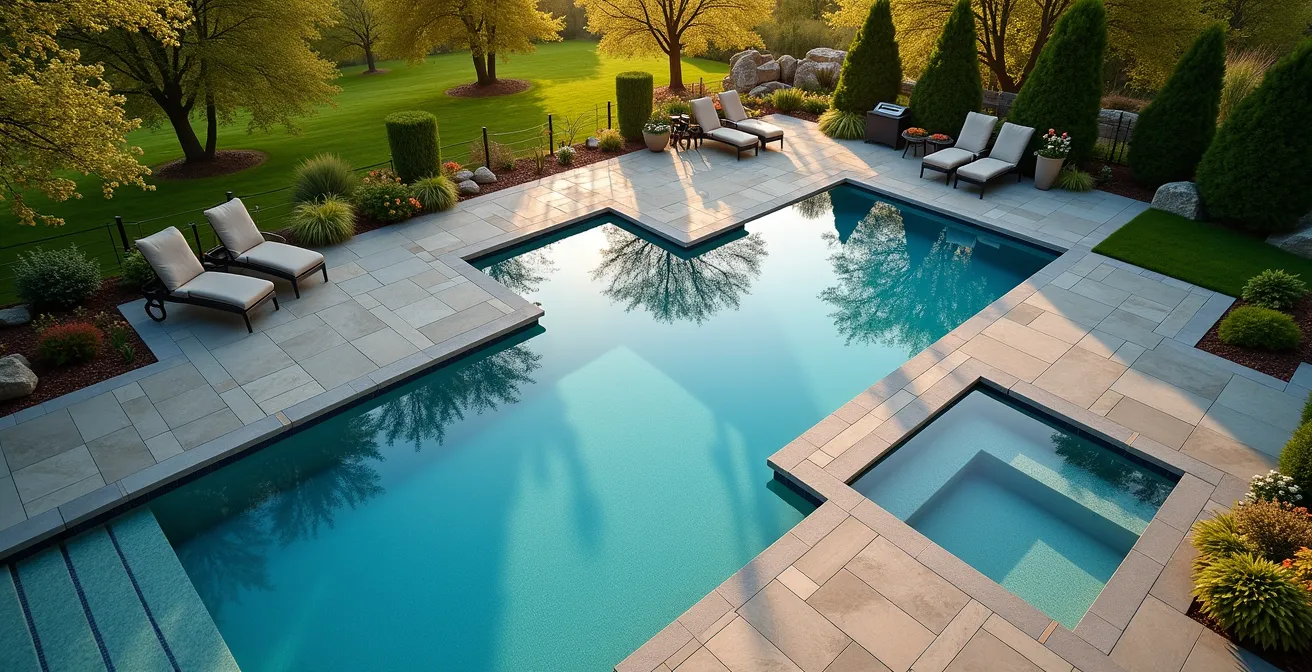
The true return on investment of a pool in Quebec does not lie in its resale value, but in a controlled Total Cost of Ownership (TCO) and an optimized “cost per swim” for your family.
Installing an inground pool is one of the largest landscaping projects a Quebec family can undertake. It is a significant investment, not only in money but also in the quality of life expected for the summers to come. When faced with the choice between a fiberglass shell, a concrete structure, or a vinyl liner, the discussion often focuses on the initial acquisition cost. However, this vision is incomplete and potentially misleading.
Brochures highlight the speed of installation for fiberglass, the design flexibility of concrete, or the attractive price of vinyl. But these arguments omit the essential part of the investment decision. What if the real key wasn’t the purchase price, but the Total Cost of Ownership (TCO) over 20 years? What if the true return wasn’t measured in resale dollars, but in “Lifestyle Return” (LR), an indicator we will define as the real cost of every family swim?
This article offers a strategic analysis for Quebec homeowners ready to invest. We will break down every facet of the expense—from regulatory fencing to the Hydro-Québec bill, including the inevitable replacement of components. The goal: to provide you with a financial and practical framework so that your pool is a source of lasting joy, not an unforeseen financial drain.
To guide you through this complete analysis, this article breaks down the crucial decision points. The table of contents below will help you navigate through the different steps of calculating your true return on investment.
- The choice of material (fiberglass, concrete, liner) has a direct impact on maintenance and heating costs over 20 years, often exceeding the initial savings.
- Quebec regulations (fencing, permits) represent an incompressible and non-negotiable cost that must be budgeted from the start.
- Location and systems (heating, sanitation) determine the frequency of use and therefore the real “lifestyle return” on your investment.
Summary: Calculating the true cost of ownership of your pool in Quebec
- 4-sided fencing: how to comply with strict provincial regulations without visually imprisoning your pool?
- Salt or chlorine: is the salt system truly lower maintenance and gentler on the skin?
- Heat pump or solar: which solution guarantees 82°F water even in June?
- The mistake of placing the pool too far from the house that discourages spontaneous swims
- Liner replacement every 10 years: what maintenance budget should you plan for over 20 years?
- Pool or large backyard: how to decide based on your children’s age?
- Inground pool: why you will never recover 100% of its cost upon resale?
- Building permits: which outdoor projects absolutely require city authorization?
4-sided fencing: how to comply with strict provincial regulations without visually imprisoning your pool?
Even before choosing the type of pool, the first incompressible cost to integrate into your budget is that of the fence. Provincial regulations in Quebec are among the strictest in North America and tolerate no exceptions. Since 2021, even pools installed before 2010 have lost their grandfathered status and must be brought up to code before September 30, 2025. This implies a fence with a minimum height of 1.2 meters, with no opening larger than 10 cm, and equipped with self-closing and self-latching gates. Non-compliance is not an option. Beyond the tragic risk of drowning, non-compliant owners face fines ranging from $500 to $1,000 per day of violation. This regulatory trade-off is therefore not a “if,” but a “how.” The choice often falls between two main options: economic functionality (chain-link fence, treated wood) and aesthetic integration (tempered glass panels). While a treated wood fence can cost between $25 and $40 per linear foot, a tempered glass solution, which preserves the view and gives a sense of space, can easily climb between $200 and $400 per linear foot. For a 100-foot perimeter, the difference can represent more than $30,000. This is a major expense item that must be decided based on your global budget and the visual impact you find acceptable for your landscaping. This trade-off between cost, safety, and aesthetics is a first concrete example of the necessary planning. To master this aspect, it is essential to properly understand les contraintes réglementaires et les options disponibles.Salt or chlorine: is the salt system truly lower maintenance and gentler on the skin?
The choice of water sanitation system is a decision that will impact your annual budget and the time spent on maintenance. The classic debate opposes traditional chlorine (in tablets or liquid) to the salt-to-chlorine electrolysis generation system. The salt system is often perceived as a luxury option, gentler on the skin and eyes, and requiring fewer chemical manipulations. But what about the long-term cost? The initial investment is the main drawback of the salt system: you should expect to pay between $800 and $1,500 for the purchase and installation of the generator (the electrolysis cell). The chlorine system itself requires no upfront equipment cost. However, the analysis of operational costs reverses the perspective. According to National Bank, annual maintenance costs about $120 in products for chlorine, compared to only $50 for bags of salt. This paragraph introduces the comparative table. The illustration that follows offers a visual representation of the water clarity often associated with salt systems, reinforcing the qualitative argument of the swimming experience.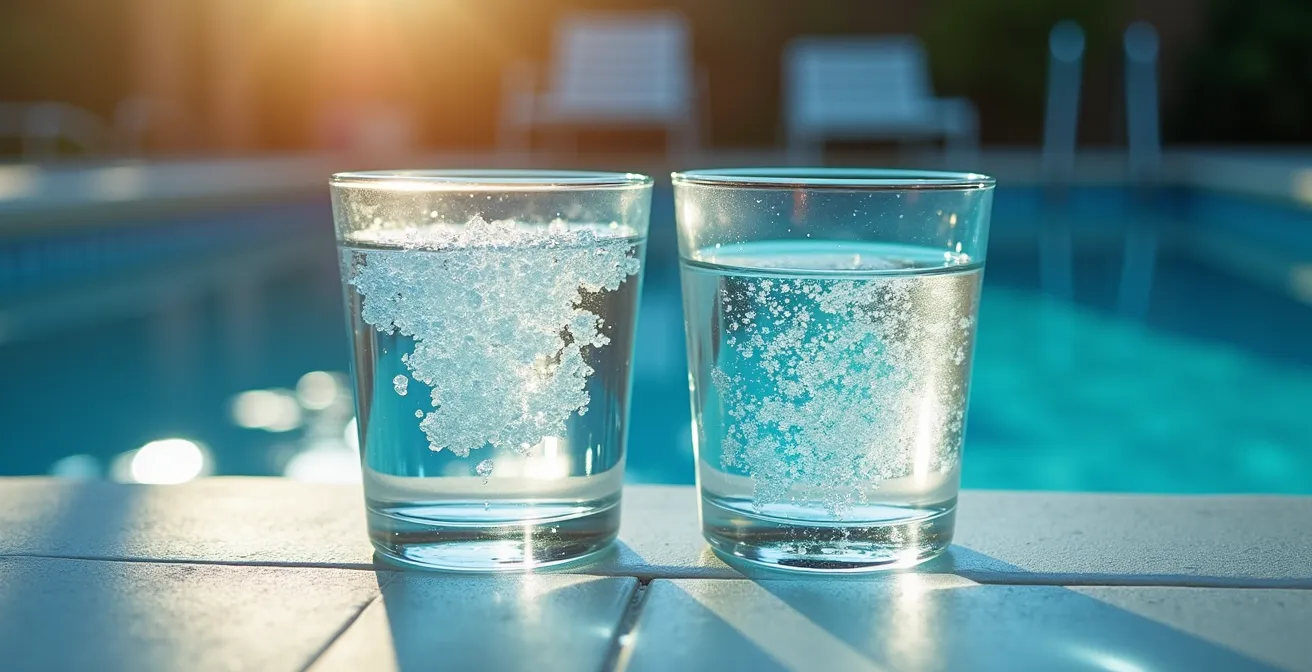
| Criterion | Salt System | Traditional Chlorine |
|---|---|---|
| Initial Investment | $800 – $1,500 (Generator) | $0 |
| Annual Product Cost | $50/year | $120/year |
| Cell Replacement | ~ $500 (every 5 years) | N/A |
| Total Cost over 10 Years | $1,800 – $2,500 | $1,200 |
| Maintenance Time/Week | ~ 30 minutes | ~ 90 minutes |
Heat pump or solar: which solution guarantees 82°F water even in June?
Having a pool in Quebec is good. Being able to swim comfortably in it from late May to mid-September is better. Water temperature is the number one factor determining the frequency of use of your installation. Aiming for a constant temperature of about 82°F (28°C) is a realistic goal, but one that has a significant energy cost. The choice of heating system is therefore strategic. The two main options are the electric heat pump and the solar heater. The heat pump is the most common solution. It offers high reliability and allows reaching and maintaining the desired temperature regardless of sunlight. Its purchase cost varies from $3,000 to $7,000 depending on power, and its impact on the electricity bill can reach several hundred dollars per season. The solar heater, for its part, uses panels to capture heat from the sun. Its initial cost is higher (often between $5,000 and $10,000), but its operating cost is near zero. Its main limitation is its dependence on the sun: it is less effective during cloudy days at the beginning or end of the season. However, a factor often forgotten in the heating equation is the pool material itself. The insulating properties of the shell play a major role in heat retention. In this regard, an analysis of materials reveals a clear advantage for one type of pool: according to industry experts, fiberglass pools naturally maintain a temperature up to 8 degrees higher than concrete pools. This superior thermal inertia translates into lower demand on the heating system, allowing for a less powerful heat pump or optimizing the performance of a solar system. This is a perfect example of how an initial choice (the material) has direct repercussions on future operational costs. Mastering the temperature is therefore a direct investment in the utility of your pool. To make the right choice, it is important to evaluate .The mistake of placing the pool too far from the house that discourages spontaneous swims
The location of the pool in your garden seems like a purely aesthetic decision. It is often placed at the back of the lot to preserve living space near the deck. This is a strategic mistake that can sabotage your “lifestyle” return on investment. A pool located more than 30 or 40 steps from the patio door becomes a destination in itself, rather than a natural extension of the house. The simple fact of having to cross a long stretch of lawn, potentially wet or covered in insects, is a major psychological barrier to quick and spontaneous swims. This “friction” factor has a direct impact on the real cost per swim. A pool that is accessible, visible, and integrated into the main living area will be used much more frequently. The “quick dip” in the morning before work, the children’s quick swim after school, or refreshing in the evening become easy options. Conversely, a distant pool is often reserved for planned long weekend afternoons, drastically reducing its window of use. It is therefore essential not to underestimate this psychological aspect of landscaping. A closer pool may require more complex landscaping or sacrificing part of the garden, but this initial investment will be largely offset by a higher usage rate, thereby decreasing the amortized cost of each moment of pleasure.Your Action Plan: Calculating the Real Cost per Swim Based on Location
- Calculate the Total Investment: Add the cost of the pool, installation, permits, and complete landscaping (deck, fence, etc.).
- Estimate Annual Swims: Be honest. For a close and inviting location, aim for 60-80 days/year. For a distant location, 20-30 days/year is more realistic.
- Calculate Cost per Swim over 20 Years: Divide the total investment by 20 years, then divide that annual cost by your estimate of annual swims.
- Add Infrastructure Costs: Don’t forget the cost of trenching for electricity and plumbing if the pool is far away. These costs can add thousands of dollars.
- Compare and Decide: Put this “cost per swim” into perspective. A high figure could indicate that the chosen location does not optimize your investment.
Liner replacement every 10 years: what maintenance budget should you plan for over 20 years?
We come to the heart of the financial analysis: the Total Cost of Ownership (TCO) over 20 years. This is where the three types of pools—concrete, vinyl liner, and fiberglass—reveal their true financial profiles. The initial purchase cost only tells a fraction of the story. Maintenance expenses, chemical products, and, above all, major replacements dictate the long-term profitability of your investment. The vinyl liner pool is often the cheapest to buy. However, its liner has a limited lifespan, generally 8 to 12 years in Quebec. Its replacement is a major expense, in the range of $8,000 to $10,000, which will occur at least once, and potentially twice, over a 20-year period. The concrete pool offers unmatched structural durability but requires resurfacing (paint or coating) every 10 to 15 years, a costly operation that can reach $25,000. The fiberglass pool, meanwhile, has the lowest maintenance cost. Its smooth surface (gelcoat) is non-porous, reducing chemical use by about 20% compared to a liner pool. Although a gelcoat resurfacing may be necessary after 15-20 years, its cost is generally lower than that of the other types. This illustration symbolizes the inevitable wear and tear of materials over the years, a key factor in the calculation of the Total Cost of Ownership.
| Pool Type | Average Initial Cost | 20-Year Maintenance (Products) | Major Replacements (Estimated) | Total 20-Year TCO |
|---|---|---|---|---|
| Concrete with liner | $30,000 | $2,400 ($120/year) | $10,000 (1x liner) | $42,400 |
| Fiberglass | $40,000 | $1,000 ($50/year) | $5,000 (gelcoat resurfacing) | $46,000 |
| Concrete (Painted/Coated) | $45,000 | $2,400 ($120/year) | $25,000 (1x resurfacing) | $72,400 |
Pool or large backyard: how to decide based on your children’s age?
Before committing to an investment of $50,000 or more, it is wise to step back and ask a fundamental question: is a pool really the best use of this space and budget for our family, at this stage of our lives? The answer depends almost entirely on the “optimal window of use,” which is directly linked to the age of your children. An analysis of the Quebec real estate market is revealing on this subject. Families with children aged 6 to 16 are those who maximize the use of their pool, with an average of 60 to 80 days of swimming per summer. For this demographic, the pool becomes the heart of summer social life, a gathering place for friends and family. The lifestyle return is then at its peak. In contrast, for couples without children, families with very young children (under 5, where constant supervision is exhausting), or those whose children have become young adults, usage drops drastically, falling to only 20-30 days per year. In these cases, the maintenance, costs, and constraints of the pool can quickly outweigh the pleasure. A large, versatile garden with a landscaped terrace, fire pit, and play areas maintains constant utility over 150 days a year across all seasons and could represent a better investment in “quality of life.” The decision is therefore not just “pool or no pool,” but “pool *now* or something else.” The relevance of a pool is therefore relative to your current and future family situation. It is crucial to honestly evaluate .Inground pool: why you will never recover 100% of its cost upon resale?
One of the most persistent myths is that adding an inground pool is an excellent investment that significantly increases a property’s value. The reality of the Quebec real estate market is much more nuanced. While a well-maintained and aesthetically integrated pool is an attractive feature, its financial return on investment is almost always disappointing. According to sector analyses, purchasing a pool increases your property value by only 8% to 15% of the total installation cost. This means that for a global project of $60,000, you will only recover, in the best-case scenario, $9,000 upon resale. The following quote from CAA-Quebec, an authority on consumer affairs, perfectly summarizes the situation:This low recovery rate is explained by the fact that a pool is a very subjective element. For a potential buyer, it can be a major asset or, on the contrary, a constraint (maintenance, safety, costs). Moreover, the investment includes many “invisible costs” that are completely non-recoverable:A pool is not a recognized investment for increasing the value of your home
– CAA-Quebec, Residential Pool Buying Guide
- The initial municipal permit ($100 – $500).
- The increase in annual home insurance premiums.
- Personal maintenance time (easily 40-60 hours per season).
- Initial landscaping destroyed during excavation that had to be redone.
- Rapid depreciation of equipment such as the heat pump, filter, and salt cell.
Key Takeaways
- The 20-Year Total Cost of Ownership (TCO) is the only reliable financial indicator, and it often favors liner or fiberglass over pure concrete.
- The financial return on investment is low (8-15%); the goal must be to maximize the “Lifestyle Return” by optimizing frequency of use.
- Regulatory costs (fencing, permits) and operational costs (heating) are major expenses that must be integrated into the initial budget, not considered extras.
Building permits: which outdoor projects absolutely require city authorization?
The final step, but certainly not the least, of your project is the administrative and legal dimension. In Quebec, the installation of an inground, semi-inground, or even above-ground pool imperatively requires obtaining a building permit from your municipality. Trying to bypass this step to save a few hundred dollars is an extremely risky strategy that can cost thousands of dollars in fines, compliance work, and even lead to a demolition order. The permit is not a simple formality. It is the mechanism by which the city ensures that your project respects all urban planning and safety standards: distances from property lines, the house, electrical lines, and compliance of the safety fence. Costs vary (for example, in Montreal, the permit for an inground pool starts at $164.20), but they are negligible compared to the consequences of a non-compliant installation. The most serious impact is often unknown and concerns your home insurance, as highlighted by the organization Protégez-Vous:In other words, in the event of a pool-related accident, your insurer could refuse to cover you if the installation was not duly authorized. This administrative step is therefore an essential protection for your investment and your civil liability. Planning must include the preparation of required documents (site plan, technical details) and the permit processing time, which can take several weeks. For your project to run smoothly and be sustainable, it is fundamental to comprendre et respecter scrupuleusement les exigences administratives de votre municipalité. In conclusion, choosing a pool in Quebec is a decision that goes far beyond aesthetics. It is an exercise in long-term financial planning. By adopting an approach based on the 20-Year Total Cost of Ownership and seeking to maximize the Lifestyle Return, you transform a simple expense into a thoughtful investment for your family’s well-being. To secure this investment, the next step is to validate every aspect of your project with your municipality’s urban planning department before the first shovel hits the ground.An undeclared installation or one that does not comply with standards can lead to a refusal of compensation from the insurer in the event of a claim
– Protégez-Vous, Residential Pool Safety Guide