Summary:
- The survival of your herbs depends on their nature: annuals like basil die every year, while perennials like chives return.
- For fresh basil year-round in Quebec, forget about wintering and adopt succession planting through relay crops indoors.
- Control invasive herbs like mint with rhizome barriers or buried pots—crucial techniques for our winters.
- Maximize your harvest by pruning your herbs correctly and preserve their fragrance by freezing them in oil rather than drying them.
Every amateur cook in Quebec knows that small victory of picking a fresh basil leaf from their balcony in July. And that poignant disappointment of seeing that same plant, once so proud, become a dry and sad stem at the first chill of October. We tell ourselves we lacked luck, that we don’t have a green thumb. We try to bring the pots inside, but the plants wither under the weak light of our winters, far from the promise of freshness we hoped for. Meanwhile, the mint planted carelessly in a corner of the garden prepares its silent conquest of the vegetable patch.
Usual advice focuses on plant choice and watering, but ignores the reality of our climate and the final goal: having flavorful herbs on hand for as long as possible. The true key lies not in a mystical talent, but in a strategic approach. We must stop treating all herbs the same way and start thinking in terms of life cycles, culinary yield, and management adapted to each Quebec season. It’s a matter of strategy, not magic.
This article proposes a change in perspective. We will break down the “why” behind the survival or death of your favorite herbs. You will learn not only how to plant, but how to manage your herb garden like a true production system for your kitchen—from managing invasive perennials to the relay cultivation of delicate annuals, to preservation techniques that truly preserve the scent of summer. Get ready for your herbs to finally end up, in abundance, in your pot.
To guide you through this process, we will cover the essential concepts that will transform your herb garden. The summary below details the key steps to move from trial gardening to mastered culinary production.
Summary: Strategies for a Productive Herb Garden in Quebec
- Why does your basil die in October while your chives return every year?
- The mistake of planting mint in the ground that colonizes the whole garden in 2 years
- How to cut your basil so it doubles in volume instead of bolting?
- Air drying or oil ice cubes: which method keeps the most flavor for winter?
- Which herbs truly survive on a windowsill in January in Quebec?
- The work triangle layout error that makes your outdoor kitchen impractical
- Peppery or sweet: which flower to pair with a chocolate dessert vs. a green salad?
- How to design an outdoor kitchen that resists winter without dismantling everything every fall?
Why does your basil die in October while your chives return every year?
This fundamental difference, which frustrates so many amateur gardeners, is not due to your skills but to the nature of the plants themselves. Chives are a perennial plant, adapted to our climate. Its bulb goes dormant underground during the winter and uses its energy reserves to be reborn in the spring. Basil, however, is an annual plant native to warm climates. Its natural life cycle is to germinate, produce leaves, flower, seed, and die in a single season. Trying to “save” it by bringing it indoors is often a losing battle, as the plant is genetically programmed to decline.
The solution, particularly in Quebec, is not persistence but strategy. You must adopt a “relay crop” approach. Instead of watching your outdoor plant die, anticipate and start a new generation indoors. This method ensures a constant supply without fighting against nature.
Case Study: Continuous Basil Production via Succession Planting
Gardening expert Larry Hodgson explained in Le Soleil that bringing basil inside is a waste of time. The plant ages poorly and becomes less productive. The real Quebec solution, according to him, is to plan sowings every two months. Sow indoors from September to April, then directly outdoors from May to August. As confirmed by this professionally inspired rotation approach, this method guarantees young, vigorous plants and a constant supply of fresh basil, defying the constraints of our climate.
To succeed with this relay crop during our long winters, a simple windowsill is not always enough. Light intensity and duration are the limiting factors. Supplemental lighting then becomes your best ally to simulate summer conditions and guarantee lush basil plants, even when the landscape is covered in snow.
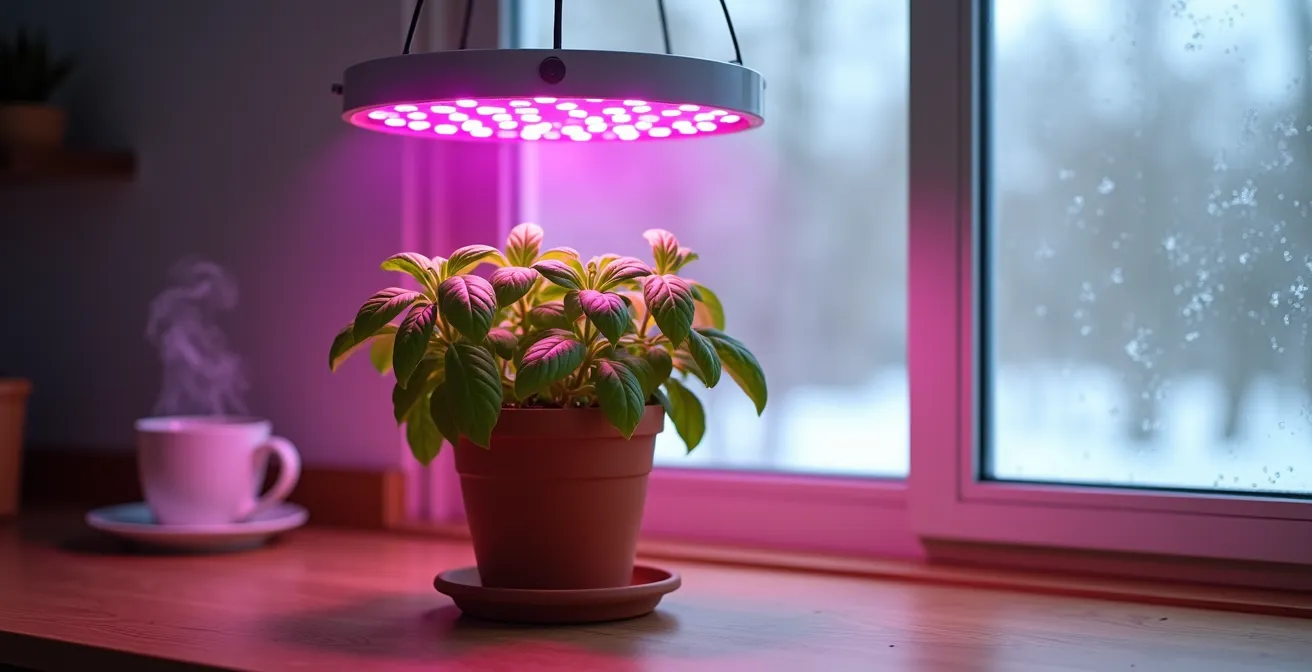
As this scene shows, it is entirely possible to recreate an ideal microclimate in your kitchen. A well-positioned grow light doesn’t just feed the plant; it transforms a winter challenge into a source of freshness and daily culinary pleasure. It is the very embodiment of a winning strategy: working with technology to complement what nature cannot offer us in January.
The mistake of planting mint in the ground that colonizes the whole garden in 2 years
If basil teaches us humility regarding annual cycles, mint teaches us caution regarding the vigor of perennials. Planting a simple pot of mint in the ground is a beginner’s mistake with long-lasting consequences. Unlike chives, which form a well-behaved clump, mint spreads aggressively thanks to its rhizomes—underground stems that run horizontally and give birth to new plants further away. This conquest strategy is so effective that it can quickly choke out other crops.
The idea of growing it in a pot is a good reflex, but planting it directly in a pot placed on the terrace makes it vulnerable to the intense frost of our winters. A more robust and aesthetic solution is to enclose it, even in the ground. It’s not about punishing it, but about containing its overflowing energy so it remains a pleasure and not a problem. Its expansion capacity is impressive, with a single plant capable of covering more than one square meter in one season, which fully justifies serious containment measures.
To choose the containment method best suited to the Quebec climate, one must consider not only effectiveness against rhizomes but also the material’s resistance to freeze-thaw cycles that can crack less robust containers. The following table compares the most common options.
| Method | Effectiveness | Freeze/Thaw Durability | Cost |
|---|---|---|---|
| Buried pot (30cm diameter) | Excellent | Risk of cracks after 2-3 winters | $15-25 |
| Rhizome barrier (30cm depth) | Very good | Thick plastic or metal resist well | $40-60/meter |
| Vertical tower culture | Excellent | Must be brought in or protected in winter | $30-50 |
The choice will depend on your budget and your layout. The rhizome barrier represents an excellent long-term investment for a discreet integration into the garden, while the buried pot is an economical and quick solution to set up, provided you check its condition every two or three years.
How to cut your basil so it doubles in volume instead of bolting?
Once you have set up your basil relay crop, the goal is to maximize the yield of each plant. Many cooks make the mistake of pinching the largest leaves at the base, one by one. While this provides an immediate harvest, this method weakens the plant and encourages it to produce a single central stem that will quickly bolt into flowers (and therefore seeds), signaling the end of savory leaf production.
The correct pruning technique is counter-intuitive: you must cut the top of the main stem. Find the main stem and go down until you find a pair of small leaves growing on the sides. Cut the stem just above this pair of leaves. This action, called apical pruning, sends a signal to the plant. It stops concentrating its energy on growing upward and redirects it to these two lateral shoots. Each of these shoots will become a new main stem. By repeating the operation on these new stems once they have grown, you aren’t just harvesting basil: you are forcing it to branch out.
A single plant can thus go from one to two, then four, then eight productive stems. You transform its structure from a simple “pole” to a dense, bushy “shrub.” This method not only delays bolting, thus extending the harvest period, but also exponentially increases the quantity of leaves available. It’s the difference between picking a few leaves for a salad and having enough to make homemade pesto every week.
Air drying or oil ice cubes: which method keeps the most flavor for winter?
At the end of the summer, even with the best strategy, we often find ourselves with an overabundance of herbs. Preservation then becomes crucial to lock in the taste of summer. The most traditional method is drying. While it works well for robust, woody herbs like rosemary, thyme, or oregano, it is disappointing for tender, delicate herbs like basil, parsley, cilantro, or dill.
The reason is scientific. The intense fragrance of these herbs comes from volatile essential oils. During air drying, a large part of these compounds evaporates with the water, leaving behind an herb that has lost most of its aromatic complexity. It retains a green “hay” taste, but the freshness and pungency are gone. To preserve this flavor, a method must be used that blocks evaporation: cold and fat.
The best technique for tender herbs is to freeze them in a fatty substance. Here is the method:
- Wash and thoroughly dry your herbs.
- Chop them finely, as you would to use them fresh.
- Fill ice cube tray sections two-thirds full with the chopped herbs.
- Cover completely with a good olive oil (or another oil of your choice).
- Freeze. Once the cubes are set, pop them out and store them in a freezer bag.
Which herbs truly survive on a windowsill in January in Quebec?
The promise of an indoor herb garden in the middle of a Quebec winter is seductive, but the reality is often disappointing if one does not choose the right plants and the right location. The most limiting factor at our latitude is not the temperature of our homes, but the lack of light. From November to February, days are short and the sun is low on the horizon, offering low-intensity light.
Not all herbs have the same needs. They can be classified into two groups:
- Sun lovers: These are herbs of Mediterranean origin like basil, thyme, and rosemary. To survive, they require maximum direct light. The only chance to see them thrive without artificial help is to place them on the windowsill of a large south-facing window. Even then, their growth will be slowed.
- Partial shade tolerant: Herbs like parsley, chives, cilantro and, to a lesser extent, mint and lemon balm, are satisfied with less intense light. An east or west-facing windowsill generally suits them. They won’t experience explosive growth, but you will be able to make modest, regular harvests.
Action Plan: Your Indoor Herb Survival Kit
- Evaluate your windows: Identify your south, east, and west-facing windows to place the right plants there.
- Invest in light: Acquire a full-spectrum horticultural LED lamp and a timer for demanding herbs or dark locations. Position the lamp 20-30 cm from the plants.
- Adapt watering: In winter, growth is slower and evaporation is less. Let the soil dry slightly on the surface between waterings to avoid root rot.
- Monitor for pests: The dry air in our homes favors aphids and spider mites. Inspect your plants regularly.
- Manage temperature: Avoid placing your herbs near a direct heat source (electric baseboard) or in a cold draft.
The mistake of layout of the work triangle that makes your outdoor kitchen impractical
When extending one’s passion for cooking to the outdoors, enthusiasm can lead to neglecting basic ergonomics. We think about materials, the barbecue, but we forget the fluidity of movement. The work triangle concept, a pillar of indoor kitchen design, is just as crucial outside. It involves the logical arrangement between three key zones: the hot zone (barbecue, griddle), the cold zone (refrigerator, cooler), and the wet zone (sink, prep countertop for washing).
The most frequent error is dispersing these elements. Placing the sink far from the barbecue forces you to cross the entire space with vegetables to wash or hands to rinse. An eccentric refrigerator leads to constant back-and-forth trips. In this context, your integrated herb garden or planters should be considered an extension of the wet and prep zone. Herbs must be within reach of the main work surface. Nothing is more frustrating than having to leave your cooking station to pick a few sprigs of parsley at the other end of the terrace.
An ideal layout places the countertop, sink, and herb planter in a single cohesive zone. The barbecue (hot zone) is in immediate proximity, and the cold zone is slightly set back so as not to clutter the main circulation space. This arrangement minimizes movement, secures actions (one does not move with a knife or a hot dish over long distances), and makes the outdoor cooking experience truly pleasant and efficient. The herb garden is no longer a distant decorative element, but an active ingredient, integrated at the heart of the culinary action.
Peppery or sweet: which flower to pair with a chocolate dessert vs. a green salad?
Once you master pruning your herbs, you will realize they inevitably end up flowering. Many gardeners see this flowering as the end of the harvest and cut the flowers to throw them away. This is a mistake! The flowers of most aromatic herbs are not only edible, but they offer a fascinating flavor palette, often a subtler or different version of the leaves. Integrating them into cooking is the ultimate zero-waste approach and a touch of refinement worthy of a chef.
The secret is knowing their flavor profile to create the right pairings. A peppery and pungent flower won’t be used the same way as a sweet and anise-flavored one.
- For a green salad: We look to enhance freshness. Chive flowers, with their delicate onion taste and vibrant purple color, are perfect. Nasturtium flowers (not from an herb but often planted nearby) bring a peppery flavor that wakes up lettuces.
- For a chocolate dessert: You need a flavor that complements the richness of the cocoa without overwhelming it. Small white basil flowers, with a sweeter and slightly more anise-like taste than the leaves, are an elegant surprise. Lavender flowers (sparingly) or mint flowers are also classics.
- For a fish or salmon dish: Freshness is key. Yellow dill flowers, sweeter than the leaves, are ideal. Cilantro flowers, with an intense citrus taste, can sublimate a ceviche or grilled white fish.
Case Study: Creative Integration of Edible Flowers in the Garden
Modern landscapers no longer separate the ornamental from the edible. As suggested by landscape professionals in their creations, the idea is to think of the garden as a 2-in-1 painting. They recommend, for example, creating borders of creeping thyme which, when flowering, draw pink carpets, or using fennel in the background of a bed to envelop rosebushes. Easy flowers like nasturtiums and marigolds can be sown directly between parsley and rosemary plants, adding touches of color while being ready to be picked to decorate a plate.
Key Takeaways
- Annual vs. Perennial: Understanding this distinction is the foundation. Don’t fight to save an annual like basil in winter; plan its succession instead.
- Relay Cropping: Adopt the succession planting strategy for annuals to guarantee a constant supply of young, productive plants.
- Strategic Containment: Use barriers or buried pots for invasive perennials like mint, to enjoy their flavor without suffering their expansion.
How to design an outdoor kitchen that resists winter without dismantling everything every fall?
The idea of an outdoor kitchen in Quebec often runs into the constraint of wintering. Having to put everything away, unplug, and protect it every fall is a major deterrent. The solution lies in a permanent design, thought out from the start to face our four seasons. This involves choosing durable materials (stainless steel, stone, treated cedar) but also an intelligent integration of functionalities, particularly the herb garden.
Instead of mobile planters to be brought inside, why not integrate the garden into the kitchen structure itself? This is the principle of the 4-season planter-countertop, a concept that combines functionality and aesthetics throughout the year.
Case Study: The Integrated 4-Season Planter-Countertop
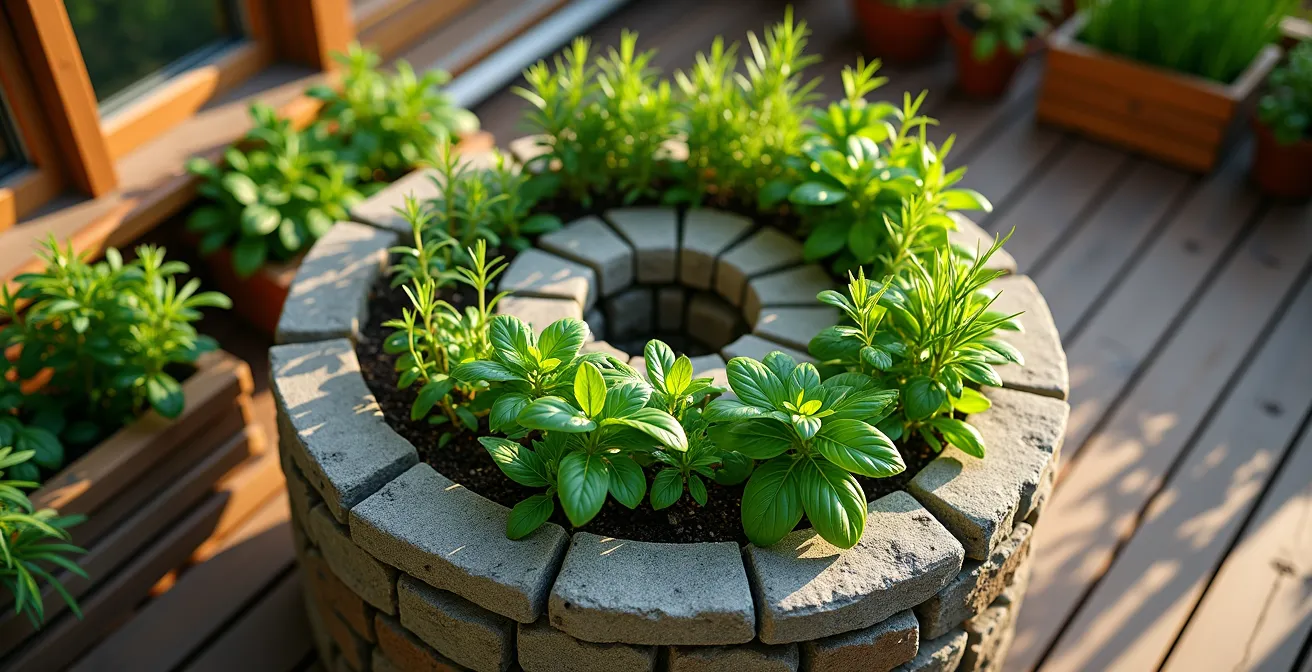
An ingenious concept, particularly adapted to our reality, has been developed in Quebec. It is a masonry or treated wood (like cedar) box that is an integral part of the outdoor kitchen counter. According to an analysis of sustainable layouts by specialists like Écohabitation, this approach maximizes space usage. In summer, this box holds basil, parsley, and chives, right at hand from the grill. In winter, instead of remaining an empty hole, it transforms: it can be decorated with fir and cedar branches for a festive look, or, during a winter barbecue, it can even serve as a natural cooler to keep drinks cold, filled with clean snow.
Such integration, however, requires technical planning, especially if a water point is planned for watering or a small sink. The plumbing must be “winterizable,” meaning it must be able to be easily drained before the deep freeze to prevent pipes from bursting under the effect of frost. A well-thought-out system with a drain valve accessible from inside the house and slightly sloped pipes is an investment that guarantees the longevity of the installation.
By thinking of the outdoor kitchen as a permanent and multifunctional structure, we move beyond the simple notion of a summer layout. We create a truly additional living space, usable and beautiful to look at all year round, where the herb garden plays a central role in every season.
By adopting this strategic approach, you will transform your relationship with your herbs. The next step is to evaluate your space, whether it’s a balcony, a window, or a corner of the garden, and start planning your garden no longer as a collection of plants, but as an integrated culinary production system adapted to the rhythm of the Quebec seasons.