
Most homeowners think that closing their yard is just a simple cleaning chore. In reality, every oversight triggers a physical chain reaction (freezing, moisture, pressure) that can result in thousands of dollars in repairs come spring. This guide does more than just list tasks; it decodes the mechanics of winter damage to help you understand how every preventive action in November is a direct investment in protecting your property’s value and avoiding hefty bills.
The arrival of November in Canada signals the end of autumn and the start of a race against the clock for any conscientious homeowner. The temptation is strong to simply put away a few chairs and consider the job done. However, this passive approach is an open door to very expensive surprises during the thaw. We often talk about draining pipes or raking leaves, but these tips are rarely connected to their real financial consequences. The real issue isn’t cleanliness, but the prevention of structural damage. Proper preparation goes beyond surface tasks and focuses on elements like the stability of interlocking pavers, the protection of young fruit trees, or even the storage of so-called “waterproof” cushions.
But what if the key wasn’t following a simple to-do list, but understanding the physics of the Quebec winter? The freeze-thaw cycle, the pressure exerted by ice, rodent activity under the snow, and the effects of stagnant moisture are the true adversaries. An undrained pipe isn’t just an oversight; it’s a time bomb where the expansion power of ice is the fuse. Clogged gutters aren’t just unsightly; they are the starting point of a chain reaction that can lead to foundation damage.
This article adopts an expert approach to winterization. We will break down the most common and costly mistakes, explaining the science behind each risk. You will no longer see closing your yard as a chore, but as a preventive risk analysis, where each action protects an asset and saves you a considerable expense. We will quantify potential costs so you can measure the return on every hour invested in November. The goal is simple: to give you the knowledge to spend a peaceful winter and approach spring without the fear of discovering thousands of dollars in damage.
To effectively navigate through your property’s protection strategies, this guide details each point of vigilance. The summary below will allow you to go directly to the sections that concern you most.
Summary: Key Steps for Successful Property Winterization in Quebec
- The mistake of leaving the garden hose connected that bursts your outdoor faucet
- Spirals or mesh: how to prevent rodents from eating the bark of your apple trees under the snow?
- Tarp or shed: is it risky to leave the BBQ and table outside under a cover?
- Why dead leaves in gutters cause ice dams in January?
- At what height should you mow the grass in November to avoid snow mold?
- The 3 warning signs that your current landscaping won’t survive the next winter
- Is it absolutely necessary to bring in “waterproof” cushions during the winter?
- Mastering the impacts of the freeze-thaw cycle on outdoor infrastructure
The mistake of leaving the garden hose connected that bursts your outdoor faucet
This is the most classic oversight and one of the most expensive. Leaving a garden hose, a spray nozzle, or any other accessory connected to the outdoor faucet traps water inside the valve body. When the temperature drops below freezing, this water freezes. The fundamental problem is a simple law of physics: as it solidifies, water increases in volume by about 9%. This expansion exerts immense and irresistible pressure on the metal walls of the faucet, which is not designed for such stress. The result is almost inevitable: a crack or a complete burst of the faucet body or the piping inside the wall.
The damage is often only discovered in the spring, during the first use. Upon opening the indoor valve, water escapes through the crack, potentially causing a basement flood or foundation damage. Replacing an outdoor faucet by a professional is no small task. According to current rates in Quebec, a plumber’s intervention to replace a burst outdoor faucet can cost between $150 and $300, including parts and labor. This is an entirely avoidable expense with a five-minute procedure.
To properly purge the system, simply follow a few easy steps. First, locate and close the indoor shut-off valve that serves the outdoor faucet. Then, go back outside and open the faucet to let all remaining water drain out. Leave this faucet in the open position all winter. This allows any minor condensation or infiltration to escape and prevents any pressure buildup. For added protection, installing a styrofoam insulating cap, sold for about fifteen dollars, is an excellent investment.
Spirals or mesh: how to prevent rodents from eating the bark of your apple trees under the snow?
Winter does not end wildlife; it redirects it. When food becomes scarce and snow covers the ground, rodents like voles (field mice) and rabbits desperately search for something to eat. The tender and nutritious bark of young fruit trees, particularly apple, pear, and plum trees, becomes a meal of choice. A tree “gnawed” around its entire circumference (a process called girdling) is a doomed tree because the circulation of sap is cut off. Losing a young tree in which you have invested time and money is a total loss and a great frustration.
Protection is not about eliminating rodents, but about making access impossible for them. The two most effective solutions are plastic spirals and metal mesh. Protective spirals are perforated plastic strips that are wrapped around the trunk. They are economical, easy to install, and allow the tree to breathe. Metal mesh (fine mesh) offers a more robust barrier but can be more expensive and complex to install.
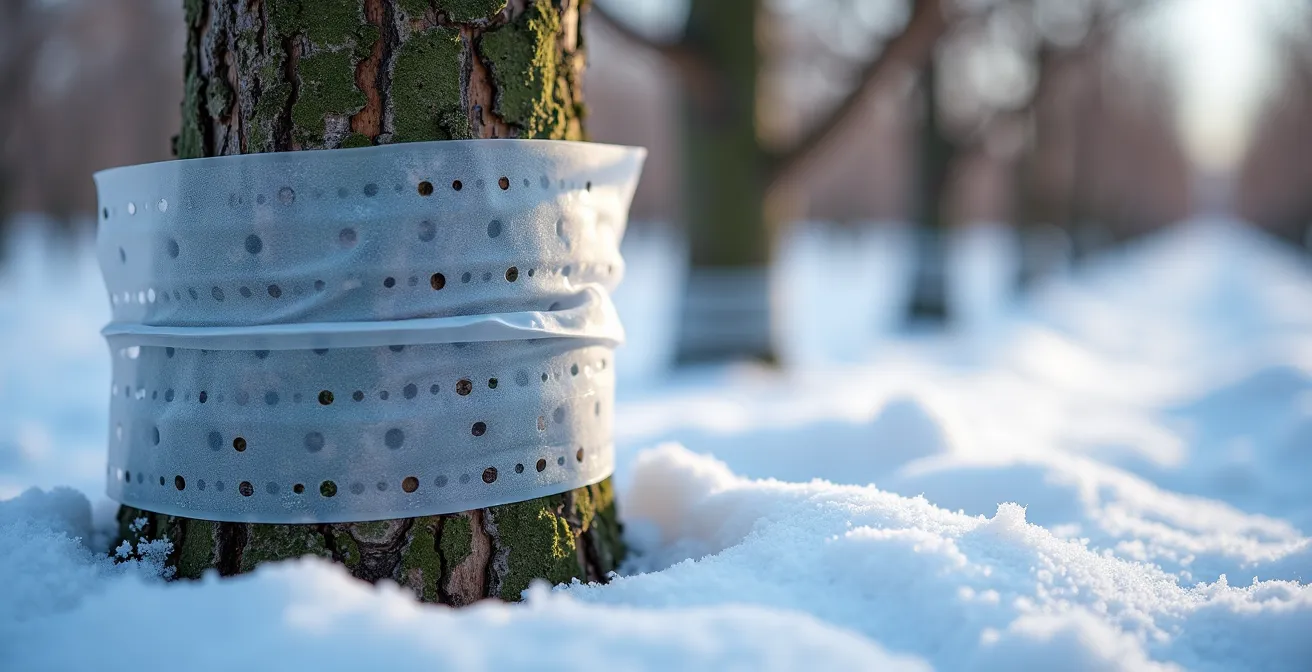
For maximum effectiveness, installation should be done before the first permanent snows, ideally in October or early November. The protector should be slightly pushed into the ground (2-3 cm) to prevent rodents from passing underneath. Height is also crucial: it must exceed the expected snow height. The “Pépinière aux Arbres Fruitiers,” a Quebec specialist, recommends using protectors at least 80 cm high. Some models, such as black TREEX protectors, have the advantage of being able to stay in place year-round, also protecting the bark from deer and damage caused by string trimmers in the summer.
Tarp or shed: is it risky to leave the BBQ and table outside under a cover?
Leaving garden furniture and the barbecue outside in winter is a common practice, but the choice of protection is decisive. A simple blue plastic tarp may seem like an economical solution, but it often creates more problems than it solves. The main enemy under a tarp is moisture and condensation. The freeze-thaw cycle and temperature variations create condensation on metal surfaces and wood. Trapped under a non-breathable cover, this moisture promotes rust on your BBQ, mold on your wooden furniture, and degradation of paint finishes.
Furthermore, a standard tarp that is poorly secured turns into a sail at the first strong November wind, leaving your furniture exposed to the elements or, worse, blowing away and causing damage elsewhere. The ideal alternative remains storage in a shed or garage, which offers total protection against the elements and moisture. However, not everyone has this space. In this case, you must invest in quality protection: custom-fit covers or reinforced tarps.
Covers designed specifically for furniture or barbecues are made of breathable materials that prevent condensation while remaining waterproof. They are also equipped with straps and elastics that ensure a perfect fit even in high winds. Although more expensive to purchase, they extend the life of your furniture by several years, quickly making the investment worthwhile.
The following table, based on observations from home insurance experts, compares the different options to help you make an informed choice.
| Option | Initial Cost | Advantages | Disadvantages | Durability |
|---|---|---|---|---|
| Standard Tarp | $50-$150 | Economical, easy to install | Risk of condensation, can blow away | 1-2 winters |
| Reinforced Tarp with Straps | $200-$400 | Wind resistant, better sealing | More complex installation | 3-5 winters |
| Shed | $800-$3000 | Total protection, no condensation | High cost, space required | 15+ years |
| Custom Covers | $100-$300 per item | Perfect fit, ventilated | Cost per piece | 5-7 winters |
Why dead leaves in gutters cause ice dams in January?
Cleaning gutters in the fall is often seen as a simple maintenance task to prevent them from overflowing in the rain. However, its importance is tenfold in a northern climate. Gutters filled with leaves, pine needles, and debris become the starting point for a destructive winter chain reaction: the formation of an ice dam. The phenomenon occurs during winter thaws. Snow on the roof melts, and the water flows toward the gutters. If these are obstructed, the water stagnates and freezes again when the temperature drops at night.
Gradually, a block of ice forms, completely blocking drainage. Subsequent meltwater can no longer drain and backs up under the roof shingles. It then crosses the membrane and infiltrates the attic, walls, and ceilings, causing major water damage: mold, rotting of the frame, blistering of paint, and destruction of insulation. Even worse, water flowing down the exterior walls can freeze near the foundations, contributing to ice buildup that exerts pressure on the concrete. Damage related to water infiltration and frost heave are among the most expensive. According to construction experts, repairing a foundation damaged by this cycle can cost between $500 and $2000 in the spring.
The only true prevention is a meticulous cleaning of the gutters after the majority of leaves have fallen, generally in late October or early November. This is a task that requires caution, but the return on investment is massive. Ensure that not only the horizontal gutters are clean, but also that the downspouts are not blocked to guarantee perfect drainage before the first permanent frost.
At what height should you mow the grass in November to avoid snow mold?
The last mow of the season is a strategic move that is often underestimated. The mowing height in November has a direct impact on the health of your lawn the following spring. A common mistake is to mow too short, thinking of “getting it over with” for the winter, or conversely, not mowing at all. Both extremes are damaging. Grass left too long (more than 8-10 cm) will lay down under the weight of the snow. This moist plant mass, deprived of air, becomes the ideal breeding ground for fungal diseases, notably snow mold (gray or pink). In the spring, you will discover circular patches of grayish or yellowish grass, felted and dead.
Conversely, a cut that is too short (less than 5 cm) exposes the crown of the grass blades—the most sensitive part of the plant—to cold and frost. The grass becomes vulnerable and will struggle to grow back vigorously in the spring, leaving the field open to weeds. The ideal cutting height for the last mow is between 5 and 7 cm (about 2 to 3 inches). This height is a perfect compromise: short enough to prevent the grass from laying down and molding, but long enough to protect the crown and allow the plant to store reserves for the winter.
The timing of this last mow is also important. You must wait until the growth of the grass has considerably slowed down, but before the first permanent snow cover. As experts point out, timing is key.
A final mow at the right height, combined with leaf removal so the lawn can breathe, is the best guarantee of a green and healthy lawn as soon as the warm weather returns.To have a beautiful lawn all year round, make sure to cut it to the right height in the fall, but especially as late as possible. We advise you to do it around early November before the first frost.
– ALPHA Assurances, Fall Yard Closing Guide
The 3 warning signs that your current landscaping won’t survive the next winter
Even before starting the closing tasks, a visual inspection of your yard can reveal critical vulnerabilities. Winter only exacerbates existing problems. Knowing how to identify these warning signs allows you to move from a reactive mode (repairing in the spring) to a proactive mode (strengthening before winter). Here are three areas to inspect carefully that betray a weakness against the freeze-thaw cycle.
The first signal is stagnant water. After an autumn rain, observe your yard. Areas where water accumulates near the house, on a patio, or at the bottom of a slope are high-risk zones. In winter, this water will freeze, turning into a dangerous ice sheet and, more seriously, saturating the soil near your foundations, increasing hydrostatic pressure and the risk of cracks. A ground slope that tilts toward the house rather than away from it is a major defect that must be corrected.
The second signal concerns your interlocking pavers or retaining walls. Walk over the entire surface of your driveway or terrace. If pavers move under your weight, it means the gravel foundation underneath is already unstable. Water infiltration and freezing will only amplify this movement, creating significant unevenness in the spring. Similarly, inspect retaining walls and borders: cracks of more than 3 mm or visible bulging indicate excessive pressure that winter will worsen.
Finally, the third signal is the condition of your vulnerable plantings. Shrubs planted too close to roof downspouts, where ice and snow will accumulate, risk being crushed. Unprotected roses or cold-sensitive perennials left without mulch are almost certain losses. The fall inspection allows you to plan the relocation, protection, or preventive pruning of these plants.
Your action plan for the pre-winter yard audit
- Documentation: Photograph all risk areas (cracks, stagnant water zones, unstable pavers) to have a reference before and after winter.
- Slope Analysis: Verify that the ground slope moves away from the foundation for at least 2 meters. Note any counter-slope areas.
- Stability Test: Walk on every section of interlocking pavers and retaining walls to identify unstable elements. Mark problem areas.
- Crack Inspection: Use a ruler to measure cracks in concrete, asphalt, and retaining walls. Those larger than 3 mm are priorities.
- Intervention Plan: List necessary corrective actions (adding soil to correct a slope, re-leveling a section of pavers, sealing cracks) and prioritize them before the final freeze.
Is it absolutely necessary to bring in “waterproof” cushions during the winter?
Marketing sells us “weather-resistant” or “waterproof” outdoor furniture and accessories. This claim may be true for a summer shower, but it is dangerously misleading when faced with a Quebec winter. Leaving cushions outside, even high-quality ones, is an invitation to accelerated degradation and unnecessary replacement costs. The term “waterproof” often refers to the surface fabric, which repels water. However, it does not guarantee the sealing of seams and zippers.
Air moisture, fine rain, and melting snow eventually seep through these weak points. Water then enters the inner foam, which acts like a sponge. Once soaked, this foam freezes and expands. This internal force exerts enormous pressure on the seams, which eventually give way and burst. You find yourself in the spring with deformed cushions, torn seams, and often filled with mold inside. Additionally, these dry and cozy shelters are a prime refuge for mice and other rodents that will make their nests there during the winter, leaving behind irreparable damage.
The experience of one homeowner illustrates this perfectly: an investment of several hundred dollars can be wiped out in a single winter.
The conclusion is clear: to preserve your investment, all outdoor cushions, poufs, and textiles must be stored in a dry and frost-free place, such as a shed, garage, or basement. Vacuum storage bags can be an excellent option for minimizing the required storage space.I had my yard closed with this company for the first time and I must say we were pleasantly surprised. They explained to us that even our so-called ‘waterproof’ $300 cushions had burst at the seams after just one winter outside. Mice had made their nests inside and the frozen water had cracked all the zippers.
– Homeowner testimony, Elit.ca
Key Takeaways
- An oversight on the outdoor faucet can cost up to $300 in plumbing repairs.
- Clogged gutters can lead to foundation repairs costing up to $2000.
- The “waterproof” label does not protect your $300 cushions from bursting due to frost.
Mastering the impacts of the freeze-thaw cycle on outdoor infrastructure
After examining concrete cases of damage, it is essential to understand the common driver behind most of these issues: the physics of the freeze-thaw cycle. The destructive power of winter does not come from the cold itself, but from the transformation of water into ice. As mentioned previously, when it freezes, liquid water increases its volume by about 9%. This expansion force, called “cryostatic pressure,” is colossal and practically incompressible. It is what bursts copper pipes, cracks concrete blocks, and lifts the pavers of your driveway.
Understanding this principle radically changes the perspective on winterizing your yard. The goal is no longer simply to “protect from the cold,” but to eliminate or manage water before it has the chance to freeze in a confined space. Every preventive action we have described aims to counter this phenomenon. Purging a faucet is removing water from a rigid container. Cleaning a gutter is ensuring an evacuation path for meltwater. Protecting a foundation is preventing water from saturating the adjacent soil. Bringing in a cushion is avoiding water being trapped in its fibers.
This force is relentless. A small crack in asphalt or concrete fills with water. The water freezes, the ice widens the crack. During a thaw, more water can infiltrate this enlarged crack. The subsequent freeze accentures the damage further. It is a destructive cycle that, winter after winter, transforms a minor defect into a major structural problem. According to climatology studies, it is precisely this 9% increase in ice volume that explains the majority of damage to infrastructure in cold climates.
Mastering the impact of freeze-thaw means adopting a “water management” philosophy. Before the first deep freeze, walk through your property with one question in mind: “Where can water accumulate, be trapped, and freeze?”. By answering this question and acting accordingly, you neutralize the greatest threat of the Canadian winter and ensure that your real estate investment retains its full value.
The next step, now that you understand the risks, is to perform a complete audit of your own yard. Use our guide as a roadmap to inspect each critical point and establish your personalized action plan for November.