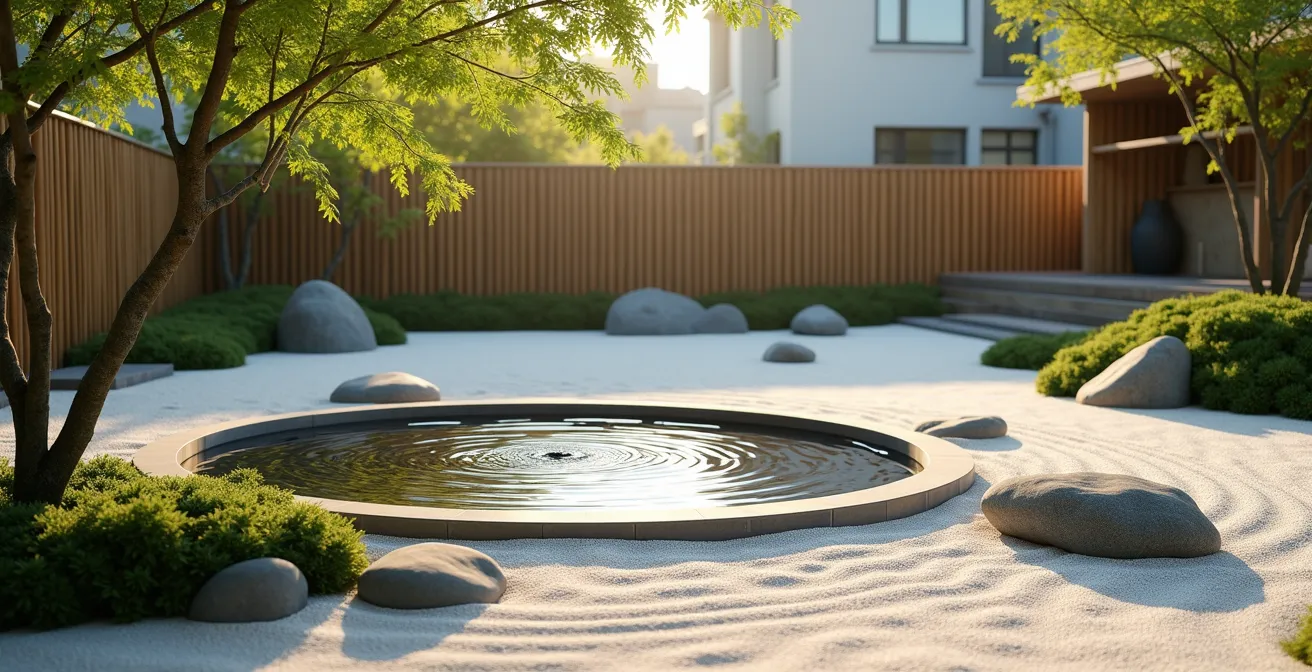
The key to a successful meditation garden in Canada isn’t aesthetics, but the creation of a resilient sensory ecosystem that acts as a therapeutic bubble active year-round.
- Sound masking must be strategic, choosing a type of water sound adapted to the specific noise nuisance (e.g., lapping for traffic).
- Plant selection should aim for gentle, continuous stimulation of the senses (scents, movement, textures) and must be perfectly adapted to Canadian hardiness zones.
Recommendation: Before starting, identify the primary sensory aggression (noise, being overlooked) in your space and focus your efforts on the most effective solution to neutralize it.
The frantic pace of urban life leaves its mark. Constant noise, lack of space, professional stress… many professionals dream of a sanctuary, a place to breathe, disconnect, and find themselves. The idea of creating a “Zen” garden at home emerges as an obvious choice. We immediately think of iconic images: a Japanese maple, a few pebbles, a stone lantern. These elements are certainly soothing, but they are only a superficial response to a deep need.
The real challenge, especially in the Canadian climate, is to move beyond simple decoration to build a functional refuge. A space that isn’t just pretty, but actively works on our well-being. But what if the true key wasn’t to copy an aesthetic, but to understand the psychological and sensory mechanisms of relaxation? What if the secret lay in creating a therapeutic ecosystem—a bubble of disconnection designed for our senses and resilient to our winters?
This article proposes a different approach. We are not just going to list plants or objects. We will explore how each element—sound, sight, smell, touch—can be strategically used to build a fortress of serenity. By focusing on pragmatic solutions adapted to the Canadian context, we will see how to transform a simple backyard into a powerful well-being tool, capable of isolating you from the surrounding chaos.
To guide you through this process, this article is structured to answer the concrete questions you may have. Each section addresses a key aspect of creating your personal sanctuary, from acoustic solutions to plant choices and spatial layout.
Summary: Creating an Oasis of Peace: The Canadian Meditation Garden Guide
- Fountain or small pond: which water sound best covers the sound of distant traffic?
- Hammock or hanging chair: how to set up a reading nook where no one can see you?
- Lavender and grasses: which plants promote relaxation through scent and movement?
- Why does a minimalist Japanese design soothe the mind more than a chaotic flower garden?
- How to create a texture path (barefoot) for natural reflexology?
- Why is your relaxation area unlivable when the kids are in the pool?
- Which shrubs scent the whole neighborhood starting in May?
- How to create distinct zones in your yard without building oppressive walls?
Fountain or small pond: which water sound best covers the sound of distant traffic?
Sound is often the primary aggressor in urban environments. The distant but constant hum of traffic generates background stress that is difficult to ignore. A common mistake is thinking any water sound will do. In reality, it is a science of sound masking. To be effective, the sound you introduce must match the frequency of the sound you want to cover. A study on outdoor space acoustics confirms that a fountain with a natural and pleasant sound can effectively mask unwanted noises, creating a true sound bubble.
For a low-frequency, continuous background noise like traffic, a high-pitched and powerful sound like a waterfall would be ineffective and even irritating. The solution lies in a sound of similar frequency: a gentle lapping or bubbling. These “pink” or “brown” noises are much more effective at neutralizing low frequencies. Conversely, high-pitched screams (children, sirens) are better masked by a “white noise” sound like that of a waterfall.
This comparative table will help you choose the solution best suited to your primary nuisance.
| Type of Noise | Frequency | Water Solution | Effectiveness |
|---|---|---|---|
| Children screaming | High frequencies | Waterfall (cascade) | Effective white noise |
| Distant traffic | Low frequencies | Lapping/Bubbling | Masking pink/brown noise |
| Pool pump | Medium frequencies | Continuous fountain | Partial masking |
It is crucial to consider the Canadian climate. Winterizing pumps and draining ponds are mandatory. To maintain a soothing sound atmosphere in winter, consider alternatives like wind chimes with deep tones or the rustling of dried ornamental grasses, which continue their work even under the snow.
Hammock or hanging chair: how to set up a reading nook where no one can see you?
After sound, comes sight. To truly disconnect, a sense of privacy is paramount. A reading or meditation corner loses all its value if you feel observed. It’s not about building a fortress, but creating a perception of isolation that is soft and natural. The goal is to block direct lines of sight without feeling enclosed. The hammock or hanging chair, with their soothing swaying motion, are perfect choices for this space.
The most effective and aesthetic solution is the plant screen. Rather than an inert wall, a living hedge creates a visual barrier that breathes and evolves with the seasons. For guaranteed year-round privacy, it is essential to choose evergreen shrubs adapted to our climate.

As this inspiration shows, using several layers of vegetation (tall shrubs, climbing plants, ground cover) reinforces the feeling of a protective cocoon. Here is an action plan to create an effective and durable plant screen in Canada:
- Install columnar evergreen shrubs: Varieties like ‘Smaragd’ Cedar (Thuja) or ‘Skyrocket’ Juniper are ideal. Plant them at a distance of 60 to 80 cm so they form a dense wall as they grow.
- Add hardy climbing plants: On metal trellises or wooden panels, Zone 3-4 clematis like ‘Jackmanii’ or golden hops will create a leafy canopy and add depth.
- Consider condo constraints: If you are in a condo, opt for self-supporting structures and large planters at least 60 cm deep to allow for proper root development.
- Create multiple layers: Combine a tall hedge (2-3m) in the back, medium shrubs (1-1.5m) in front, and ground covers at the base for a natural abundance effect.
This approach not only hides you from prying eyes but also surrounds you with life, transforming a simple reading corner into a true immersion in nature.
Lavender and grasses: which plants promote relaxation through scent and movement?
A meditation garden must engage all the senses. Smell and hearing, beyond the sound of water, are powerful vectors for relaxation. The scent of certain plants has a direct effect on our nervous system, while the movement and subtle sound of foliage in the wind capture attention and soothe the mind. Lavender is a classic, but the Canadian climate offers us a much broader palette.
For the olfactory aspect, it is interesting to create a four-season scented palette. In spring, the intoxicating scent of lilacs (Syringa) is a must. In summer, wild thyme releases its aroma when brushed against, and anise hyssop (Agastache) diffuses a licorice-like scent. In autumn, the Katsura tree (Cercidiphyllum japonicum) surprises with the smell of burnt sugar from its falling leaves. Even in winter, the resinous scent of dwarf conifers maintains an olfactory presence.
For movement and sound, ornamental grasses are king. Their graceful dance in the breeze and the soft rustle of their stems create a hypnotic spectacle. They have the major advantage of maintaining visual and auditory interest all winter long, with their dried plumes covered in frost rustling in the wind. Choosing hardy varieties is essential here.
This table presents some grasses particularly suited to the Canadian garden, as confirmed by an analysis from Quebec horticultural specialists.
| Grass | Hardiness Zone | Height | Winter Interest |
|---|---|---|---|
| Calamagrostis ‘Karl Foerster’ | Zone 4 | 150-170 cm | Persistent plumes, rustling |
| Miscanthus sinensis | Zones 4-6 | 75-200 cm | Beige plumes until spring |
| Switchgrass (Panicum virgatum) | Zone 4 | 90-200 cm | Yellow-red autumn coloring |
| Little Bluestem (Schizachyrium scoparium) | Zone 3 | 60-90 cm | Autumn colors, stands under frost |
By judiciously combining these plants, your garden will never be a static space, but a living stage that evolves, moves, and breathes with the rhythm of the seasons, offering gentle and constant stimulation to your senses.
Why does a minimalist Japanese design soothe the mind more than a chaotic flower garden?
In the face of stress, one might think an exuberant and colorful flower bed is the ideal solution to change one’s mind. Yet, for a mind already overloaded with information and stimuli, this visual “chaos,” even if beautiful, can paradoxically increase cognitive load. Our brain unconsciously tries to analyze, catalog, and process every color, shape, and flower. This is where the philosophy of minimalist Japanese design reveals its full therapeutic relevance.
The fundamental principle is not emptiness, but the intentional reduction of stimuli. By limiting the number of elements, we allow the mind to settle. The garden is no longer a source of information to process, but a space for contemplation. Each element—a stone, a branch, a sandy area—is chosen for its texture, its shape, and its ability to invite calm. We speak of functional minimalism: each element has a function, which is to soothe the mind.

This type of design makes abundant use of negative space (“ma” in Japanese), meaning the empty zones around objects. This space is not “wasted”; it is essential because it highlights the few elements present and gives the mind the space needed to wander without feeling oppressed. Instead of fifty points of interest competing for attention, there are only one or two. The gaze and the thought can settle there, favoring a meditative state.
Adopting this approach doesn’t mean giving up all vegetation. It means choosing a few sculptural plants (like an ornamental grass or a dwarf pine) and giving them the space to express themselves fully, rather than drowning them in a mass. it is a shift from the “quantity” of stimuli to the “quality” of contemplation.
How to create a texture path (barefoot) for natural reflexology?
To ground the mind in the present moment, nothing is more effective than reconnecting with physical sensations. Touch, often neglected in our modern lives, is a direct channel to mindfulness. Creating a small sensory path to walk barefoot is a simple and powerful way to integrate a natural reflexology and grounding practice into your garden.
The principle is to create a succession of “compartments” filled with different materials, offering a variety of sensations under the soles of the feet. Each texture—soft, prickly, hot, cold, smooth, rough—awakens nerve endings and forces the mind to focus on bodily sensations, thereby diverting it from anxious thoughts. This is a form of active meditation. Materials must be chosen carefully, prioritizing natural elements adapted to the Canadian context.
Creating such a path requires a bit of planning, especially to ensure its durability against rain and frost. The use of clear borders and good drainage is essential to prevent materials from mixing and the path from turning into a muddy area.
Your action plan: creating a Canadian sensory path
- Delineate the route: Trace a winding path of 10 to 15 meters. Use rot-resistant wood borders like Eastern White Cedar to separate the different texture zones.
- Create texture zones: Set up 5 to 7 sections of 30 to 50 cm each. Vary the materials: smooth St. Lawrence river stones, cedar chips (for scent as well), fine sand, moss, pea gravel, or wood rounds.
- Ensure drainage: Dig a 30 cm base, install a geotextile membrane, then a layer of gravel. This will prevent mud formation and limit issues related to freezing and thawing.
- Play with temperature: Incorporate dark stones like slate or basalt. They store heat from the sun and offer a pleasant thermal sensation at the end of the day.
- Integrate living things: Finish with foot-traffic-resistant ground covers that can withstand the climate (Zone 4), such as Irish moss or creeping thyme, for a soft, living texture.
This path then becomes more than just a trail: it is a daily invitation to a grounding ritual, a therapeutic tool integrated directly into your environment.
Why is your relaxation area unlivable when the kids are in the pool?
It’s a classic scenario: you finally settle in with a book in your relaxation corner, and at that very moment, the kids transform the pool into a festival of screams and splashes. Your sanctuary of peace shatters. The problem here isn’t the noise itself, but the conflict of use and the absence of acoustic zoning. The high-pitched and unpredictable sound of children’s screams is one of the most difficult for the human brain to ignore.
The solution isn’t to ban joy, but to create zones with distinct sound atmospheres. A case study conducted near a highway in Quebec (generating 80-85 decibels, a noise comparable in intensity) demonstrated the effectiveness of a double barrier. The first was a dense cedar hedge, which absorbs high frequencies (screams) very well. The second was a waterfall-style fountain placed near the relaxation area. This fountain didn’t mask the highway noise but created a “sound bubble” of white noise that made external sounds much less intrusive for the person sitting nearby.
This layering strategy is key. Instead of trying to eliminate the noise at the source (which is often impossible), we create a buffer zone (the hedge) and protect the calm zone with its own controlled sound environment. In Quebec, the mandatory pool fence can be transformed from a legal constraint into an asset. By using openwork wooden panels or trellises as a fence, you get an ideal support for climbing plants. This creates an additional visual and acoustic barrier, much more effective than a simple metal fence.
By applying this zoning principle, you can have the energy of the play area and the tranquility of the meditation space coexist. One no longer encroaches on the other, allowing everyone to enjoy the yard in their own way.
Which shrubs scent the whole neighborhood starting in May?
Aromatherapy is a powerful component of relaxation, and your garden can become its natural diffuser. The secret to a successful scented garden is not only choosing the right plants but orchestrating them for sequential flowering and placing them strategically. The goal is to have waves of scent succeeding each other from spring to late summer, and ensuring these scents reach your living areas.
May in Canada is often marked by the scented explosion of lilacs (Syringa vulgaris) and dwarf Korean lilacs like ‘Palibin’ (Zone 3), whose heady scent is a true natural antidepressant. But the scent calendar doesn’t stop there. As early as April-May in milder zones, Daphne odora (Zone 7, needs protection) offers an intense citrus scent. In June, mock orange (Philadelphus, Zone 4) takes over with its fragrance reminiscent of orange blossoms. Later in the season, toward late summer, Sweet Autumn Clematis (Clematis terniflora, Zone 5) releases a powerful and surprising vanilla scent.

The placement of these shrubs is crucial. In Canada, prevailing winds often come from the west. By placing your most fragrant shrubs to the west of your patio, your reading nook, or your home’s windows, you let the wind do the work of diffusion and bring the fragrances directly to you. This is a simple application of your garden’s micro-meteorology at the service of your well-being.
By choosing 3 or 4 of these shrubs with different blooming periods, you ensure a continuous olfactory atmosphere, transforming every breeze into a breath of serenity. Your garden is no longer just seen; it is breathed.
To Remember
- Noise masking is a matter of strategy: the sound of water must be chosen based on the frequency of the noise to be covered to be effective.
- Plant selection must be multi-sensory and durable: aim for plants that offer interest for smell, sight, and hearing, while being resistant to the Canadian winter.
- Spatial zoning relies on psychology: subtle boundaries (materials, elevation changes, plant hedges) are more soothing than walls and create sanctuaries of privacy.
How to create distinct zones in your yard without building oppressive walls?
Structuring the space is essential to give it a function. A large open space can feel intimidating and unsuited to privacy. However, erecting walls or high fences can quickly create a feeling of confinement—the opposite of the desired effect. The solution lies in psychological delimitation techniques, which suggest separation without imposing it, thus maintaining a feeling of openness and fluidity.
One of the subtlest techniques is delimitation through ground materials. Creating “carpets” of different materials visually defines zones. Imagine moving from a cedar wood deck to a fine gravel area, then to a section covered in moss or creeping thyme. Without any vertical barrier, your brain perceives that it has moved from one zone to another—for example, from the “dining” space to the “meditation” space.
Another approach, inspired by Japanese architecture, is the level change. A simple wooden platform raised by 15 to 20 cm, called an Engawa, is enough to sanctify a space. This slight elevation change creates a symbolic threshold that invites a change of mindset upon entering, while preserving an unobstructed view of the rest of the garden. It is an incredibly effective way to define a yoga or meditation corner.
Finally, plants themselves can serve as light and airy partitions. Rather than an opaque cedar hedge, an alignment of tall grasses creates a plant curtain that filters the view without blocking it. According to specialists,tall grasses like Calamagrostis can form privacy screens exceeding two meters, while still letting light through and adding movement. These “living walls” define the space while reinforcing the natural and soothing character of the garden.
Creating a meditation garden is a journey, not a destination. It is a process of listening to your needs and your environment. By applying these principles of sensory management and functional design, you are not just building a garden, but a daily well-being partner. To begin your path toward serenity, identify the main source of stress in your outdoor space and choose just one of these strategies to implement. This is the first step toward transforming your yard into a true personal sanctuary.