Summary:
- The secret to a red pepper harvest in a cold climate does not lie in last-minute tricks, but in a proactive strategy of heat accumulation throughout the season.
- The most crucial decision is choosing ultra-early varieties (60-75 days to maturity), specifically adapted to short Canadian summers.
- Create an artificial microclimate by using tunnels in the spring and black plastic mulch in the summer to maximize the thermal units available for the soil and the plant.
- Strategic pruning of new flowers and shoots in August is not an option, but a requirement to force the plant to redirect all its energy toward ripening the fruits already formed.
The scene is familiar to many gardeners in Canada: it is late September, the nights are cooling dangerously, and the pepper plants are leaning under the weight of magnificent fruits… that are desperately green. Frustration sets in facing the imminent threat of the first frost that will wipe out months of effort. Gardeners then rush to the usual advice: bring the plants indoors, or pick the green peppers hoping to ripen them in a paper bag with a banana.
While these catch-up methods have their uses, they do not address the root of the problem. They act like a bandage on a wound when a preventive strategy could have avoided it. The challenge of growing peppers in a northern climate is not so much a matter of luck as it is of physics and biology. The real key is not to wait until autumn to react, but to actively manipulate the plant’s environment starting in the spring to give it a decisive head start in its race against time.
The angle we are taking is that of a climate expert: it is not about “growing” peppers, but about “actively managing their energy and thermal budget.” Every action, from seed selection to August pruning, must be seen as a strategic maneuver to accumulate a maximum of heat units and ensure the plant concentrates its energy on ripening, rather than futile growth. This article will guide you through this chronological battle plan, transforming your autumn frustration into red, crunchy satisfaction.
To help you visualize and plan your season, we will explore fundamental strategies, from spring startup to last-minute rescue measures. The table of contents below details the key steps to mastering pepper cultivation in short-season climates.
Table of Contents: The Complete Strategy for Ripe Peppers in Quebec
- Gaining 3 weeks in spring: how plastic tunnels warm the soil for tomatoes?
- “Sub-Arctic” or “Early Girl” tomatoes: why the number of days to maturity is your #1 criterion?
- Should you top tomato plants in August to force fruit ripening?
- Why producers use black plastic at the base of eggplants and should you do the same?
- Floating row covers: how to save your harvest during an early frost in September?
- Why orienting your largest windows to the south can reduce your heating bill by 15%?
- Do you really have enough sun to grow peppers or should you stick to spinach?
- What is the ideal monthly maintenance schedule for an impeccable plot in Quebec?
Gaining 3 weeks in spring: how plastic tunnels warm the soil for tomatoes?
The race for ripe peppers doesn’t start in August, but as soon as the snow melts. The most common mistake is waiting for the “official” last frost date to transplant. However, peppers, like tomatoes and eggplants, are solanaceous plants that love heat, particularly at the root level. Cold soil considerably slows down their initial development, a delay that will never be caught up. This is where caterpillar tunnels or mini-greenhouses come into play, not as a luxury, but as an essential strategic tool in the Canadian climate.
The principle is to create a microclimate that tricks the calendar. A simple transparent plastic film stretched over hoops can radically change the game. The resulting greenhouse effect increases the air temperature, but more importantly, it warms the soil much faster than if it were exposed to the open air. Experience shows a gain of 10 to 15 degrees Celsius during the day and 3 to 5 degrees at night, which is colossal in the spring. This heat accumulated in the soil prepares an ideal transplant bed.
The concrete advantage is the ability to get ahead of the game. Instead of waiting until late May or early June, a Quebec gardener can, thanks to a tunnel, transplant their young plants as early as late April or early May. This head start can represent two to four additional weeks of growth under optimal conditions. These weeks gained in the spring are precisely those that will be missing in the fall to turn a pepper from green to red. It is an initial investment that translates directly into an extension of the effective growing season.
“Sub-Arctic” or “Early Girl” tomatoes: why the number of days to maturity is your #1 criterion?
If you only remember one criterion for succeeding with peppers in a short climate, let it be this: the number of days to maturity. This is a data point, generally indicated on the seed packet, which represents the estimated time between transplanting the plant and the first harvest of ripe fruit. Ignoring this figure is like starting a hike without knowing the distance to be covered. You can have the best soil and the best location, but if the chosen variety requires 120 days to ripen and your frost-free season is only 130 days, failure is mathematically almost certain.
Exotic varieties with evocative names, like ‘Carolina Reaper’ or certain Habanero peppers, can require up to 150 days. These varieties are simply unsuitable for field cultivation in Canada without a heated greenhouse. The strategic gardener must turn to cultivars selected for their earliness. You should actively look for peppers and chilies with a ripening period between 60 and 75 days. Varieties like the ‘King of the North’ pepper or the ‘Early Jalapeño’ chili were specifically developed or selected to perform in our conditions.
The choice of seed company is also an indicator. Favoring Canadian companies like Veseys or Prairie Garden Seeds increases the chances of finding locally proven genetics. These varieties are not only fast; they are often more vigorous at low temperatures, a crucial characteristic for the cool late summers of Quebec.
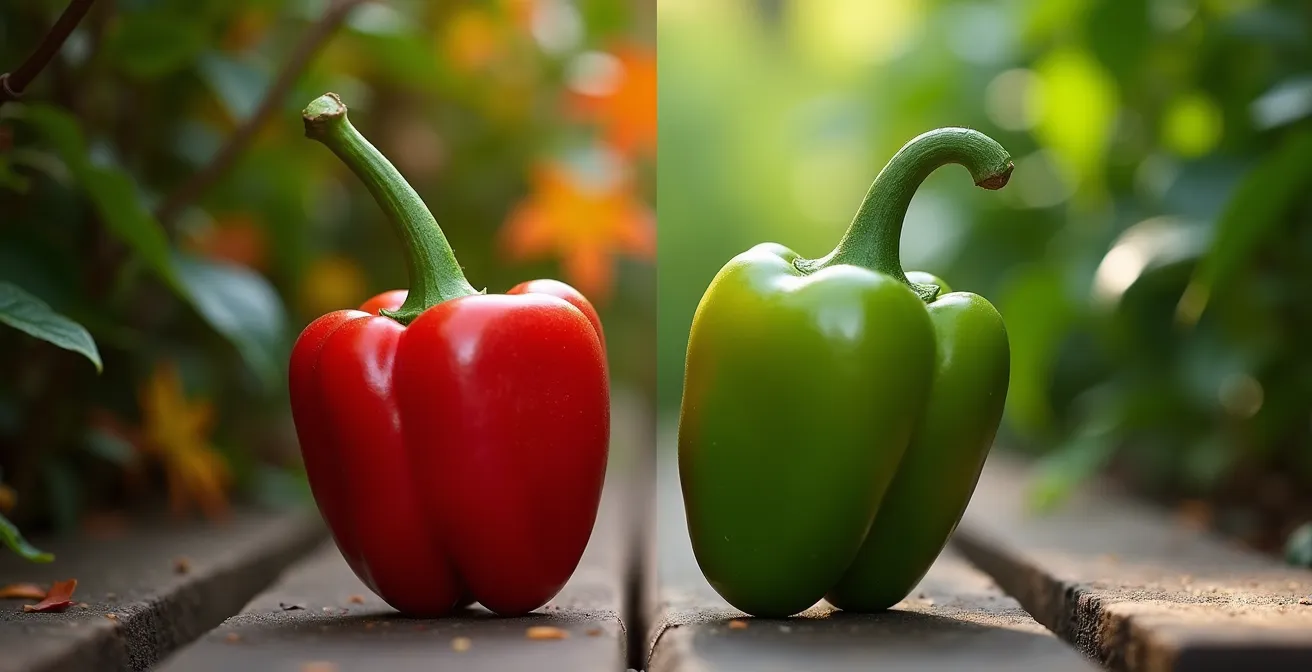
The illustration above clearly shows the difference: on the left, an early variety already ripe; on the right, a late variety that will never be ready in time. This initial choice conditions everything else in the season.
Your roadmap for choosing a winning variety in Canada
- Actively look for the mention “early” or “precocious” on seed packets and a number of days to maturity between 60 and 75.
- Systematically avoid exotic or “super-hot” varieties that indicate 90, 120, or even 150 days, unless you have a heated greenhouse.
- Prioritize Canadian seed companies (e.g., Veseys, Prairie Garden Seeds, etc.) that select varieties adapted to our climates.
- Note the names of cultivars known for their earliness, such as ‘King of the North’, ‘Ace’, or ‘Early Jalapeño’ for chilies.
- Check if the description mentions “good vigor at low temperatures,” a major asset for the end of the growing season.
Should you top tomato plants in August to force fruit ripening?
The question of pruning solanaceous plants (tomatoes, peppers, eggplants) is a passionate debate among gardeners. However, in the context of a northern climate, late pruning is no longer a matter of preference but a strategic necessity. In particular, topping and removing new flowers starting in mid-August are crucial gestures for anyone wanting a ripe harvest. As an experienced gardener on a horticultural forum summarizes, the intuition is often correct: “prune your plants, it speeds up ripening”.
But why does this technique work? You have to see the plant as a system with a limited energy budget. Every day, through photosynthesis, it produces a certain amount of energy (in the form of sugars). It must then allocate this energy to different tasks: root growth, production of new leaves, creation of new flowers, and finally, development and ripening of fruit. However, starting in mid-August in Quebec, the clock is ticking. A flower that appears at this time will physically not have the time, nor the heat units necessary, to transform into a ripe fruit before the frosts.
By topping the plant (cutting the main stem above the last cluster of fruit deemed viable) and systematically pinching off all new flowers and secondary shoots (suckers), you force the plant to make a choice. You cut off its access to its expansion projects (growth and flowering). The energy it produces then has no other choice but to be massively redirected toward the fruits already present. This energy surplus will accelerate their growth and, above all, trigger and support the ripening process—the transition from green to red (or yellow, or orange).
Why producers use black plastic at the base of eggplants and should you do the same?
If you have ever visited a commercial market garden in Quebec, you have likely noticed those long strips of black plastic at the base of pepper, eggplant, or melon crops. This practice is not aesthetic; it is purely strategic and aims, once again, to manipulate the microclimate. Black plastic mulch is one of the most effective tools for increasing soil temperature, a factor as critical as air temperature for solanaceous plants.
The mechanism is simple: the black color absorbs solar radiation and transfers this heat directly to the ground below. Furthermore, the plastic film acts as a barrier, preventing this heat from dissipating too quickly during the night and limiting water evaporation. The result is an increase of 3 to 5 °C in soil temperature compared to bare soil. For the roots of a pepper plant, this difference is enormous. Warm roots mean a more active metabolism, better nutrient assimilation, and ultimately, more vigorous growth and faster fruit ripening.
However, black plastic is not the only option, and it has ecological drawbacks. The following table, inspired by a comparative analysis of mulching options, allows for weighing the pros and cons of different solutions available to the amateur Canadian gardener.
| Mulch Type | Heating Efficiency | Advantages | Disadvantages |
|---|---|---|---|
| Black plastic | Excellent | Heats the best, weed control | Non-degradable, soil asphyxiation |
| Red plastic | Good | Claims to improve fruiting | More expensive, efficiency debated |
| Hemp mulch | Moderate | Ecological, Canadian crop | Less effective for heating |
| Dead leaves | Low | Free, improves soil | Decomposes quickly |
For the gardener whose sole objective is to maximize heat for their peppers, black plastic remains the most effective solution. For those looking for a compromise, hemp mulch is an interesting local alternative, although less effective thermally. The choice will depend on your priorities between maximum performance and environmental impact.
Floating row covers: how to save your harvest during an early frost in September?
Despite all the strategies put in place, Quebec weather remains unpredictable. An early frost in September can occur when peppers are only a few days away from full maturity. At this moment, the last line of defense comes into play: nocturnal protection. The most effective tool for this is the floating row cover (or agrotextile), a light fabric that allows air and light to pass through but offers thermal protection of a few degrees, often enough to pass a critical threshold.
The alarm should be triggered as soon as weather forecasts announce clear, calm nights with temperatures approaching 5°C. Under these conditions, the temperature at ground level can easily drop below the freezing point. Action must be preventive: protection must be installed before sunset to trap the heat accumulated by the soil during the day. The simplest way is to create a sort of tent using stakes, tomato cages, or any other support so that the fabric does not directly touch the foliage, which could cause cold burns.
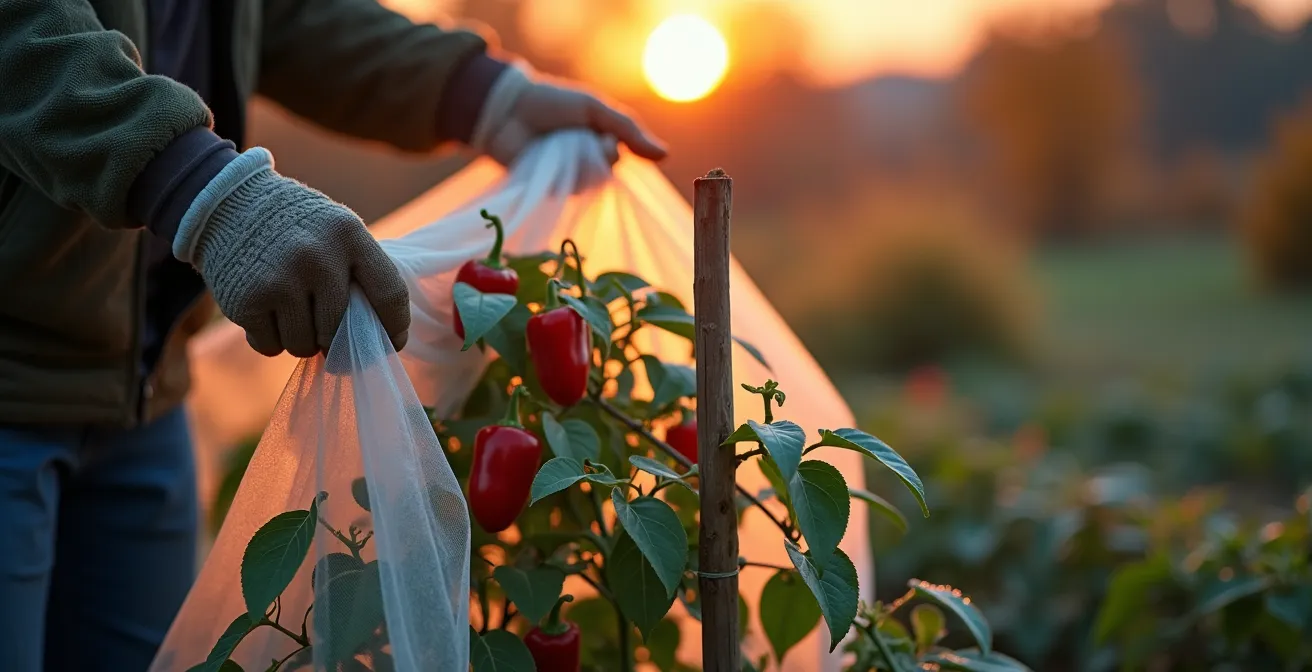
In an emergency and in the absence of floating covers, old sheets, blankets, or even newspaper can do the trick for a night or two. The important thing is to create an insulating layer between the plants and the cold sky. It is crucial to remove these protections in the morning to allow the plants to benefit from the sun. Another technique, for very light frosts (0°C to -1°C), consists of finely spraying the plants with water just before sunrise. As it freezes, the water releases heat (latent heat of solidification) and maintains the temperature of the plant tissue right at 0°C, protecting it from more serious damage.
Emergency Frost Plan for Canadian Gardeners
- Monitor the weather: act as soon as nights of 5°C or less are predicted, especially if the sky is clear.
- Set up a tent: use stakes to support a floating cover (agrotextile) or old sheets above the plants, without direct contact with the leaves.
- Emergency solutions: in the absence of materials, large sheets of newspaper or large plastic bags can help for one night.
- Spraying technique: only for very light frost, spray a fine mist of water on the foliage just before dawn to protect tissues.
- Inspection before bringing in: if you decide to bring potted plants inside, inspect them and spray them with insecticidal soap to avoid bringing pests indoors.
Why orienting your largest windows to the south can reduce your heating bill by 15%?
This architectural design principle, known as passive solar, has a direct and powerful application in the garden. The idea is to use thermal mass to capture the sun’s heat during the day and release it slowly at night, creating a microclimate that is warmer by several degrees. This is a fundamental strategy that can make a huge difference for thermophilic plants like peppers, especially in regions with cool nights like Quebec and the Prairies.
In Canada, most people choose to grow pepper plants in a greenhouse, where the temperature can be maintained at at least 18 °C.
– A.Vogel Canada, Pepper Cultivation Guide
This observation from A.Vogel Canada highlights the difficulty of field cultivation. Creating a warm microclimate is therefore a way to reproduce, on a small scale, the advantages of a greenhouse. The simplest example is to plant your peppers along a south-facing brick or stone wall. The wall absorbs solar energy all day. At nightfall, as the air temperature drops, the wall begins to release this stored heat, maintaining a higher ambient temperature around the plants for several crucial hours.
This technique transforms a simple wall into a passive radiator. The same principle applies to patio slabs, a stone pathway, or even large rocks strategically placed in the vegetable garden. By deliberately choosing the location of your pepper plants so they benefit from this released heat, you offer them a bonus of thermal units every night. It is a smart and free way to buffer temperature fluctuations and extend the period where conditions are favorable for ripening.
Do you really have enough sun to grow peppers or should you stick to spinach?
Before even considering tunnels, mulches, or pruning techniques, there is a fundamental and non-negotiable question to ask: does your vegetable garden receive enough direct sun? Peppers are children of the sun. Without adequate exposure, all other techniques will be in vain. Spinach or lettuce can settle for partial shade, but peppers have much higher energy needs to develop and ripen their fruits.
The rule of thumb, confirmed by many horticultural sources, is a minimum of 6 hours of direct sun per day. “Direct” means that the sun’s rays strike the foliage directly, without being filtered by trees, buildings, or other obstacles. Ideally, to maximize production and ripening, aim for 8 hours or more. This intense need for light is directly related to photosynthesis, the engine that produces the energy needed to manufacture the sugars that will make your peppers sweet and colorful.
Before planting, take a day to observe the sun’s path across your property. Identify the area that receives the most sunlight, especially in the afternoon when the heat is most intense. It is this “five-star” location that you must reserve for your most demanding crops like peppers, tomatoes, and eggplants. If your garden is mostly shaded, it may be more realistic and less frustrating to focus on crops adapted to those conditions. Trying to force nature without providing its basic fuel, the sun, is a losing battle.
Takeaways
- The most determining factor for a ripe pepper harvest in a cold climate is the initial choice of an ultra-early variety, with a maturation cycle of 60 to 75 days.
- Soil heat is as important as air heat. Using black plastic mulch can increase root temperature by 3 to 5 °C, significantly accelerating the plant’s metabolism.
- Pruning new flowers and shoots starting in mid-August is not an option but a mandatory strategic maneuver to force the plant to redirect all its energy toward ripening existing fruits.
What is the ideal monthly maintenance schedule for an impeccable plot in Quebec?
Succeeding with peppers in a northern climate is not the result of a single action, but the result of a sequence of well-orchestrated interventions throughout the season. Having a calendar in mind allows you to anticipate the plant’s needs and take the right steps at the right time. Each month brings its share of critical tasks that build, step by step, the success of the final harvest. From indoor germination to frost protection, rigor is the key.
The season begins well before the thaw. From late February or early March, seeds must be started indoors, as peppers need 8 to 10 weeks of growth before being transplanted. Next comes the critical phase of transplantation, between mid-May and early June, which should only be done when all risk of frost has passed and the soil has been previously warmed. The months of June and July are dedicated to growth: regular watering must be ensured to keep the soil moist and monitor for pests. It is in mid-August that the strategic shift occurs: all nitrogen-rich fertilizer (which promotes foliage) is stopped, and drastic pruning of new flowers begins. Finally, September and October are the months of vigilance, where the weather must be monitored closely to install anti-frost protections and harvest just before disaster strikes.
This general calendar must absolutely be adapted to your micro-region. Frost dates vary considerably across Quebec. Knowing the specifics of your zone is essential for adjusting your planning. The following table provides valuable reference dates for major regions.
| Region | Last Spring Frost | First Fall Frost | Frost-Free Season |
|---|---|---|---|
| Montérégie | Mid-May | Early October | 140 days |
| Montreal | After May 10 | Early October | 145 days |
| Quebec City | After May 20 | Late September | 130 days |
| Saguenay–Lac-St-Jean | Mid-June | Mid-September | 90 days |
This data, taken from observations for the specific context of Quebec, clearly shows why a gardener in Saguenay, with a 90-day season, cannot afford the same varieties as a gardener in Montreal.
Now that you have a complete action plan, from seed selection to final protection, the next step is to integrate these strategies into the planning of your next vegetable garden. Do not let autumn frustration dictate your results anymore and transform your garden into a red pepper factory.