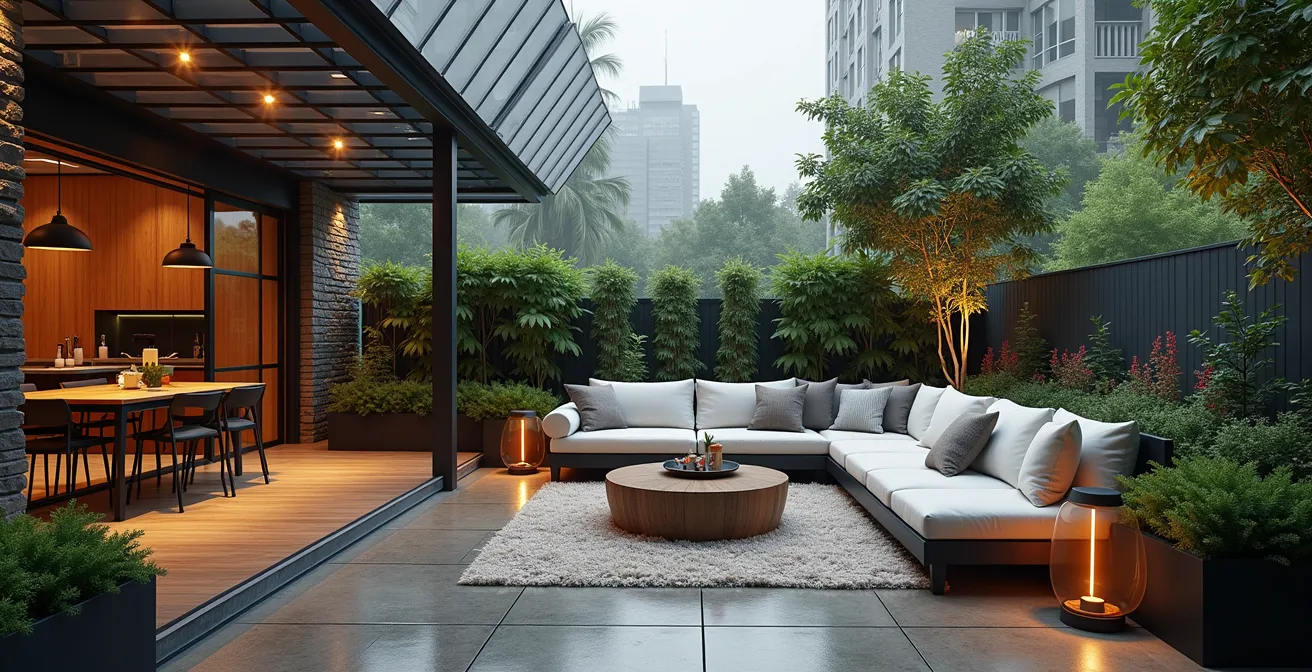
In summary:
- Opt for technical materials like Sunbrella fabric and high-resilience foam (min. 2.5 lb/ft³) for cushions that resist UV rays, humidity, and sagging.
- Structure your space with weighted polypropylene outdoor rugs and lighting fixtures to define cozy zones (zoning), even when facing Canadian winds.
- Prioritize a large, robust, and waterproof storage box over individual covers for quick and effective protection against rain and local wildlife (raccoons, squirrels).
- Extend your usage season by several weeks with wall-mounted infrared heating solutions, which are more efficient and economical than propane in cool weather.
The scenario is familiar to anyone who enjoys the Canadian summer: a perfect blue sky, the barbecue heating up, friends settled comfortably on the terrace. Then, suddenly, the sky darkens, and it’s a frantic race to bring in cushions, throws, and accessories before the downpour hits. This frustration often transforms our greatest outdoor living ambitions into a simple functional but temporary setup. We resign ourselves to buying patio furniture and protective covers, accepting that outdoor comfort is a fleeting luxury, conditioned by fickle weather.
But what if the true key wasn’t to protect better, but to no longer have to worry? What if, instead of thinking in terms of “garden furniture,” we adopted an “outdoor interior design” approach? The secret to creating an extension of your living room that fears neither rain, nor squirrels, nor even the first chills of autumn, lies in technical and strategic choices. It’s not just about aesthetics, but a true engineering of comfort designed for our climate.
This article will guide you through the crucial decisions to achieve this “perceived permanence”: from fabrics that defy the sun to foam densities that don’t sag, including zoning tips and heating solutions that will gain you an extra month on your summer season. Prepare to never run to save your cushions again.
To help you navigate the creation of your outdoor oasis, we have structured this guide into several key steps. Discover how to choose the right materials, arrange the space, and select the accessories that will make all the difference.
Table of Contents: The Complete Guide to a Durable Outdoor Living Room in Canada
- Sunbrella or Olefin: Which cushion fabric won’t fade after 3 summers in the sun?
- Why your cushions go flat in one summer and what density (high resilience) to demand?
- Rugs and floor lamps: Tips for “zoning” an open outdoor lounge
- Rugs or planters: Which trick to use to separate the dining area from the lounge?
- Why multiplying small tables is more convivial than a single central coffee table?
- Waterproof deck box or individual covers: Which solution truly protects against squirrels and humidity?
- Throws, lanterns, and trays: The 3 accessories that transform a dull patio into a chic lounge
- How to gain 4 weeks of terrace use in the spring and fall?
Sunbrella or Olefin: Which cushion fabric won’t fade after 3 summers in the sun?
The first enemy of your outdoor lounge is the sun-rain duo, which quickly turns bright cushions into faded, damp rags. Choosing a fabric is not a matter of color, but of technology. Two materials dominate the market for their durability: Sunbrella (a solution-dyed acrylic) and Olefin (a polypropylene). Sunbrella is often considered the gold standard for its exceptional UV resistance, ensuring that a bright red stays red even after several seasons. Olefin, more affordable and widely available in Canadian big-box stores, offers excellent moisture resistance and very fast drying, a major asset during unexpected summer showers.
To see things more clearly, here is a direct comparison of the performance of these two fabrics in a Canadian context, based on a recent comparative analysis.
| Criteria | Sunbrella | Olefin |
|---|---|---|
| UV Resistance | Excellent (2200h+) | Very Good |
| Mildew Resistance | High | Good |
| Fast Drying | Moderate | Very Fast |
| Price in Canada | Premium | Affordable |
| Availability | Specialized | Home Depot, Rona |
Beyond the weather, you must consider the local fauna. The tight weave of superior quality fabrics offers a significant advantage against small animals.
Case Study: Fabric Performance Against Canadian Wildlife
Feedback from Canadian users is clear: more robust fabrics like Sunbrella resist wildlife assaults better. A customer from Brossard, Quebec, reports that their Sunbrella cushions remained intact after three seasons, despite regular visits from raccoons and squirrels on their terrace, while cheaper fabrics showed signs of wear and scratches by the first summer.
Why your cushions go flat in one summer and what density (high resilience) to demand?
Having a fabric that doesn’t fade is one thing, but what good is it if the cushion sags and becomes uncomfortable in the first season? This is the problem with low-end foam. The engineering of comfort lies in a technical parameter: foam density, measured in pounds per cubic foot (lb/ft³). Low density means larger air bubbles in the foam, which crush quickly under weight and the variations in temperature and humidity so typical of the Canadian summer. For lasting comfort and a shape that holds, you must demand “High Resilience” (HR) foam.
For outdoor furniture subject to regular use, Canadian experts recommend a minimum density of 2.5 lb/ft³. Below this threshold, the cushion risks losing a significant portion of its bounce and support in a single summer. This higher initial investment is the guarantee of comfort that lasts several years, not just a few months. But how do you recognize quality in-store without a technical sheet? A specialist gives us his tip.
Press the cushion firmly and observe the return speed. A quality cushion regains its shape in less than 3 seconds. A slow return indicates low-end foam that will not survive a Canadian summer with its variations in temperature and humidity.
– Owner,Jardin de Ville in Montreal
A good in-store test will save you many disappointments. Foam resilience is the true secret of a seat that remains as welcoming in September as it was in June.
Rugs and floor lamps: Tips for “zoning” an open outdoor lounge
For a terrace to feel like a living room, you need to recreate defined sub-spaces, a technique designers call “zoning.” Indoors, walls do this work. Outdoors, rugs and lighting fixtures visually anchor the different functions: the dining area, the relaxation space, the reading nook. A large outdoor rug instantly delimits the “lounge” zone, inviting conviviality. However, in Canada, an unprepared rug can quickly turn into a kite during a gust of wind. The choice of material and weighting is therefore paramount. As one expert points out, not all materials are equal in our climate.
Polypropylene outdoor rugs can tolerate being forgotten under the first Quebec snow, unlike recycled polyester which risks cracking during freeze/thaw cycles.
– Denis Bégin, Expert in outdoor design, GTL Paysagiste
Floor lamps, on the other hand, create virtual walls once night falls. An arched lamp over the sofa defines an intimate bubble of light, while lanterns on the ground mark a path. Again, wind resistance is the key.
Action Plan: 5 Weighting Solutions to Resist Canadian Winds
- Fillable lighting bases: Choose models whose bases can be filled with sand to reach a minimum weight of 20 to 30 kg.
- Decorative weights: Install discrete cast iron weights or heavy river rocks at the corners of the rugs.
- Double-sided tape: Use robust outdoor adhesive tape (3M certified for all weather conditions) to fix the edges of the rug to the ground.
- Rubber-backed rugs: Prioritize rugs with a heavy, non-slip rubber backing; they have a better grip on the ground.
- Windbreak panels: Create sheltered areas with vertical slat panels (available at Rona/Home Depot) that cut the wind before it reaches your layout.
Rugs or planters: Which trick to use to separate the dining area from the lounge?
While a rug anchors a zone, planters can physically delimit it. Using tall, elongated planters is an elegant and doubly effective solution for separating the dining space from the lounge area. Not only do they create a subtle visual barrier, but they can also serve as a natural windbreak—a considerable advantage on condo balconies or exposed terraces. The effectiveness of this method has been proven in dense urban environments.
Case Study: Windbreak Solution for Montreal Condo Balconies
Facing the swirling winds of downtown, a Montreal resident installed 1.5 m tall planters filled with dense grasses (Calamagrostis). According to his measurements, this plant barrier reduced wind force on his balcony by nearly 60%, while creating a clear and aesthetic separation between his dining table and relaxation corner.
For an optimal result, the choice of plants is crucial. You should opt for native species adapted to your province’s climate, which will require less maintenance and better resist harsh winters. Here are some suggestions for high-performance planters across Canada:
- Quebec: Ornamental grasses like Calamagrostis canadensis are ideal, resisting temperatures down to -30°C.
- Ontario: For shaded areas of Toronto terraces, hostas and heucheras offer dense and colorful foliage.
- British Columbia: Native ferns, such as the bracken fern, create an excellent green screen and thrive in the West Coast humidity.
- Maritimes: Sea lavender (Limonium) is an excellent choice as it tolerates salt spray and helps repel insects.
- Prairies: Purple coneflowers (Echinacea) handle drought and full sun well, while attracting local pollinators.
Why multiplying small tables is more convivial than a single central coffee table?
In an indoor living room, the large coffee table is king. Outdoors, its relevance is debatable. Life on a terrace is more fluid, more dynamic. Replacing a large central table with several small mobile side tables introduces “convivial modularity.” Each guest can have their own table within reach for their drink or plate, avoiding the gymnastics required to reach the center. This flexibility allows for reconfiguring the space in the blink of an eye, moving from a large group for a “happy hour” to several small duos for a more intimate conversation. This approach has even proven its worth in the commercial sector.
Modular Layout for Canadian Happy Hours
A popular terrace restaurant in Montreal’s Plateau Mont-Royal noticed a 30% increase in its effective seating capacity during peak hours by swapping its massive coffee tables for sets of nesting side tables. Customers naturally reorganize the space to suit their group size, optimizing occupancy and improving the experience.
The choice of material for these tables should be adapted to your region. A fiber-reinforced concrete table (weighing over 20 kg) will be perfect for resisting Prairie winds. Nesting tables in powder-coated metal are ideal for optimizing space on a small condo balcony in Vancouver or Toronto. Driftwood, available through artisans on Etsy Canada, brings a perfect coastal touch for the Maritimes or British Columbia, while woven resin remains a safe bet for its humidity resistance everywhere in the country. Some models with removable trays are also very practical for serving and quick storage before a storm.
Waterproof deck box or individual covers: Which solution truly protects against squirrels and humidity?
Managing cushions and accessories is the major pain point of terrace life. Individual covers seem like a good idea but quickly become a tedious chore to put on and take off. The superior solution for true peace of mind is the large-volume storage deck box. A single gesture is enough to put everything away. However, not all deck boxes are equal. It must be perfectly waterproof, but also ventilated to prevent condensation and mildew. More importantly in Canada, it must be “vermin-proof”: its locking system must resist the ingenuity of raccoons and the tenacity of squirrels.
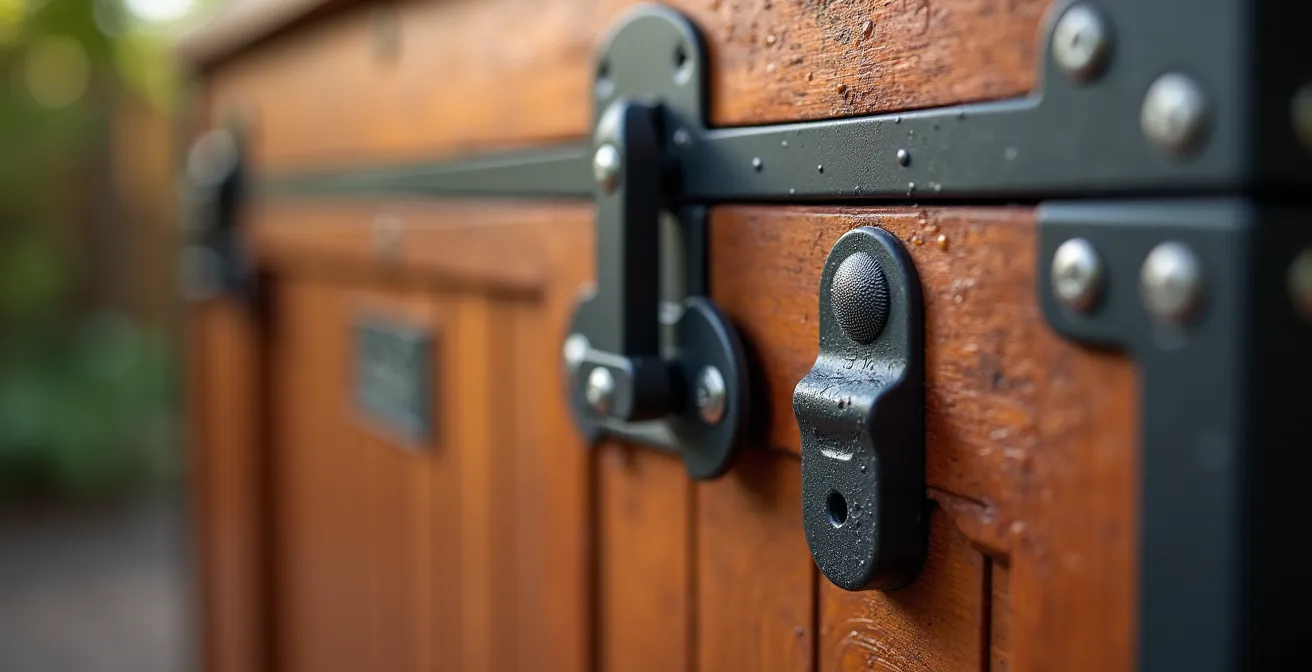
A deck box’s robustness is also measured by its load capacity. A quality model can serve as an extra bench, proving its structural strength. For example, a quality box can support up to 399 kg on its lid. But even with the best box, humidity can remain a sneaky enemy, especially during winter storage. A field tip shared by a Quebec owner proves redoubtably effective.
A Quebec owner recommends placing a container filled with rice or cat litter in the box during the winter. This simple trick absorbs residual humidity and has prevented any trace of mildew on their cushions after 4 consecutive winters.
– Feedback from an maintenance guide
This simple precaution ensures your cushions come out fresh and dry in the spring, ready for a new season of relaxation.
Throws, lanterns, and trays: The 3 accessories that transform a dull patio into a chic lounge
Once the structure is in place (furniture, rugs, storage), it is the accessories that breathe the soul of a living room into your terrace. Three elements are particularly effective in creating a sophisticated lounge atmosphere: throws, lanterns, and trays. Cozy throws, nonchalantly draped over a sofa, are not just there for cool evenings; they add texture, color, and an immediate invitation to relax. Trays, whether made of wood, metal, or slate, serve to group objects (glasses, candles, a small vase) to create an orderly focal point while being practical for serving.
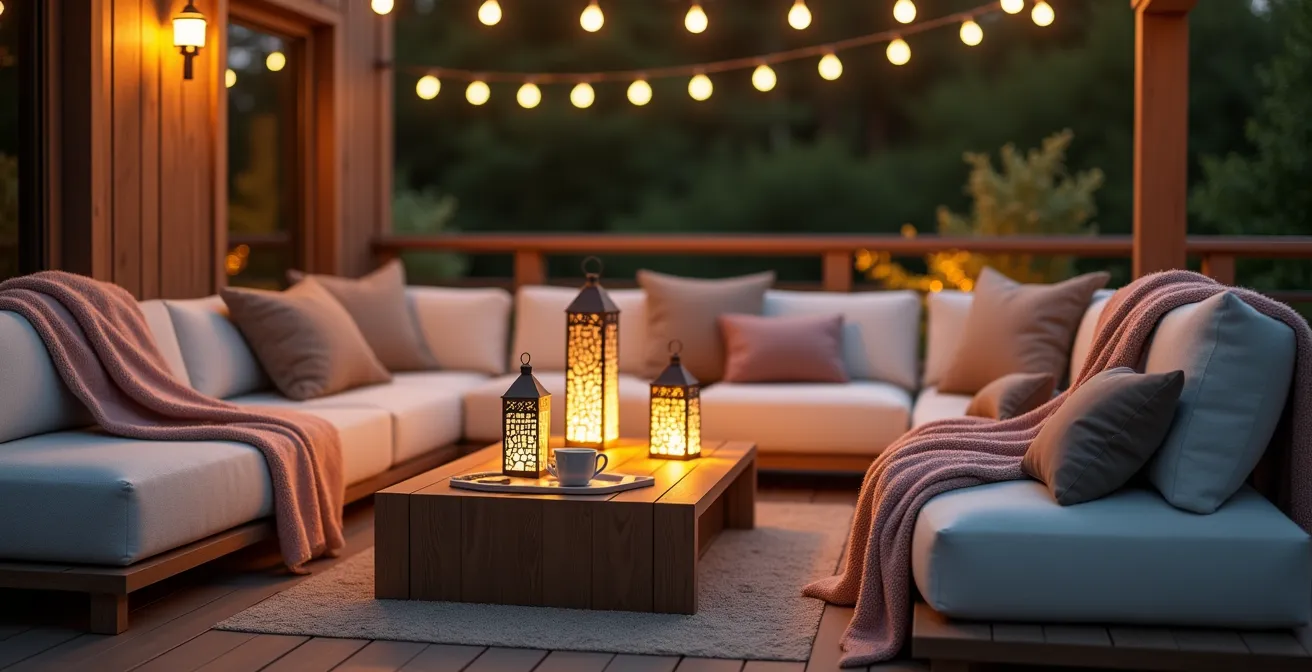
Lanternes are perhaps the most transformative accessory. They provide a warm and flickering ambient light much more intimate than wall lighting. In Canada, their function can be dual: creating an atmosphere and fighting mosquitoes. Options vary from traditional citronella candles (moderate effectiveness, 2m radius) to UV lamps that attract and eliminate insects. For maximum effectiveness without odor, Thermacell-type devices, available at retailers like Canadian Tire, are excellent. They create a protection zone of about 4.5 meters in radius, ideal for protecting your entire seating area for 5 to 6 hours.
The arrangement of these three elements is enough to instantly elevate the perception of the space, turning it from a simple “patio” into a true outdoor “lounge,” ready to host memorable evenings.
Key Takeaways
- Durability comes first: Invest in technical fabrics (Sunbrella, Olefin) and high-density foam (2.5 lb/ft³+) for comfort that resists Canadian seasons.
- Structure the space: Use weighted rugs and tall planters to zone your terrace and create functional spaces protected from the wind.
- Think practical and secure: A large waterproof deck box is superior to covers for quick storage and effective protection against humidity and local wildlife.
How to gain 4 weeks of terrace use in the spring and fall?
The greatest luxury of an outdoor living room in Canada is not its size, but its duration of use. Being able to enjoy your terrace from the end of April until mid-October means “gaining” more than a month of outdoor life. The key to achieving this is an efficient heating system. While propane “mushroom” heaters are popular, wall- or ceiling-mounted infrared heaters are a much more elegant and high-performing solution for a lounge-type space. Unlike propane which heats the air (which blows away), infrared directly heats bodies and objects, providing a soft and enveloping sensation of warmth, similar to that of the sun.
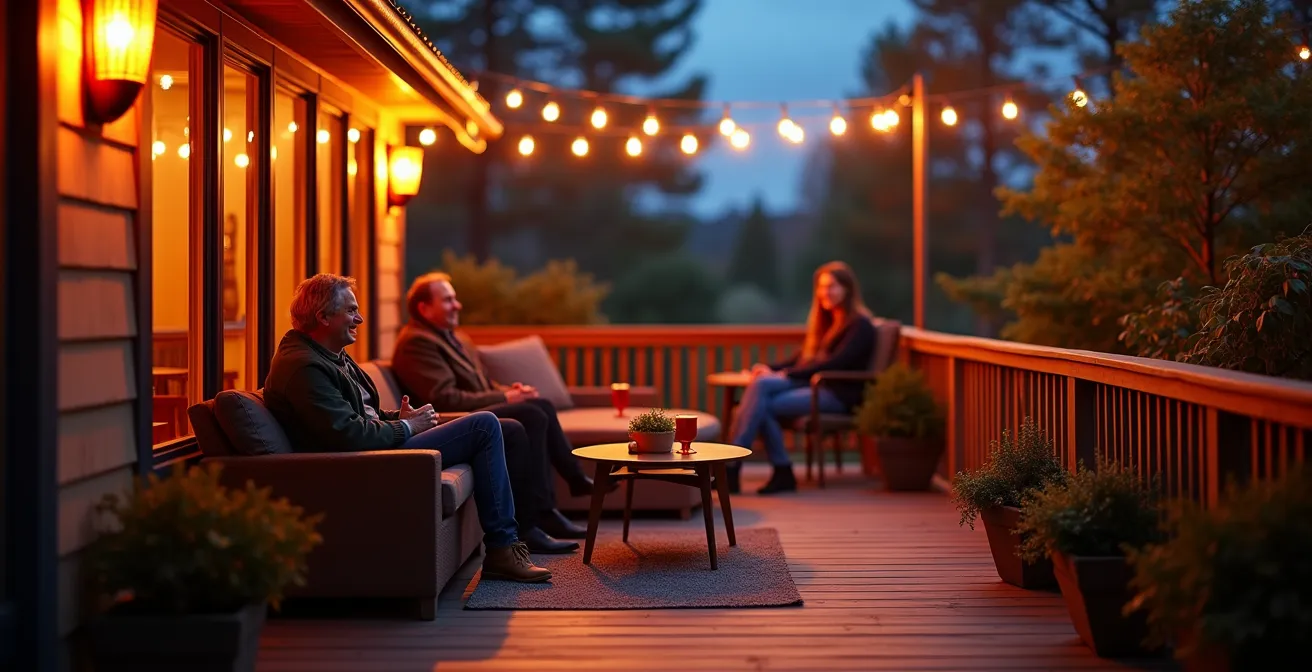
This technology is not only more pleasant but also more economical to use. Installing a 3000W model may require an electrician, but its operating cost is much lower than that of a propane device, as shown in this analysis of available options on the Canadian market.
To choose the option best suited to your space and budget, it is useful to compare the initial and operating costs of the different patio heating technologies available in Canada. The following data, taken from an analysis by La Presse, highlights the key differences.
| Type | Initial Cost ($CAD) | Cost/Hour | Coverage | Installation |
|---|---|---|---|---|
| Infrared 3000W | 600-900 | 0.39 | 8×8 ft | Electrician Required |
| Propane 35000 BTU | 1900 | 1.50 | 12×12 ft | Standalone |
| Infrared 6000W | 1200-1500 | 0.78 | 11×11 ft | 240V Circuit |
Combined with a semi-sheltered space and a few throws, infrared heating makes spring and autumn evenings quite comfortable, transforming your investment into an additional room usable for a large part of the year.
In a covered area with curtains, it’s easy to stay comfortable until November with infrared heating, even in Quebec.
– Véronique Saindon, Patio Heater Specialist, Auvents Polo
By adopting this thoughtful approach, your terrace will cease to be a concern and become an obvious choice—a place of permanent comfort ready to welcome you at any time. The next step is to move from inspiration to action by evaluating your specific needs to create the oasis you deserve.