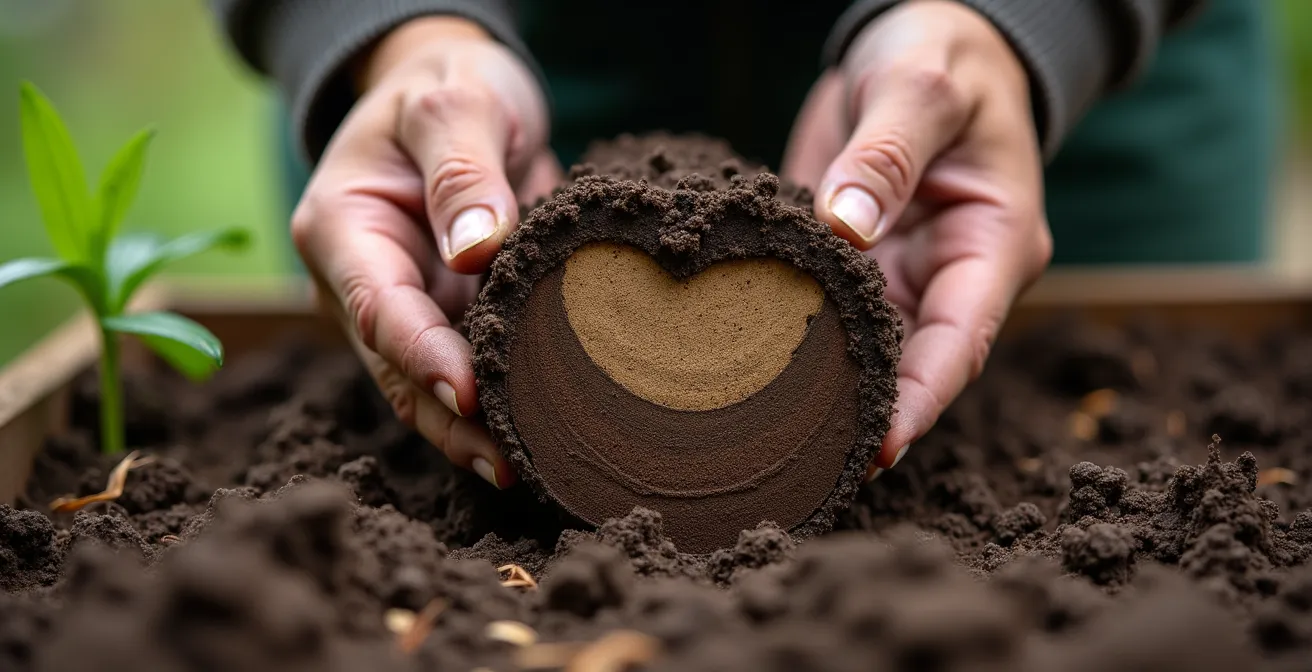
Contrary to popular belief, touching the surface of the soil is the least reliable method for deciding when to water, especially in Canada.
- Dry surface soil can hide abundant moisture just a few centimeters deep, where the roots are located.
- Soil type (clay, sandy) and plant behavior at dusk are much more accurate indicators of actual water needs.
Recommendation: Before reaching for the watering can, learn to diagnose the actual moisture levels at the root zone. This is the key to avoiding over-watering and rot.
The gesture is almost a reflex for every gardener: a hot day, a blazing sun, and a hand reaches down to the soil of the vegetable garden or flower beds. The surface is dry, cracked, almost dusty. Instinct screams: “It needs water!”. Yet, how many times has this well-intentioned gesture led to the exact opposite of the desired result? Yellowing leaves, stagnant growth, and ultimately, roots rotting in water-saturated soil. This frustrating situation is common for many gardeners, particularly in the Canadian climate where extremes are the norm.
Usual advice, such as observing leaf wilting or relying on the weather forecast, are often late or misleading indicators. The real problem is not at the surface, but in our inability to perceive what is happening underground. Soil texture, its water-holding capacity, the impact of the freeze-thaw cycle, or the plant’s physiological reaction to heat are all invisible variables that determine the actual need for water. Over-watering is one of the leading causes of garden plant mortality, much more so than drought itself.
But what if the real key wasn’t guessing, but diagnosing? What if, instead of reacting to surface symptoms, we learned to read the deep signals that the soil and plants are sending us? The good news is that simple and logical methods exist. They don’t require being an agronomist, but simply a more informed observer. This article is not a simple list of watering tips. It is a diagnostic guide designed for the conscious Canadian gardener who wants to move from blind watering to precise and effective hydration.
We will explore reliable methods for probing actual soil moisture, understand how soil composition influences water retention, and learn to distinguish a simple heat spell from a true cry for help from your plants. You will discover techniques and knowledge specific to our context, to finally water just enough, at the right time.
Table of Contents: A Step-by-Step Guide to Soil Moisture Diagnosis
- Why touching the soil surface is misleading and how to probe at 3 inches?
- Sandy or clay: how to amend your soil so it holds water like a sponge?
- Temporary or permanent wilting: when does the plant truly need help?
- Gadget or pro tool: do $15 moisture probes actually work?
- Which plants to choose for a dry slope that never holds moisture?
- Watering at 5 AM or 8 PM: which schedule maximizes absorption and minimizes evaporation?
- The grading error that floods 40% of basements during spring rains
- Rain gardens: how to turn a drainage problem into an ecological landscape?
Why touching the soil surface is misleading and how to probe at 3 inches?
The surface finger test is gardening’s most persistent myth. The top layer of soil, exposed to sun and wind, dries out extremely quickly—much faster than the root zone located a few centimeters below. Relying on this dry surface is like judging the ocean temperature by touching the burning sand on the beach. It is partial and often misleading information that leads directly to over-watering. In Canada, this phenomenon is accentuated by a characteristic of silty and clay soils, particularly in Quebec and Ontario: the formation of a “surface crust” (croûte de battance). After rain or snowmelt, the surface can harden and appear dry, while sealing in considerable moisture underneath. According to an analysis of local soil characteristics, it is even recommended to wait 2 to 3 days of drainage after saturation before measuring actual moisture, as this phenomenon can heavily skew the diagnosis.
The reliable method is to ignore the surface and probe directly into the zone where roots draw water. For most annuals and vegetables, this zone is between 5 and 10 cm deep (2 to 4 inches). The simplest technique is the index finger test: push your finger into the soil up to the second knuckle. If at that depth the soil still feels cool and moist, watering is not necessary. If it feels dry to the touch, it’s time to intervene. For an even deeper diagnosis, especially for shrubs or well-established perennials, a simple long screwdriver or thin metal tube works wonders. Drive it in 15 to 20 cm, pull it out, and observe: if moist soil adheres to it, the water reserve is still good. This simple habit radically changes perspective and transforms watering from a hazardous chore into a targeted and beneficial action.
Sandy or clay: how to amend your soil so it holds water like a sponge?
Watering without knowing your soil’s composition is like filling a bathtub without a plug or, conversely, one that is already full. Soil texture—its proportion of sand, silt, and clay—determines its water-holding capacity. A sandy soil, composed of large particles, has excellent drainage but low retention: water passes through it quickly before roots have time to absorb it. In contrast, a clay soil, made of very fine particles, retains water so well that it can become compact, poorly aerated, and risk root suffocation in case of excess. The ideal soil, loamy soil, offers a perfect balance between drainage and retention.
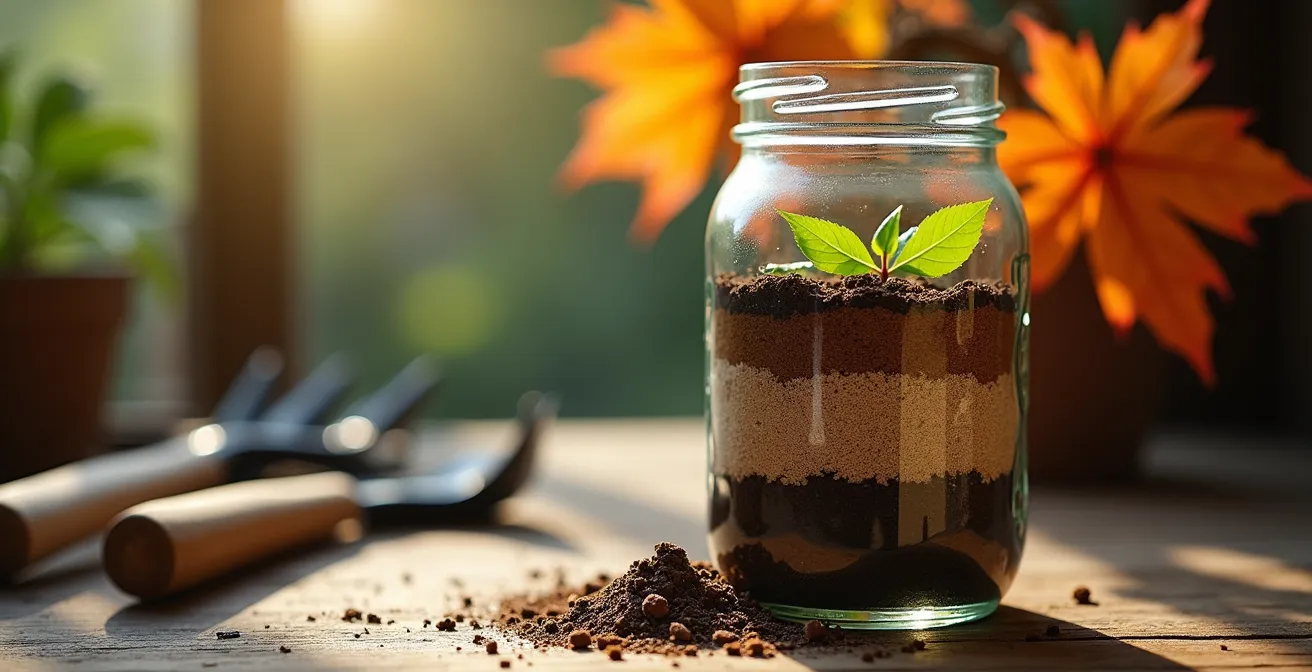
Knowing your soil type is the first step toward smart watering. The Mason jar test is a simple and effective visual method. Simply fill a jar one-third full with soil from your garden, top it up with water, shake vigorously, and let it settle for several hours. The different particles will settle into distinct layers: sand at the bottom, silt in the middle, and clay on top. This observation will allow you to choose the right amendments.
Once the diagnosis is made, the goal is to improve the soil structure so it acts like a sponge. For sandy soil, adding organic matter such as maple leaf compost or well-rotted manure will significantly increase its retention capacity. For heavy clay soil, the goal is to aerate it by incorporating coarse sand, perlite, or compost. These amendments are not just a “bonus”; they transform the very nature of your soil. Indeed, it has been shown that amended garden soil can retain up to 25% more water, thereby reducing watering frequency and hydraulic stress for your plants.
The following table, adapted to Canadian conditions, guides you in choosing the right amendments.
| Soil Type | Recommended Amendment | Suggested Amount |
|---|---|---|
| Sandy Soil | Maple leaf compost | 5-8% of volume |
| Clay Soil | Coarse sand + perlite | 20-30% of volume |
| Loamy Soil | Locally produced biochar | 3-5% of volume |
Temporary or permanent wilting: when does the plant truly need help?
Watching a plant whose leaves sag under the midday sun is alarming, and the first reflex is to flood it. However, this is often a mistake. Plants, like humans, have protection mechanisms against heat. Temporary wilting is one of them. During the hottest hours of the day, certain plants (especially those with large leaves like squashes or hydrangeas) voluntarily reduce the surface area of their leaves exposed to the sun to limit evapotranspiration—the loss of water. It’s a strategic nap, not a cry for help. Watering at this time is not only useless, as the plant is in “economy mode,” but can also be harmful by abruptly cooling the roots and promoting thermal shock.
The true alarm signal is the permanent wilting point. This is the stage where the plant has exhausted all available water that its roots can extract from the soil and cannot regain its turgidity, even when the heat decreases. How to tell the difference? The dusk test is foolproof. After sunset, when the temperature drops, go back to see your plant. If its leaves have straightened up and regained their vigor, it was merely temporary wilting. The soil still contained enough moisture. If, on the other hand, the plant remains slumped in the evening or early morning, it has reached its permanent wilting point and has an urgent and deep need for watering. A study conducted during long Canadian summer days confirmed that this evening test is the most reliable diagnosis for identifying real water stress. Watering only when necessary is not just good for plant health; it is also a major ecological and economic gesture. For example, better management of residential watering can represent a saving of up to 1000 liters of water per hour for a standard garden hose.
Gadget or pro tool: do $15 moisture probes actually work?
Browsing the aisles of garden centers, you’ll find a multitude of small, inexpensive moisture probes, often sold for around $15. The promise is tempting: a simple device to stick in the ground that tells you instantly if you need to water. For the conscious gardener looking to optimize watering, the question arises: are these gadgets reliable tools or just toys? The answer is nuanced but leans heavily toward caution. The vast majority of these entry-level probes do not directly measure the amount of water in the soil. In reality, they measure something else: electrical conductivity.
The principle is simple: water containing mineral salts conducts electricity. The wetter the soil, the more conductive it is. The problem is that many other factors influence this conductivity, completely skewing the reading. The most important is the presence of fertilizer. Recently fertilized soil, even if it is dry, will be rich in salts and therefore very conductive. The probe will indicate “moist” while the plant is cruelly lacking water. Conversely, very mineral-poor soil or the use of rainwater (which is very low in minerals) can give a “dry” reading even if the soil is soaked. Natural soil salinity and temperature are other variables that can mislead the device.
Professional tools used in agronomy, such as TDR (Time Domain Reflectometry) probes, work on a completely different and much more reliable principle. As one expert in the field points out:
Low-cost galvanic probes measure electrical conductivity, which is distorted by fertilizers and soil salinity, rather than the water itself. Professional TDR probes measure the dielectric constant of water for true precision.
– Agralis Technical Service, Agralis Sensors and Measurements
Should you throw these gadgets away? Not necessarily. You just need to understand their limits. A $15 probe can be useful for following a *trend* in the same pot with the same potting soil, but it should never be considered an absolute measurement. Your index finger, a screwdriver, and careful observation of your plants remain much more reliable—and free—diagnostic tools.
Which plants to choose for a dry slope that never holds moisture?
Sometimes, the problem is not the watering method, but a fundamental mismatch between the plant and its environment. A sloped bank, sandy soil near a foundation, or a flower bed in full sun are areas where water drains and evaporates at lightning speed. In these conditions, struggling to grow water-hungry plants is a losing battle, costly in terms of both time and resources. The smartest and most ecological solution is to adopt the principle of xeriscaping: choosing plants naturally adapted to drought.
Canada is full of magnificent native plants that have evolved to thrive in difficult conditions. These champions of resilience develop deep root systems to seek water far underground, thick or waxy leaves to limit evaporation, or life cycles adapted to dry periods. Opting for these plants means working *with* nature rather than against it. Once established, they require very little, if any, additional watering, even during summer heatwaves. Some xerophytic plants can indeed stay perfectly healthy with only 5 cm of rain per month, which represents less than a quarter of the average summer rainfall in Canada.
For a dry slope or a difficult area of your garden, here is a selection of Canadian native plants renowned for their robustness and drought tolerance:
- Serviceberry (Amelanchier canadensis): A versatile shrub that offers spring flowers, edible berries in summer, and spectacular foliage in autumn. Extremely hardy, it adapts to many conditions (hardiness zones 3-7).
- Black-eyed Susan (Rudbeckia hirta): This iconic perennial with bright yellow flowers is a pillar of low-maintenance gardens. It reseeds easily and thrives in full sun (zone 3).
- Butterfly Milkweed (Asclepias tuberosa): With its vivid orange flowers and deep taproot, it is nearly indestructible once established. It is also an essential host plant for the Monarch butterfly.
- Little Bluestem (Schizachyrium scoparium): An ornamental grass that brings texture and movement to the garden. Its blue-green summer color turns bronze-orange in autumn, and it perfectly tolerates poor, dry soils.
- Purple Coneflower (Echinacea purpurea): A classic that attracts pollinators and tolerates a wide range of soils, from clay to rocky and dry ground.
Watering at 5 AM or 8 PM: which schedule maximizes absorption and minimizes evaporation?
The question of watering time is a classic debate among gardeners. While, according to Statistics Canada, nearly four out of five households in Canada water their garden, doing it at the right time can tenfold the efficiency of every drop of water. The two popular options are the evening, after a hot day, or early in the morning. While evening watering seems logical to “cool down” plants, it is actually the riskiest option in much of the country. In humid summer climates, such as Southern Ontario and Quebec, evening watering creates ideal conditions for fungal diseases. Foliage stays wet all night in a cool, stagnant atmosphere—a literal breeding ground for mildew, powdery mildew, and other black spots.
The absolute optimum, recommended by all horticulture experts, is watering very early in the morning, ideally between 4 AM and 7 AM. The advantages are multiple and irrefutable. First, evaporation is almost zero. The temperature is at its lowest, the sun isn’t up yet, and the wind is generally calm. Every drop of water has time to penetrate deep into the soil to the roots, where it is needed. Second, the water pressure on the municipal network is often at its peak, ensuring a constant flow. Finally, and this is the crucial point, as soon as the sun rises, it quickly dries the foliage, thereby eliminating the risk of disease. The plant is then perfectly hydrated to face the heat of the day.
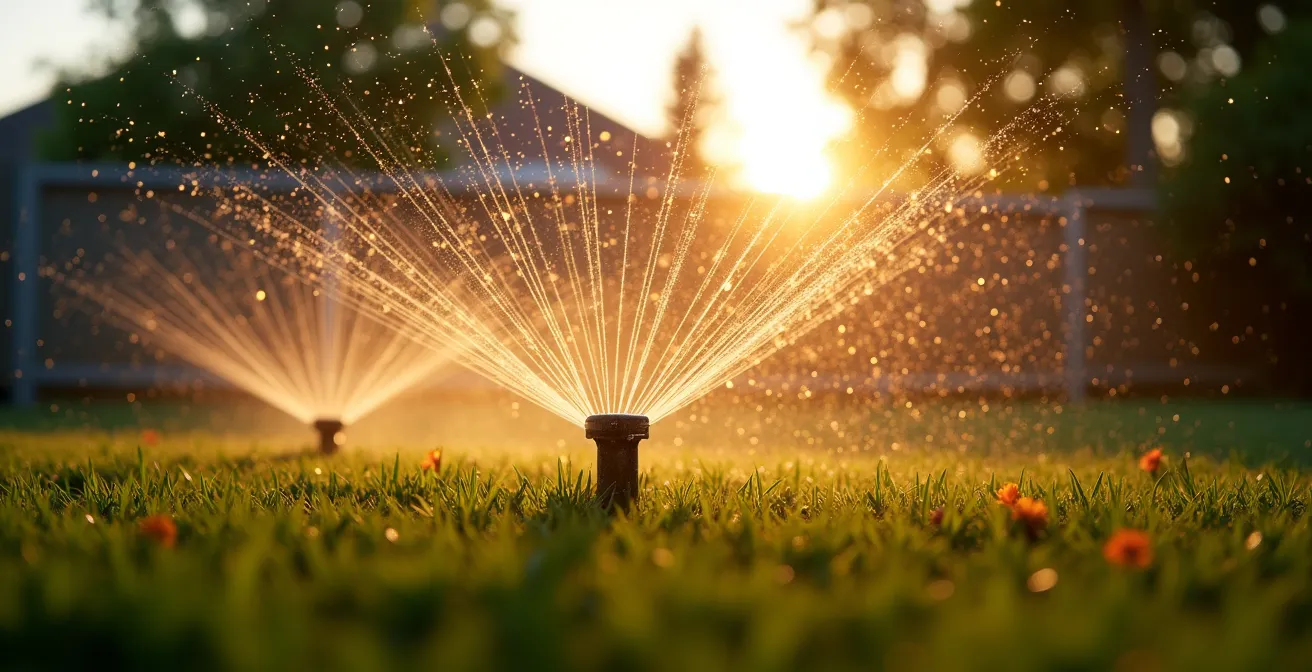
Watering in the middle of the day should be absolutely avoided. Up to 50% of the water can evaporate before it even hits the ground, and water droplets on leaves can create a magnifying glass effect that burns plant tissue. Programming an irrigation system or simply getting into the habit of doing it before your morning coffee is one of the most impactful changes for a healthy garden and responsible water consumption.
The grading error that floods 40% of basements during spring rains
Water management in the garden is not just about watering; it also, and primarily, involves evacuating excess. The most common and damaging error is negative grading, meaning soil that slopes toward the house foundations instead of away from them. During a Canadian spring, this design flaw becomes a literal ticking time bomb. Water from melting snow accumulates against the foundation walls, but the soil deep down is still frozen and impermeable. The water cannot seep downward and has no choice but to stagnate, exerting considerable pressure on the foundations. As pointed out by a drainage expert in the Quebec stormwater management guide, this situation maximizes hydrostatic pressure and is a major cause of water infiltration and moisture in basements.
Beyond damage to the structure, this zone of chronic saturation is a disaster for foundation plants (hydrangeas, hostas, shrubs…). Their roots are literally drowned, deprived of oxygen, which inevitably leads to rot. Correct grading is your home and garden’s first line of defense. The standard is a positive slope of at least 2% (a drop of 2 cm per meter) sloping away from the house for a distance of 2 meters (about 6 feet). Correcting this problem is an essential investment, achieved by adding specific soil, often richer in clay to better direct surface water.
Action Plan for Your Grading Audit
- Post-Thaw Inspection: Just after the snow has completely melted (April-May), observe where water stagnates around your house. This is the best time to spot negative slopes.
- Window Well Check: Ensure your basement windows are protected by quality window wells and, importantly, that they have adequate drainage so they don’t become pools.
- Slope Measurement: Use a long board and a level to check that the ground slopes away from your foundations for at least 2 meters.
- Correction Planning: If the slope is inadequate, plan to bring in “foundation-specific” soil (often a clay mix) to recreate a minimum 2% positive slope.
- Vegetation Integration: Once the slope is corrected, choose plants whose root systems will help stabilize the soil without interfering with drainage (avoid trees with aggressive roots near foundations).
Key Takeaways
- The surface test is misleading; always probe the soil at 5-8 cm depth before deciding to water.
- Amending the soil with organic matter (compost, biochar) is more effective in the long run than frequent watering.
- In Canada, very early morning watering (4 AM – 7 AM) is crucial to maximize absorption and avoid fungal diseases caused by nighttime moisture.
Rain garden: how to transform a drainage problem into an ecological feature?
After exploring how to avoid a lack of water, it is logical to look at managing its excess. Good water management in the garden is not a one-way street. Rather than seeing a low spot, an overflowing gutter, or a poorly drained area as a problem, it is possible to transform it into an ecological opportunity: the rain garden. This is a clever landscaping feature designed specifically to collect, filter, and absorb runoff. It is a shallow depression planted with native vegetation that tolerates both temporary flooding and dry periods. It is an elegant solution that reduces the load on municipal sewer systems, recharges groundwater, and creates a habitat for pollinators and local wildlife.
The principle is to direct water from your gutters or impermeable surfaces (patio, driveway) toward this area. The plants and specially prepared soil act as a sponge and a natural filter. For particularly wet areas, one can draw inspiration from another ingenious Canadian invention: the “wicking bed.” This raised garden system integrates a water reservoir beneath the soil. Moisture rises by capillary action directly to the roots, providing constant access to water without ever saturating them. Once filled, the reservoir can provide water autonomy for your vegetables for several days, even during a heatwave.
The key to a successful rain garden lies in plant choice. They must be robust and capable of handling extremes. Fortunately, Canadian native flora offers a wide range of perfect candidates:
- Blue Flag Iris (Iris versicolor): Quebec’s native iris, which beautifully handles having “wet feet” in the spring.
- Spotted Joe Pye Weed (Eutrochium maculatum): A tall perennial that attracts a myriad of butterflies and tolerates variable moisture.
- Red Osier Dogwood (Cornus stolonifera): A shrub with decorative red stems in winter, perfect for stabilizing the banks of a rain garden.
- Swamp Milkweed (Asclepias incarnata): Unlike its dry-field cousin, this one loves wet areas and is essential for Monarchs.
- Cutleaf Coneflower (Rudbeckia laciniata): A tall and robust perennial that thrives in moist to average soils.
Creating a rain garden completes the water management cycle. It means moving from a “problem-to-solve” logic to an “ecosystem-to-create” logic, transforming a drainage challenge into an aesthetic and ecological asset for your garden.
To apply these principles now, the next step is to conduct a complete diagnosis of your land’s texture and grading. This is the starting point for truly conscious gardening adapted to the realities of your environment.