Solar lighting can work in Quebec winters, but its reliability depends on a rigorous technical trade-off, often overlooked by consumer-grade products.
- Winter performance is conditioned by the choice of warm white (3000K), a cold-resistant LiFePO4 battery, and a shadow-free location.
- Even when optimized, solar remains limited in design and reliability compared to a professional wired 12V system.
Recommendation: For an aesthetic, reliable, and durable outdoor lighting solution that enhances your property’s value, the initial investment in a wired 12V system is almost always the wisest and most economical choice in the long run.
The promise of solar lighting is seductive for any homeowner in Quebec: illuminating your property without digging trenches, without hiring an electrician, and with zero electricity bills. Yet, disappointment is often palpable as soon as the first snow falls. The path lights, so valiant in July, emit nothing more than a ghostly blueish glow that flickers out long before midnight. This frustrating experience raises a legitimate question: is solar lighting fundamentally ill-suited to our climate, or are we simply making the wrong choices?
The common answer is often limited to “buy good quality” or “keep the snow off.” This advice, while correct, is only the tip of the iceberg. The real issue is not a simple matter of brand or maintenance, but a complex technical trade-off between light warmth, battery chemistry, and the physics of winter sunshine. Ignoring any of these factors inevitably leads to a disappointing investment.
This article offers an honest technical analysis, specifically for the Quebec context. We will deconstruct myths and give you the keys to understanding why your current lights are failing and how to make an informed choice. More importantly, we will directly compare the performance of the best solar system to that of a professional 12V system to determine which represents the truly smart investment for your property.
To navigate through technical aspects and practical solutions, this article is structured to guide you step-by-step, from understanding common failures to mastering reliable solutions.
Summary: Solar vs. 12V Lighting in Winter, the Verdict for Quebec
- Why your solar lights glow pale blue and how to choose a 3000K warm white
- The mistake of installing path lights under trees that reduces charging by 60%
- When to change your rechargeable batteries to restore original power?
- Is a solar motion sensor floodlight powerful enough to deter an intruder?
- Solar or battery-powered string lights: which option lasts for a party until 2 AM?
- How to calculate the total power of your lights so you don’t fry your transformer?
- The lighting mistake that makes your outdoor stairs dangerous at night
- Professional 12V system vs. solar: why investing in wiring is worth it for design?
Why your solar lights glow pale blue and how to choose a 3000K warm white?
The first sign of low-quality solar lighting in winter is that cold, almost clinical light that leans toward blue. Far from creating a welcoming atmosphere, it gives your garden a glacial and inhospitable look. This color is no accident: it is the result of choosing low-end light-emitting diodes (LEDs), often above 5000 Kelvins (K). While these LEDs are cheaper to produce, their psychological impact is negative. In fact, studies show that cold light of 5000K+ can increase the perceived sensation of cold by up to 25% in winter.
For successful landscaping, creating a warm lighting signature is essential. The goal is to aim for a “warm white,” situated between 2700K and 3000K. This color temperature mimics the glow of old incandescent bulbs and creates an atmosphere of comfort and security. It highlights natural materials like wood and stone and makes the snow sparkle rather than look bleak. When purchasing, the “3000K” or “warm white” indication on the packaging is a non-negotiable criterion for quality winter lighting.
The following table summarizes the choices available to you and their impact on your outdoor space’s ambiance.
| Color Temperature | Type of White | Created Atmosphere | Winter Recommendation |
|---|---|---|---|
| 2700-3000K | Warm White | Welcoming, warm | Highly recommended |
| 3500-4000K | Neutral White | Natural, balanced | Acceptable |
| 5000K+ | Cool White | Cold, clinical | To be avoided in winter |
Opting for a 3000K warm white is therefore the first step in your technical trade-off. It is a choice that directly influences the perception and comfort of your outdoor space during the long Quebec winter months.
The mistake of installing path lights under trees that reduces charging by 60%
A frequent error is thinking that the absence of leaves in winter makes tree shadows negligible. This is a flawed calculation that ignores a crucial factor in Quebec: the very low angle of the sun. In summer, the sun is high and shadows are short. In winter, it skims the horizon, casting very long shadows, even from bare deciduous trees. Conifers, such as spruces or cedars, become literal walls that block the little light available.
To better visualize this phenomenon, the illustration below shows how the winter solar angle transforms a simple conifer into a major obstacle for a solar panel.
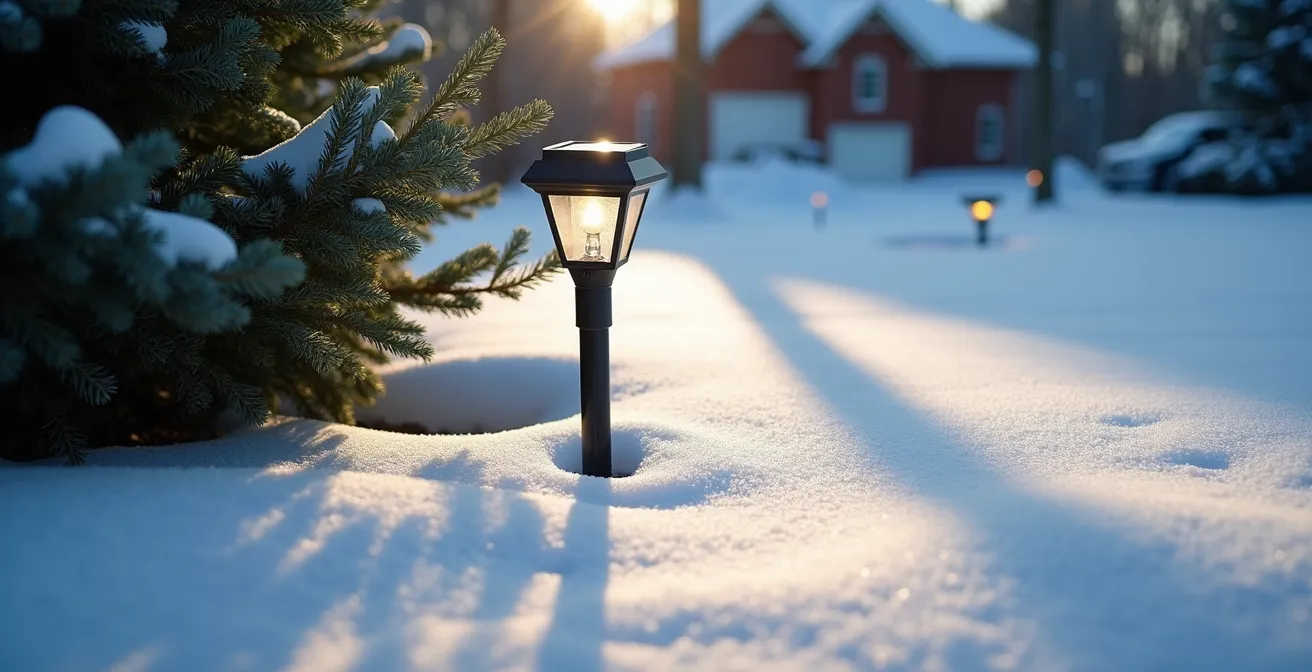
This diagram is not just theory. A case study conducted on an installation near Montreal demonstrated that solar panels placed in the shade of conifers produced up to 60% less energy than those in full sun, even without foliage. Furthermore, the impact of snow must be considered. According to Quebec government data, a simple layer of powdery snow can reduce charging by 50%, and sticky snow can block it by nearly 100%. Positioning is therefore doubly strategic: it must not only guarantee maximum southern exposure but also be sheltered from cast shadows and easily accessible for regular snow removal.
Case Study: The critical impact of conifer shade
A 43 kW commercial installation near Montreal, featuring a 45-degree roof angle, served as a study site. In January 2019, panels in full sun produced 949 kWh. In comparison, panels located under the shadow cast by nearby conifers showed production reduced by up to 60%. This study confirms that even the leafless branches of deciduous trees can have a significant impact due to the low trajectory of the sun in winter.
Location is not a detail; it is the number one factor that dictates whether your lamp will have a chance to charge. Even before considering power or battery, an honest analysis of your property’s direct sunlight between 10 AM and 3 PM in winter is imperative.
When to change your rechargeable batteries to restore original power?
If your solar lamp is well-exposed and equipped with a good 3000K LED but still falters, the culprit is almost certainly its battery. Most affordable solar lamps are equipped with Nickel-Metal Hydride (Ni-MH) batteries. While they work correctly in mild weather, they are notoriously poor performers in the cold. The intense freeze of a January night can paralyze their internal chemistry, drastically reducing their ability to store and release energy. In fact, a Quebec study reveals that Quebec winters reduce the lifespan of standard Ni-MH batteries by nearly 50%.
Generally, if your lamps have lasted more than two winters, it is very likely that their Ni-MH batteries are at the end of their life and responsible for the drop in performance. Replacing them with new ones of the same type can provide a temporary boost, but the underlying problem remains. The durable and high-performance solution lies in choosing a superior battery chemistry: Lithium Iron Phosphate (LiFePO4). This more expensive technology is what you find in high-end solar systems and electric vehicles for a good reason: its resistance to cold is exceptional.
Energy solution experts confirm the decisive advantage of this technology for harsh climates:
LiFePO4 batteries excel in extreme cold, maintaining about 80% of their capacity at -20°C, ensuring reliable outdoor lighting.
– Experts at Large Battery, Guide to battery solutions for outdoor lighting in extreme cold
Thus, when buying a new solar lamp, the mention of a “LiFePO4 battery” is a guarantee of winter performance. If you are replacing batteries in your existing lamps, check if the format is compatible. Investing in a LiFePO4 battery is the third essential technical trade-off for solar lighting that keeps its promises in Quebec.
Is a solar motion sensor floodlight powerful enough to deter an intruder?
When it comes to security, the question is no longer just atmosphere but raw power. Can a solar floodlight truly surprise and deter an ill-intentioned person? The answer is yes, provided you choose the right light output, measured in lumens. A simple 50-lumen marker light won’t make anyone flinch. For a deterrent effect, you must aim much higher.
The advantage of a motion sensor floodlight is that it isn’t on continuously. It conserves its energy for a brief burst of full power, making it more viable in winter than a constant-light lamp. However, there is a fascinating and often underestimated phenomenon that works in our favor in Quebec: winter albedo. The white snow blanket on the ground acts as a massive reflector, considerably amplifying the perceived light.
Case Study: Light amplification by snow
A study by Sunna Design, which equipped a large solar farm in Canada, analyzed the performance of its autonomous lighting in winter conditions. Results showed that an 800-lumen floodlight appeared 40% more powerful in winter thanks to reflection off the snow. This albedo effect massively increases the surprise and deterrent effect without consuming more energy, making medium-power solar floodlights surprisingly effective for security.
To choose the right floodlight, it is useful to refer to a power scale based on usage. The following table, adapted for the context of snowy ground, can guide you.
| Power (lumens) | Recommended Usage | Deterrent Effect | Visibility on Snow |
|---|---|---|---|
| 400-600 | Walkway, driveway | Low | Good |
| 800-1200 | Driveway entrance | Medium to High | Excellent |
| 1500+ | Large area | Very High | Blinding |
For most residential entrances, an 800 to 1200 lumen solar floodlight, equipped with a LiFePO4 battery and well-positioned, represents an excellent compromise. It will be powerful enough to illuminate a wide area, surprise an unexpected visitor, and offer real security value thanks to natural snow amplification.
Solar or battery-powered string lights: which option lasts for a party until 2 AM?
Creating a magical atmosphere on your terrace for a winter evening is a pleasure, but relying on solar string lights to do so is often a recipe for a party that ends in the dark. The problem is mathematical: data shows that 70% of annual solar production is concentrated between April and September. Short, dark winter days simply do not provide enough energy to power dozens of small lights for more than a few hours, even with the best battery.
For a party that stretches late into the night, where light ambiance is crucial, solar is a risky bet. Reliability requires turning to alternatives. Disposable battery-powered string lights are an option, but they are expensive and not environmentally friendly. The most efficient, economical, and reliable solution is USB-powered string lights plugged into a power bank (portable external battery). A good power bank can power a long string of lights for 8 to 12 hours without failing, even in deep cold, and can be recharged indoors the next day. The cost of use is virtually zero, and reliability is total.
The image below captures the essence of a successful winter atmosphere, made possible by a reliable power solution.
The comparison of costs and autonomy speaks for itself. For occasional but intense use like a party, investing in quality string lights and a good power bank is by far the wisest choice. It ensures peace of mind and a perfect atmosphere without fearing a power failure in the middle of the evening. Solar, in this context, is a false economy that sacrifices the essential: reliability.
While solar is excellent for light marking, for events where lighting must be guaranteed for long hours, the technical trade-off leans massively in favor of external battery solutions or, ideally, a permanent wired system.
How to calculate the total power of your lights so you don’t fry your transformer?
If reliability and design freedom lead you to consider the superior alternative, the wired 12V system, a crucial technical step is required: choosing the transformer. Unlike solar, where each lamp is autonomous, a 12V system centralizes power. An undersized transformer will overheat and fail, while an oversized model represents unnecessary expense. Calculating the required power is simple but must be done rigorously to guarantee the safety and durability of your installation.
The basic principle is to add up the power in watts (W) of all the lamps you plan to connect and add a safety margin. This margin is essential to avoid running the transformer at maximum capacity constantly and to allow for potential future light additions. A 20% margin is the professional standard. The following checklist details the safe calculation method.
Action Plan: Your 12V Transformer Calculation in 6 Steps
- Inventory: List all your future 12V lights (spots, bollards, floodlights, etc.).
- Individual Power: Note the power consumption in watts (W) for each light model (indicated on packaging or spec sheet).
- Subtotal by Type: Add the power for each group of identical lamps (e.g., 10 path lights at 3W = 30W).
- Total Power: Calculate the total sum in watts for all your fixtures.
- Safety Margin: Multiply the total power by 1.20 to add the 20% safety margin.
- Final Selection: Choose a transformer with a power rating equal to or greater than this result, ensuring it is CSA or cUL certified for outdoor use in Canada.
Concrete Example for a Typical Quebec Landscape
Imagine a residential project: 5 spots at 5W to illuminate the facade (25W), 10 path lights at 3W to mark the driveway (30W), and 2 floodlights at 7W to highlight spruces (14W). Total consumption is 25 + 30 + 14 = 69W. Applying the 20% safety margin (69W x 1.2), we get a need for 82.8W. The wise choice would be a 100W or 120W certified transformer, providing sufficient capacity and room for future additions.
This simple calculation is the foundation of a reliable and safe 12V lighting system. It ensures your investment is protected against overloads and ready to evolve with your landscaping.
The lighting mistake that makes your outdoor stairs dangerous at night
Beyond power and reliability, the superiority of a 12V system lies in absolute control over light positioning. With solar, you are forced to place the lamp where there is sun. With a wired system, you place it where it is most effective and safest. Nowhere is this distinction more critical than for outdoor stairs in winter.
The most common and dangerous error is lighting a staircase from above (overhead lighting), for example with a floodlight fixed under the roof soffit. This approach, while seemingly logical, is a trap. Vertical light flattens relief, eliminates shadows that help us perceive step depth, and worse, makes dreaded black ice completely invisible. The Quebec Association of Building Inspectors warns against this practice, noting that overhead lighting can create a “deadly danger” on stairs in winter.
The safe solution is grazing light, positioned low. The 12V system excels here, allowing for the integration of small, discreet lights directly into the risers or along the stair stringers. This side or bottom lighting creates slight shadows on the nose of each step, instantly revealing the surface’s relief and texture. Ice, instead of being invisible, begins to shine, immediately alerting you to the danger. This is a fundamental safety issue that solar, due to placement constraints, can rarely address optimally. A 12V system gives you the freedom to prioritize the safety of your family and guests above all else.
Takeaways
- Solar performance in winter is a technical trade-off: aim for warm white (3000K) for ambiance and a LiFePO4 battery for cold resistance.
- Location is crucial: south-facing exposure, no shadows from trees (even bare ones), and regular panel snow removal are non-negotiable.
- Solar is viable for simple path marking or a security floodlight (800-1200 lumens), but insufficient for prolonged needs (parties) or precise design.
- For absolute reliability, optimal safety (stairs), and total design freedom, a wired 12V system remains the superior and more economical long-term investment.
Professional 12V system vs. solar: why investing in wiring is worth it for design?
The final decision between solar and a wired 12V system often comes down to perceived initial cost versus performance. However, this view is incomplete. The most significant advantage of 12V is not just its reliability, but its absolute creative freedom. With wiring, your only limit is your imagination. You are no longer a slave to sunlight.
Imagine being able to up-light the white, textured bark of your birches, create spectacular backlighting behind a snow-covered cedar hedge, or subtly mark a winding path to your outdoor fire pit. These effects, which transform a garden into a nocturnal work of art, are impossible to achieve with solar lamps that must be planted in full sun. The 12V system allows light to be placed exactly where the effect is desired, creating scenes, depth, and atmospheres that solar can only dream of. It’s the difference between simply “lighting” and truly “sculpting with light.”
Furthermore, the initial cost argument needs nuance. If you compare a quality solar system (with LiFePO4 battery) to a professional 12V system over a 5-year period, the numbers are surprisingly close. Solar requires the expensive replacement of batteries every 2-3 years, while the 12V system, once installed, only incurs minimal electricity costs thanks to low-consumption LEDs (a few dollars a year on an Hydro-Québec bill).
The following table, based on average costs in Quebec, illustrates the total cost of ownership over 5 years.
| Criterion | Quality Solar System | Professional 12V System |
|---|---|---|
| Initial Cost | $800 – $1500 | $1200 – $2000 (with installation) |
| Battery Replacement (5 years) | $300 – $600 (1-2 times) | $0 |
| Annual Electricity Cost | $0 | $8 – $12 (Hydro-Québec rate) |
| Total Cost over 5 Years | $1100 – $2100 | $1240 – $2060 |
| Design Freedom | Limited (sun required) | Total |
At nearly equivalent costs in the medium term, the 12V system offers infinitely superior reliability, durability, and aesthetic possibilities. Investing in wiring is therefore not an expense, but an investment in the value, safety, and beauty of your property.
To put these tips into practice and design a lighting scheme that withstands Quebec winters without fail, the next step is to accurately assess your property’s constraints and potential. Considering a consultation with a landscape lighting professional can transform your vision into a durable and beautiful reality.