
To achieve a spectacular spring in the garden, the secret is not so much choosing between lilac and magnolia, but mastering the invisible interventions that prepare and protect the blooms long before the thaw.
- Pruning at the wrong time can destroy 100% of a forsythia’s flowers.
- Raking up dead leaves isn’t just for aesthetics; it prevents the shrub from being reinfected the following year.
- Protecting a shrub isn’t just for winter; it’s also for early frosts in September.
Recommendation: Focus less on buying new plants and more on mastering the maintenance calendar of the ones you already own to multiply their floral potential.
After the long months of Canadian winter whiteness, the desire for color becomes a true obsession for the gardener. The question returns, unchanging: will it be the lilac or the magnolia that first announces the end of the cold season? Yet, this iconic duel hides a deeper truth. The promise of an early and abundant bloom does not rely solely on the choice of variety, but on a series of precise actions—a true floral choreography orchestrated throughout the year.
We often think it is enough to plant a hardy shrub and wait patiently. We focus on classics like forsythia or crabapples, hoping that a late frost will spare their delicate buds. But what if the real key wasn’t in waiting, but in action? What if the secret to a radiant spring resided in invisible interventions—those preventive cares that take place in autumn, winter, and even inside our homes?
This article proposes to go beyond simple variety selection. We will explore together the techniques that allow you not only to choose the right actors for your spring stage but, above all, to become the director of their flowering. From pruning that multiplies flowers to protection that saves a harvest, including the art of making winter bloom in your living room, you will discover how to transform your impatience into a mastered floral spectacle, perfectly adapted to the realities of our Canadian climates.
To guide you in this quest for the first flower, we have structured this article into several key steps. Each section addresses an essential technique or knowledge to get ahead of spring and savor every moment, from soil preparation to the plant architecture that endures even under the snow.
Summary: The fragrant duel for the first bloom that defies Canadian frosts
- Why pruning your forsythias in autumn removes all their spring flowering?
- How to force crabapple branches to bloom in your living room as early as March?
- Which bulbs to plant at the base of shrubs to hide their bare wood?
- The mistake of leaving diseased leaves on the ground that reinfect the shrub the following year
- Which shrubs scent the entire neighborhood starting in May?
- Floating row covers: how to save your harvest during an early frost in September?
- How to wrap a Zone 5 shrub so it survives in Zone 4?
- Calamagrostis or Miscanthus: which grass remains beautiful and upright even under snow?
Why pruning your forsythias in autumn removes all their spring flowering?
One of the most frequent and discouraging mistakes for the impatient gardener is pruning their forsythia in the fall, at the same time as other shrubs. This action, which seems logical, is actually the direct cause of a spring without a single yellow flower. The reason is purely botanical: forsythia, like many early spring-flowering shrubs, develops its flower buds on the previous year’s wood during the summer and autumn. Thus, an autumn pruning amounts to cutting off all the promises of flowers for the following season. Botanical observations confirm that 100% of the flowering forms on the previous year’s wood.
The right time to intervene is therefore crucial. You must wait until the end of the flowering period, generally late May or early June depending on your hardiness zone in Canada. It is at this moment, and only then, that you can prune the shrub to give it shape, eliminate old wood, and encourage the growth of new stems that will carry the flowers the following year. This post-flowering intervention gives it the entire summer to prepare its spring show.
For the harshest Canadian climates, the choice of cultivar is also an insurance policy. The ‘Northern Gold’, for example, was specifically developed in Ottawa for our winters. Its flower buds are hardy to Zone 3 and can survive cold temperatures of -35°C, guaranteeing a full bloom where other varieties would lose all their buds. This is proof that knowing the “when” and the “what” is the winning duo.
How to force crabapple branches to bloom in your living room as early as March?
Impatience for the arrival of spring can be beautifully soothed by an almost magical horticultural technique: branch forcing. This involves taking cuttings from spring-flowering shrubs in late winter and encouraging them to bloom indoors, creating spectacular bouquets weeks before their natural blooming in the garden. The crabapple, with its delicate white or pink flowers, is an ideal candidate for this indoor floral choreography.
The secret lies in proper timing and a precise method to “wake up” the dormant buds. You must wait until the shrubs have experienced enough cold and the buds are just beginning to swell, usually from late February to mid-March in Canada. This is the signal that the plant is ready.

Once inside, these branches become a living work of art, a tangible taste of the coming spring. The sight of buds slowly opening into flowers on a coffee table, while snow is still visible through the window, is an invaluable reward for any winter-weary gardener.
Your action plan: forcing branches for an early spring
- Selection and cutting: In February or March, cut crabapple, forsythia, or cherry branches diagonally when their buds begin to swell.
- Preparation: Lightly hammer the base of the stems or make a 5 cm slit to increase water absorption.
- Shock hydration: Submerge the branches entirely in a warm water bath for a few hours to rehydrate them and simulate a thaw.
- Vase placement: Place the branches in a large vase filled with lukewarm water, ensuring at least one-third of their length is submerged.
- Maintenance: Place the vase in a bright room but out of direct sunlight, at a temperature of 18-20°C. Change the water every two days and mist the buds daily to maintain humidity. Flowering should occur in 7 to 14 days.
Which bulbs to plant at the base of shrubs to hide their bare wood?
In early spring, many shrubs like forsythia or magnolia display their flowers on wood that is still completely bare. To dress the base of these “lone giants” and create a richer, more textured scene, nothing beats pairing them with early-flowering bulbs. This layered planting strategy occupies the space, multiplies points of interest, and hides the bare wood under a carpet of bright colors.
The choice of bulbs must, however, be strategic, especially in Canadian gardens. You must consider not only the flowering period but also resistance to specific spring conditions, such as soil waterlogged by melting snow and pressure from hungry squirrels. Crocuses, snowdrops (Galanthus), and early daffodils are classics that work well. They often bloom even before the shrub’s leaves unfurl, thus capturing maximum light.
A particularly clever association for Canadian urban gardens, where squirrel populations are dense, involves planting bulbs that they dislike. Ornamental onions (Allium) and Crown Imperial (Fritillaria imperialis) are renowned for their repellent effect. A case study conducted in Montreal gardens showed the effectiveness of pairing a Physocarpus ‘Diabolo’ with these bulbs, creating a visually superb scene that is perfectly protected from rodents.
The type of soil at the base of your shrubs is also a determining factor for the success of your bulbs. It is essential to choose varieties adapted to your ground’s drainage to avoid rotting.
| Soil Type | Recommended Bulbs | Flowering Period | Moisture Resistance |
|---|---|---|---|
| Clay (typical in Ontario) | Camassia, Leucojum | May-June | Excellent |
| Sandy (common in the Maritimes) | Botanical Tulips | April-May | Average |
| Well-drained | Crocus, Daffodils | March-April | Good |
| Wetlands | Erythronium, Fritillaria meleagris | April-May | Very Good |
The mistake of leaving diseased leaves on the ground that reinfect the shrub the following year
One of the most crucial invisible interventions for the health of our shrubs takes place in autumn: the great cleanup of dead leaves. Many gardeners see this task as a purely aesthetic chore or neglect it, thinking the leaves will form a natural mulch. This is a costly mistake that sets the stage for the following season’s diseases. Leaves from roses, crabapples, or maples affected by fungal diseases such as black spot, scab, or anthracnose are real ticking time bombs.
The spores of these fungi are not destroyed by the cold of the Canadian winter. On the contrary, the snow cover provides them with ideal shelter. In the spring, with the return of rain and mild temperatures, the spores are splashed by water onto the new leaves and young shoots of the shrub, starting a new infection cycle. According to data from Espace pour la vie in Montreal, it has been shown that 90% of anthracnose spores survive under the Canadian snow cover, ready to reinfect the plant as soon as the thaw begins.
Managing this plant debris is therefore paramount. It is imperative to meticulously collect all fallen leaves at the base of sensitive shrubs. Be careful: these leaves should never be put into a home composter. The temperatures reached there are often insufficient to destroy pathogens. The safest solution is to use the municipal organic waste collection (the brown bin). Industrial composting facilities, like those in Toronto or Vancouver, reach temperatures over 60°C that effectively eliminate spores. In the absence of this service, deep burial (more than 30 cm) or destruction by fire (where permitted) are the only viable alternatives. This simple gesture is one of the most effective ways to break the disease cycle and guarantee healthy, vigorous shrubs.
Which shrubs scent the entire neighborhood starting in May?
Beyond the visual spectacle, spring flowering is a multi-sensory experience where fragrance plays a leading role. A single strategically placed shrub can scent not only your garden but also the neighbors’, creating an olfactory bubble that truly marks the arrival of sunny days. The choice of these natural fragrance diffusers must take into account the hardiness zone to ensure that their delicate flower buds survive our winters.
Among the fragrance champions, common lilac (Syringa vulgaris) and Koreanspice viburnum (Viburnum carlesii) are safe bets for a large part of Canada. A study conducted in several Canadian botanical gardens mapped the reach of these scents. In Zone 4, such as in Quebec and Ontario, these two shrubs can create a 20-meter fragrant bubble in calm, humid weather. For colder areas like the Prairies (Zone 3), Tatarian honeysuckle (Lonicera tatarica) is an excellent option, diffusing its sweet scent up to 15 meters.
In milder areas like southern Ontario (Zone 5), Daphne ‘Carol Mackie’ is a gem. Despite its modest size, its powerful, spicy fragrance can be perceived within a 10-meter radius. The choice of cultivar also matters, as highlighted by the Department of Horticulture at Agriculture and Agri-Food Canada. Indeed, they are the source of a particularly popular cultivar. As confirmed by a publication in a major Quebec newspaper, the ‘Sensation’ lilac, developed at the Central Experimental Farm in Ottawa, is a national pride with its exceptional fragrance. Planting one of these shrubs is like giving an olfactory gift to the entire neighborhood, a unique signature for your spring garden.
Floating row covers: how to save your harvest during an early frost in September?
The dialogue with frost is not limited to late spring frosts. In Canada, an early frost in September can wipe out a whole summer’s efforts in a single night, cutting down tomatoes, peppers, and other sensitive crops. Protecting against this risk is another of those invisible interventions that make all the difference. The simplest and most effective tool is the floating row cover, also known as garden fabric or agrotextile.
These non-woven polyester or polypropylene fabrics are lightweight, breathable, and water-permeable, acting as an insulating blanket. They trap the heat radiated by the ground during the day, which can gain precious degrees during the night. The choice of cover thickness is directly linked to the level of protection sought. A lightweight fabric will protect against a light frost of -2°C, while a heavy fabric can offer protection down to -6°C. For more severe frosts, the double sheltering technique is formidable: a first layer of fabric on hoops, then an old blanket or sheet on top, creating an insulating air pocket.
Having these covers on hand and monitoring weather forecasts starting in late August is a habit to adopt. It’s worth the effort: a few extra weeks of production can be gained, allowing the last fruits to ripen. It is crucial to remove the protection in the morning as soon as the temperature rises above 5°C to prevent overheating and allow for pollination.
To navigate the options available on the Canadian market, this comparative guide can be very useful.
| Type/Weight | Protection | Thermal Gain | Availability |
|---|---|---|---|
| Light (17g/m²) | Down to -2°C | +2-3°C | Canadian Tire |
| Medium (30g/m²) | Down to -4°C | +4-5°C | Lee Valley Tools |
| Heavy (50g/m²) | Down to -6°C | +5-7°C | Specialized Garden Centers |
| Double layer | Down to -8°C | +7-10°C | Home technique |
How to wrap a Zone 5 shrub so it survives in Zone 4?
One of the greatest pleasures for a passionate gardener is “zone pushing”—successfully growing a plant normally intended for a milder climate. Making a Zone 5 Star Magnolia survive in a Sherbrooke garden in Zone 4b is not an unreachable dream, but the result of a meticulous winter protection technique. It’s not just about “wrapping” the shrub, but about creating a stable microclimate that protects it from the two worst enemies of the Canadian winter: drying winds and freeze-thaw cycles.
The most effective method is the “burlap wall.” It involves driving four sturdy stakes in a square around the shrub, at a respectful distance so as not to touch the branches. Burlap is then stapled to these stakes to create a windbreak. The space between the burlap and the shrub is then filled with dry oak leaves. Oak leaves are ideal because they decompose slowly and do not mat down, maintaining insulating air pockets. You must absolutely avoid sawdust or wood chips, which absorb moisture and freeze into a solid block of ice, fatal for the plant.
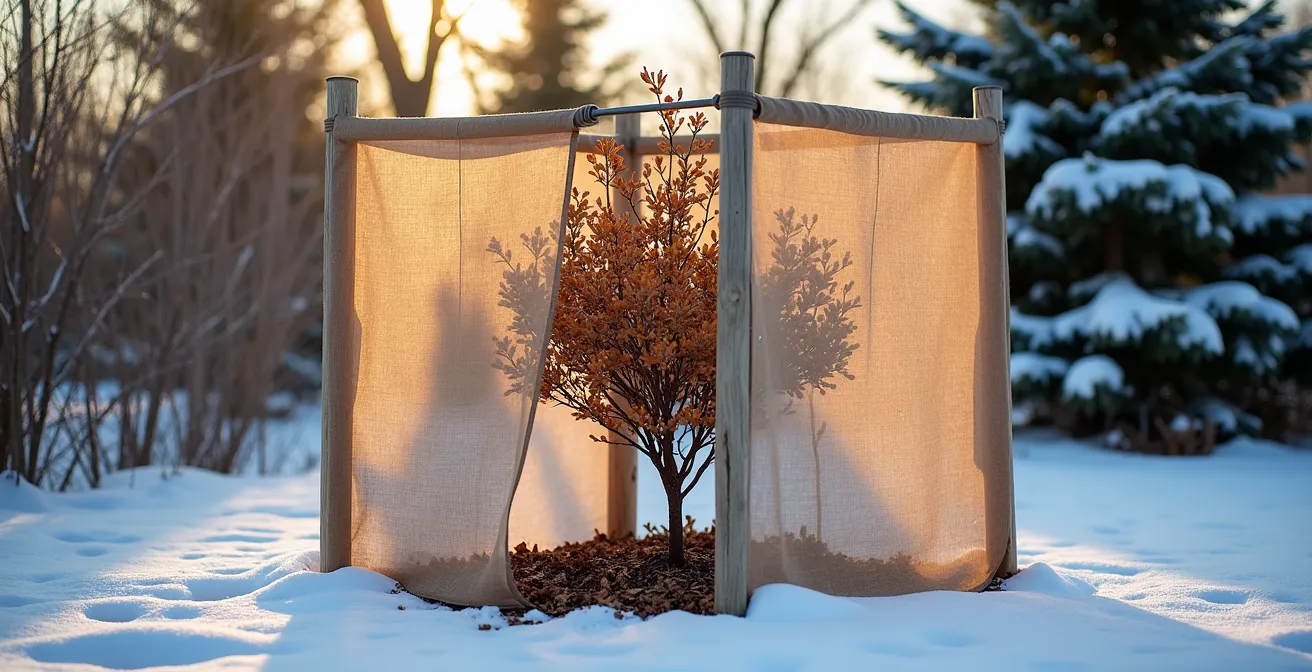
This protection, installed in late November after the first hard frosts and gradually removed in April, helps maintain a more stable temperature around the flower buds and protects them from dehydration caused by the wind. A documented case study in Sherbrooke shows that a magnolia protected this way for eight years has an 85% survival rate of its flower buds—a spectacular success that transforms the garden into a place of experimentation and pride.
Key Takeaways
- Pruning timing is more important than the pruning itself for spring-flowering shrubs.
- Garden cleanliness in autumn is a phytosanitary measure, not just an aesthetic one, to prevent diseases.
- You can “cheat” the seasons by forcing branches to bloom indoors weeks before spring.
Calamagrostis or Miscanthus: which grass remains beautiful and upright even under snow?
The floral choreography of a garden doesn’t stop with the last autumn flowers. Winter architecture—the structure that remains visible and attractive even under the snow—is what distinguishes a well-thought-out garden. Ornamental grasses are the queens of this season, offering texture, movement, and presence. However, not all behave the same way under the weight of heavy, wet Canadian snow. Knowing whether to choose Calamagrostis or Miscanthus means choosing between a silhouette that collapses and a soldier that stays standing.
Miscanthus, with its silvery plumes, is magnificent in autumn but tends to slump under the first heavy snow. Calamagrostis, particularly the ‘Karl Foerster’ cultivar, is famous for its columnar habit and exceptional rigidity. It remains perfectly upright all winter, its golden stems silhouetted against the white snow, creating vertical exclamation points in the sleeping landscape.
Calamagrostis ‘Karl Foerster’ literally defies our Quebec winters. After the December 2023 storm that dropped 45 cm of heavy snow, our specimens remained perfectly vertical, while all the Miscanthus in the garden had collapsed.
– Julie Boudreau, Montreal Botanical Garden – 2024 Annual Report
Beyond aesthetics, leaving grasses in place all winter has immense ecological value. Their hollow stems serve as shelter for many beneficial insects and pollinators, while their seeds feed birds like juncos and goldfinches. It is therefore crucial to resist the urge to cut everything down in autumn and to only prune these grasses in late April, just before the new shoots emerge. You can categorize grasses by their winter behavior to better compose your landscape:
- The ‘Soldiers’ (stay upright): Calamagrostis ‘Karl Foerster’, Schizachyrium scoparium (Little Bluestem).
- The ‘Architectural’ (slump with grace): Panicum virgatum, Sporobolus heterolepis.
- The ‘Winter Carpets’ (form a textured groundcover): Carex pennsylvanica, Deschampsia cespitosa.
By integrating these targeted interventions and thoughtful choices, the Canadian gardener transforms passive waiting into active and creative participation. Each season becomes an opportunity to prepare for the next, ensuring a renewed spectacle year after year. To start putting this approach into practice, choose just one of these techniques and apply it this season: you will be amazed at the impact of a single, well-mastered gesture.