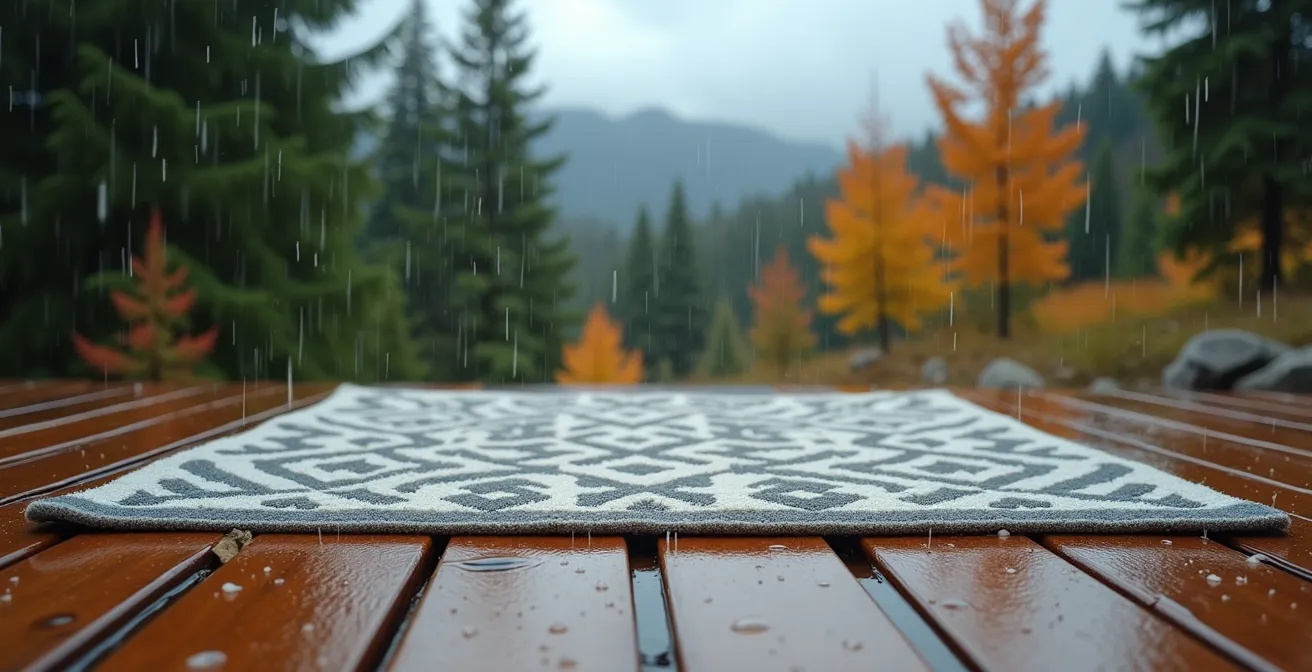
The secret to an impeccable outdoor rug in Canada lies not in the material alone, but in a complete moisture management system.
- Polypropylene is structurally superior to natural fibers for wicking away water and resisting mold.
- A draining rug pad is a non-negotiable investment, especially on a wooden deck, to prevent rot.
Recommendation: For maximum durability in the Canadian climate, always prioritize a flat-weave polypropylene rug, combined with an aerated rug pad and smart anchoring.
For a decorator, a cold concrete patio is a blank canvas full of potential, but also a challenge. The goal is to transform it into a warm and welcoming extension of the home. An outdoor rug is often the centerpiece of this transformation, bringing color, texture, and comfort underfoot. However, the Canadian climate, with its sudden showers and harsh winters, can quickly turn this decorative asset into a breeding ground for mold and disappointment. Many think the choice boils down to a simple opposition between natural fibers—aesthetic but fragile—and synthetic fibers—practical but soulless.
This view is incomplete. The real issue is not just the rug material, but the creation of a true moisture management ecosystem. The question is no longer “polypropylene or jute?”, but rather “How to design a coherent set that breathes, drains water, and resists thermal shocks?”. The durability of an outdoor rug doesn’t depend on a single characteristic, but on the intelligent interaction between the rug, its pad, the surface it rests on, and even the surrounding furniture. Forgetting one of these elements is sentencing your investment to premature degradation.
This article goes beyond a simple material comparison. We will explore the mechanisms that make a rug truly stand the test of rain and time in Canada. We will see why a rug might lose its color, how to avoid deadly traps for your wooden deck, and which maintenance and storage techniques are adapted to our winters. The goal is to give you the keys to making an informed choice and building an outdoor layout that is as durable as it is elegant.
To navigate through the crucial aspects of selecting and maintaining your outdoor rug, this guide is structured to answer every concern, from fading to space planning.
Table of Contents: Complete Guide to Outdoor Rugs Resistant to the Canadian Climate
- Why your blue rug turned gray in a month and how to avoid it?
- The mistake of leaving a wet rug on a wooden deck that causes boards to rot
- How to clean a wine or BBQ grease stain from a synthetic rug?
- How to stop your rug from sliding or blowing away without gluing it?
- Rugs or planters: what trick to use to separate the dining area from the living room?
- Rugs and floor lamps: tips for “zoning” an open outdoor living room
- Should you roll or fold your outdoor rug for winter?
- How to reproduce the comfort of your indoor living room on your patio without fearing rain?
Why your blue rug turned gray in a month and how to avoid it?
The disappointment of seeing a vibrant blue rug fade to a washed-out gray after only a few weeks of exposure is a frustrating experience. This phenomenon is mainly due to two factors: dye quality and ultraviolet (UV) resistance. Low-end outdoor rugs often use surface dyes that do not penetrate the fiber deeply. Under the effect of the Canadian sun, which is particularly intense in summer, pigments degrade quickly. Conversely, high-quality polypropylene rugs are generally “solution-dyed.” This means the dye is integrated into the polymer before the fiber is even spun, guaranteeing a color that resists fading much better.
Beyond the sun, the silent enemy is the accumulation of micro-debris. Pollen, dust, and pollution particles become embedded between the fibers and create a grayish veil that alters the perception of colors. Regular cleaning is therefore essential, not just for cleanliness, but to preserve the rug’s chromatic brilliance. A well-maintained rug is a long-term investment; according to experts, the average lifespan can reach up to 10 years for quality models in Canada. To achieve this, a proactive approach to maintenance is indispensable.
Your action plan to preserve your rug’s brilliance
- Contact points: List all color aggressors: direct sun exposure, high-traffic areas, proximity to trees (sap, leaves), dining area (stains).
- Collection: Inventory your current maintenance tools: vacuum, soft brush, garden hose, mild detergent (dish soap).
- Consistency: Does your current routine match the needs? Compare cleaning frequency to actual exposure to dirt and UV.
- Memorability/Emotion: Is the rug reversible? If so, plan a rotation every 3 months to even out wear and sun exposure.
- Integration Plan: Establish a simple schedule: a weekly vacuum, a monthly water wash, and a seasonal rotation.
By adopting this simple but structured routine, you are not just cleaning your rug: you are actively protecting your investment and the aesthetics of your patio for years to come.
The mistake of leaving a wet rug on a wooden deck that causes boards to rot
The most expensive mistake a homeowner can make is not choosing the wrong rug, but ignoring the surface it is placed on. Placing a rug, even a polypropylene one, directly on a pressure-treated or cedar deck is an invitation to disaster. After a downpour, the rug traps a thin layer of moisture against the wood. Without air circulation, this standing moisture creates an ideal microclimate for the growth of mold and fungi that attack and rot the boards. The rug appears dry on the surface, but underneath, a slow and destructive decay process is underway.
The solution is not to give up on the rug, but to create a breathing barrier. This is the fundamental role of the draining rug pad. These underlays, often made of rubber or PVC with an open structure, create a gap of a few millimeters between the rug and the deck. This space, although minimal, is enough to allow air to circulate and water to evaporate completely, effectively protecting the wood. It is a centerpiece of your layout’s drainage ecosystem.
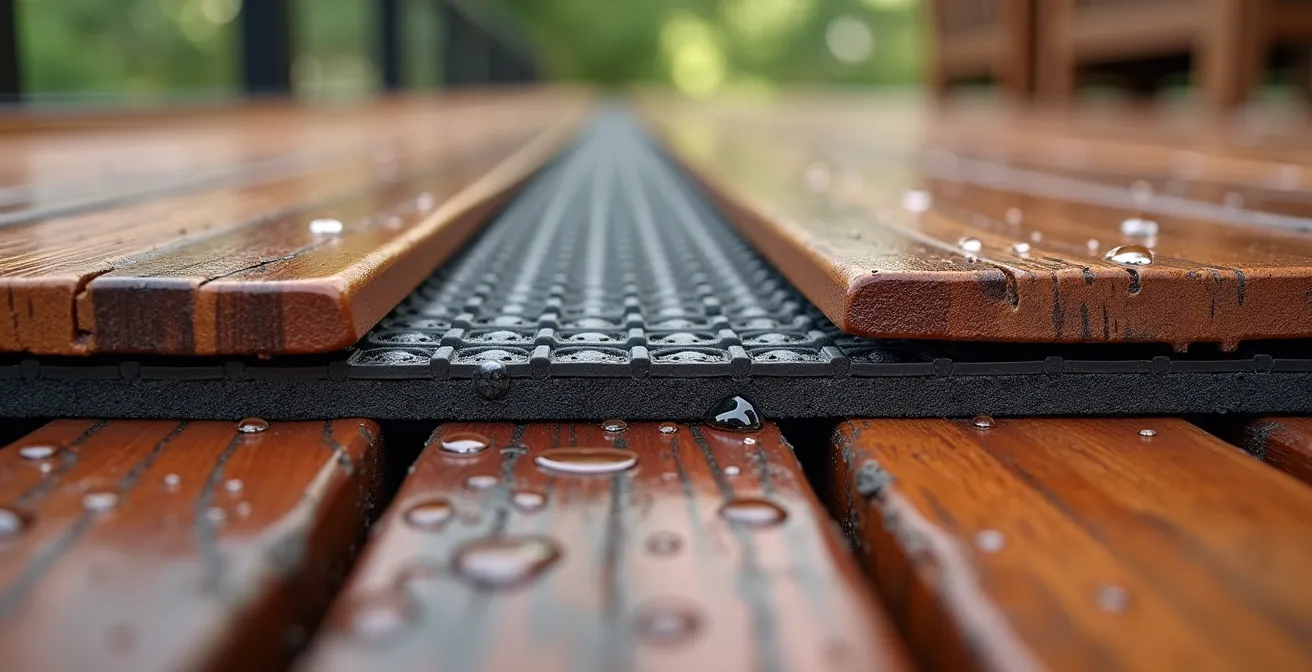
As shown in this image, the layering system is the key. The synthetic fibers of the rug shed water on the surface, while the aerated structure of the pad prevents any prolonged contact with the cedar. This simple precaution transforms the rug from a potential risk into a safe and aesthetic addition, extending the life of your deck by several years.
How to clean a wine or BBQ grease stain from a synthetic rug?
A successful barbecue afternoon on the patio can quickly leave unwanted memories on your rug: a splash of red wine, a drop of sausage grease… Fortunately, one of the greatest advantages of polypropylene fiber rugs is their low porosity. Unlike natural fibers that absorb liquids, polypropylene is hydrophobic. The stain mostly stays on the surface, which makes cleaning much easier if you act quickly.
The golden rule is to intervene immediately. For a liquid stain like wine, first blot (do not rub!) the excess with an absorbent paper towel. For a greasy stain, you can sprinkle a little baking soda or cornstarch to absorb the fat before cleaning. A simple cleaning protocol can handle most summer incidents:
- Shake: First, remove the rug from the area and shake it vigorously to remove any surface debris.
- Vacuum: Vacuum both sides to eliminate dust and embedded fine particles.
- Clean: Prepare a solution of lukewarm water with a few drops of mild dish soap. Gently scrub the stain with a soft-bristled brush using circular motions.
- Rinse: Rinse thoroughly with a garden hose. If possible, place the rug on a slight slope so the water flows off easily and doesn’t stagnate.
- Dry: Let the rug dry completely in the open air, ideally hanging up or on a clean, aerated surface.
For more specific stains, targeted solutions are often more effective. The following table, based on expert recommendations, offers a practical guide for the most common accidents.
| Stain Type | Recommended Method | Product to Use | Action Time |
|---|---|---|---|
| Red wine | Blotting + dilution | Sparkling water + paper towel | Immediate |
| BBQ grease | Absorption + degreasing | Dish soap + lukewarm water | 15 minutes |
| Mold | Antifungal treatment | Diluted white vinegar + baking soda | 10 minutes |
| Pine sap | Dissolution + rinsing | Rubbing alcohol | 5 minutes |
This approach, combining speed of intervention and adapted methods, will allow you to enjoy your outdoor space without fearing daily little accidents. The key lies in responsiveness and the use of simple, effective products.
How to stop your rug from sliding or blowing away without gluing it?
A rug that slides on concrete or turns into a projectile at the first gust of wind is not only annoying but also dangerous. This is a particularly relevant problem in Canada, on high-rise condo balconies or exposed terraces. The solution is not to glue the rug, which would damage both the floor and the rug, but to use functional anchoring and intelligent stabilization techniques.
The first line of defense is the non-slip rug pad. As we’ve seen, it is essential for drainage, but its role is dual. Models with a rubberized coating offer exceptional grip on smooth surfaces like concrete, tile, or composite wood. According to an analysis of modern solutions, these pads are particularly effective because they maintain optimal grip even on wet surfaces, a crucial feature after a summer rain. This prevents slips and stabilizes the rug’s base.
However, against the wind, a rug pad might not be enough. The most elegant and effective strategy consists of using patio furniture as anchor weights. This is called functional anchoring: each piece of furniture has an aesthetic role and a practical stabilization role.
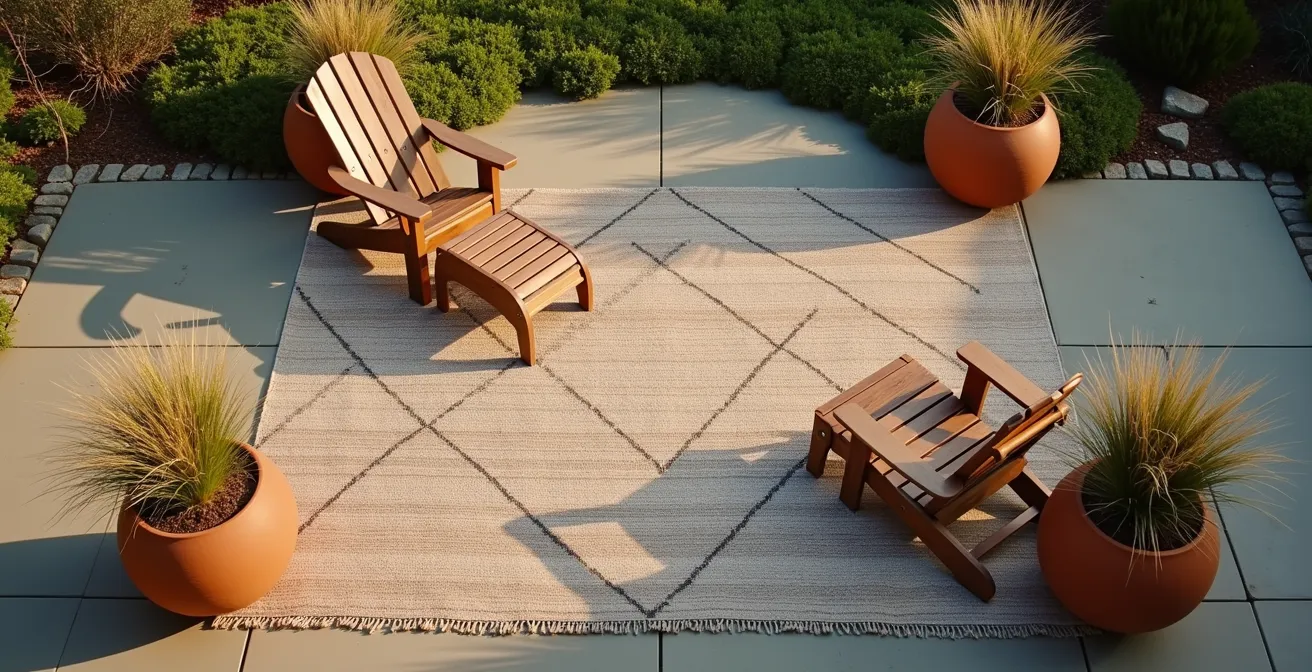
By strategically positioning the front legs of your sofa or armchairs on the rug, you fix it firmly to the ground. Adirondack chairs, typically Canadian and robust, or heavy cedar planters placed on the corners are also excellent anchor points. This method has the double advantage of securing the rug while unifying the entire layout to create a visually coherent and stable composition.
Rugs or planters: what trick to use to separate the dining area from the living room?
On a large terrace or an open patio, creating distinct zones for dining and relaxation is essential to structure the space and make it more functional. Without walls to delimit, it is the elements on the ground and the furniture that play the role of “visual partitions.” An outdoor rug is the most powerful tool for achieving this, acting as an “island” that clearly defines the boundaries of an outdoor lounge. A large rectangular rug under a sofa and armchairs immediately signals the relaxation area, separating it from the table and chairs zone.
The choice of material is again paramount here. For a rug that structures a space, you want good hold and great resistance. As experts point out, choosing polypropylene is wise:
This resistance ensures that your structuring element will remain impeccable throughout the season. But a rug is not the only option. Planters, especially tall and rectangular models, can act as a subtle and natural physical barrier.Polypropylene is mold-resistant, making it ideal for outdoor spaces subject to moisture and variable weather conditions.
– Maanta Experts, EF Maat Ecological Outdoor Rug Guide
The most sophisticated approach often involves combining several techniques for a delimitation that is both clear and aesthetic. Here are three effective configurations:
- The Rug & Planters Duo: This is the most complete solution. A large rug delimits the lounge, and tall planters placed at its ends or along one side reinforce the separation from the dining area while adding a touch of greenery.
- The Planter Barrier: If space is more limited, lining up three or four identical planters can create an effective visual separation without cluttering the floor. This is an excellent option for long, narrow balconies.
- The Double Rug: Using two rugs of different sizes or patterns is a bold “zoning” technique. A round rug under a small bistro table and a large rectangular rug for the lounge create two distinct but complementary worlds.
By playing with these elements, you can transform a uniform surface into a multi-functional and well-organized outdoor living space, where each zone has its own identity.
Rugs and floor lamps: tips for “zoning” an open outdoor living room
Creating distinct zones on a deck is not limited to physical separation; it’s also about creating moods. This is where the interaction between rugs and lighting becomes a powerful design tool. A rug defines a “floor” for your outdoor lounge, while a floor lamp acts as a “ceiling” of light, completing the creation of a virtual open-air room. This zoning by light technique is particularly effective at dusk, transforming a functional deck into an intimate and warm space.
Canadian retailers like JYSK have understood this by offering standard-sized outdoor rugs that make it easy to create living “islands.” A 5×7 foot rug is perfect for delimiting a reading nook with an armchair and a small table, while a larger model will accommodate a sofa set. Once the floor zone is defined, adding a floor lamp or a light arch to one of the rug’s corners “closes” the space vertically, concentrating light and attention on that specific area.
Safety is paramount when choosing outdoor lighting. It is imperative to only use fixtures certified for outdoor use (look for the CSA certification in Canada) and to plug them into GFCI (ground fault circuit interrupter) outlets to prevent any electrical risk. The Canadian market offers many safe options for every mood.
| Type of Lighting | Advantages | Required Protection | Approximate Cost |
|---|---|---|---|
| Solar lights | Wireless, eco-friendly | Minimum IP65 rating | 30-100 CAD |
| LED string lights | Warm ambiance | CSA outdoor certification | 40-150 CAD |
| Waterproof floor lamps | Directional lighting | GFCI outlet mandatory | 100-300 CAD |
| Citronella torches | Mosquito repellent | Stable support required | 20-60 CAD |
By combining a well-chosen rug to delimit the ground space and safe ambient lighting to define the volume, you can sculpt distinct and welcoming living zones, even on the most open of decks.
Key Takeaways
- The durability of an outdoor rug in Canada depends on an “ecosystem”: the rug, the pad, and ventilation are interdependent.
- Polypropylene is the clear winner for its resistance to moisture and UV, but the quality of the weave and dye is crucial.
- On a wooden surface, a draining rug pad is not an option; it is an absolute necessity to prevent rot.
Should you roll or fold your outdoor rug for winter?
The arrival of the Canadian winter imposes a logistical question: what to do with your outdoor rug? Leaving a rug outside under meters of snow and ice is the best way to drastically reduce its lifespan, even for the most robust polypropylene. The cycle of freeze and thaw can weaken the fibers and especially the backing of the rug. It is therefore imperative to store it for the winter after a complete cleaning and perfect drying.
The storage method has a direct impact on the longevity and appearance of the rug the following spring. The question then arises: should you roll or fold it? The expert consensus is unanimous: you should always roll a rug, never fold it. Folding a rug, especially a polypropylene rug with a stiff backing, creates permanent creases. These creases are not only unsightly; they create weak points in the rug’s structure where fibers can wear prematurely or even break. The backing can also crack along the fold lines, compromising the integrity of the whole.
Rolling the rug, on the contrary, preserves its shape and structure. The correct method is to roll it firmly, but not excessively, with the pile (the visible side) facing inward. This protects the surface from dust and potential friction during storage. Once rolled, it is advisable to wrap it in a protective cover or a simple plastic tarp to preserve it from moisture and dirt. Then store it horizontally in a dry place like a garage, basement, or shed. Proper maintenance and adequate storage can easily extend the life of a polypropylene rug to 5 to 10 years—a small effort for a great benefit.
How to reproduce the comfort of your indoor living room on your patio without fearing rain?
The ultimate goal of a successful deck layout is to blur the line between inside and outside, creating an “outdoor room” as comfortable and welcoming as your living room. Achieving this level of comfort without fearing the whims of Canadian weather relies on the synergy of three key elements: a suitable rug, quick-drying furniture, and a high-performance rug pad. This is the creation of a quick-dry ecosystem.
The starting point is a quality polypropylene rug, whose structure allows water to pass through rather than being absorbed. Flat-weave models are particularly effective. But the rug alone is not enough. The water that passes through it must be able to drain away quickly. This is where the aerated and draining rug pad plays its second crucial role: it creates an air gap that accelerates drying from underneath, preventing the rug from remaining waterlogged for hours.
The third pillar of this ecosystem is the furniture. Technology has advanced tremendously. Cushions featuring “Quick Dry Foam” have an open-cell structure that lets water flow freely, while upholstery fabrics are treated to be water-repellent and UV-resistant. The combination of a permeable rug, a draining pad, and quick-drying cushions creates an incredibly resilient outdoor lounge. A summer shower is no longer a drama: 30 minutes after the rain, the set is practically dry and ready to use. It is this thoughtful combination that allows for compromise-free comfort with minimal maintenance. Such a system, well-maintained, can offer a lifespan of 10 to 15 years for quality components.
Ultimately, the secret lies not in a miracle product, but in a holistic approach. By thinking of your deck as a complete system where each element contributes to moisture management, you ensure a durable, comfortable outdoor space that is always ready to welcome you.
To transform your deck into a true living space, the next step is to evaluate your space and design your own durable rug ecosystem by applying these principles.