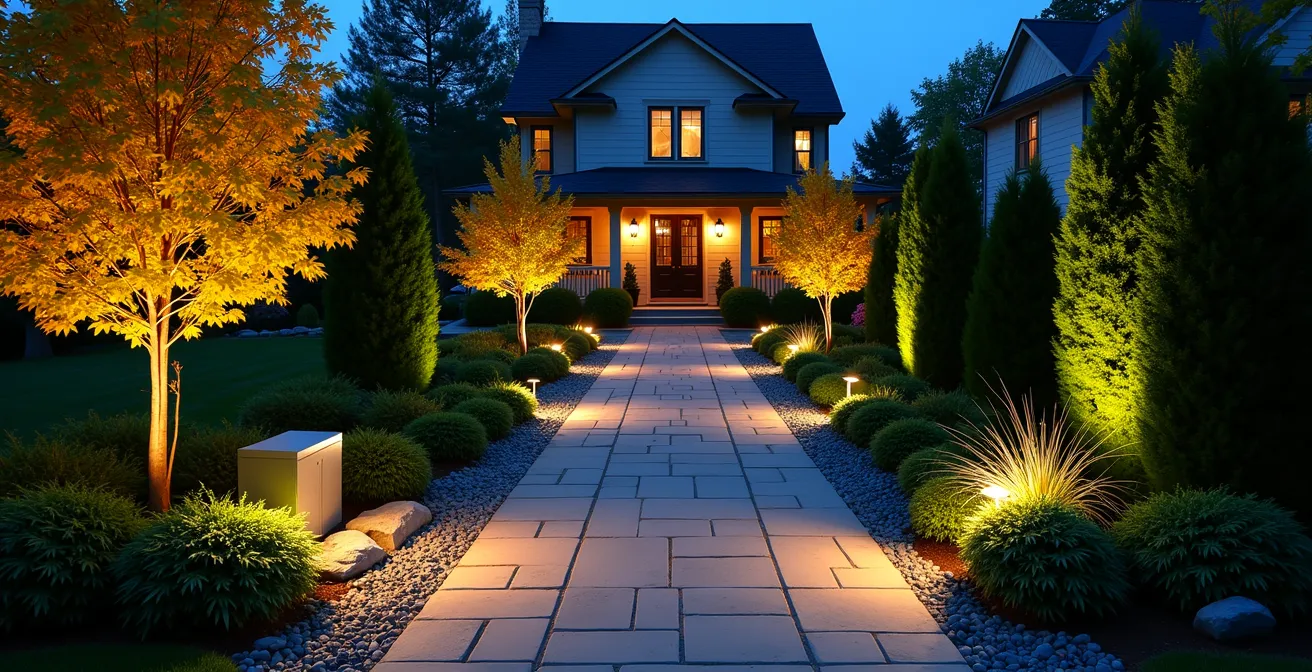
For premium outdoor lighting in Quebec, investing in a 12V hardwired system is not just an option, but a necessity for performance, safety, and design freedom.
- The 12V hardwired system guarantees constant power and total reliability, even during Quebec winters where sunlight is minimal and snow is frequent.
- It offers absolute creative freedom (grazing, silhouetting, dimming) that is impossible to achieve with the positioning constraints of solar fixtures.
Recommendation: Think of your lighting not as a gadget, but as a long-term architectural investment that enhances your property’s value and ensures an impeccable nocturnal signature in every season.
You have invested time and passion into your home’s architecture and landscaping. Every detail has been thought out to create a harmonious whole that reflects who you are. Yet, as soon as the sun sets, this visual masterpiece fades into darkness, leaving behind an anonymous facade. To remedy this, the solution seems obvious: outdoor lighting. Quickly, thoughts turn to solar kits, praised for their ease of installation and “eco-friendly” aspect. It’s the easy fix, the one you find at the end of the aisle.
But what if the true key to a “wow” effect didn’t lie in ease, but in mastery? What if the goal wasn’t just to light up, but to sculpt the night, creating a true nocturnal signature? This is where the approach changes radically. For a high-end homeowner in Canada, and specifically in Quebec, the question is not just aesthetic; it is also pragmatic. A lighting system must perform twelve months a year, whether it’s 30°C or -30°C under the snow. The weakness of solar in winter is no longer a secret, but few realize how much it stifles creativity.
This article goes beyond a simple technical comparison. It demonstrates why the 12V hardwired system, far from being a constraint, is a powerful design tool and an indispensable value investment. We will break down, step by step, how this initial investment in wiring translates into unfailing reliability, increased safety, and unparalleled creative freedom to transform your property into a nighttime work of art.
This guide is structured to provide you with professional lighting expertise, addressing technical aspects, aesthetic choices, and climatic realities. You will discover how to master the power, color, and positioning of your lights for a result that exceeds all expectations.
Summary: Professional 12V System vs. Solar: Why Wiring is a Design Investment
- How to calculate the total wattage of your lamps to avoid blowing your transformer
- Techniques for running wires under an existing sidewalk without breaking everything
- 2700K or 4000K: Which light color enhances stone vs. vegetation?
- Silhouetting or Grazing: How to give relief to a brick wall
- How to control your outdoor lighting zones from your phone
- The lighting error that makes your outdoor stairs dangerous at night
- How to light the path to the fire pit without killing the ambiance of the flames
- Is solar lighting effective in Quebec winters or a waste of money?
How to calculate the total wattage of your lamps to avoid blowing your transformer
The foundation of any reliable 12V lighting system is a correctly sized transformer. Underestimating this calculation is a perfect recipe for premature failure and mediocre performance. Unlike solar where each lamp is autonomous (and therefore individually prone to failure), a 12V system relies on a robust central power supply. The goal is not just to power current lights, but to guarantee stability and room for maneuver for the future. Outdoor lighting is a living project; you might want to add a spotlight on a new mature tree or light up a future spa area.
The calculation is simple but must be rigorous. It is not just about adding up the wattage of each bulb. Professionals systematically apply an “80% rule,” which consists of never loading a transformer to more than 80% of its rated capacity. This safety margin prevents overheating, extends the equipment’s lifespan, and ensures stable voltage across the entire length of the wiring, even for the most distant fixtures. Forgetting this rule is like constantly driving your car in the red zone: it works for a while, but a breakdown is inevitable. Furthermore, the very low consumption of modern LED fixtures makes the 12V system extremely energy-efficient, sweeping away the idea that a hardwired system is necessarily power-hungry.
Action Plan: Your 5-Point Lighting Audit
- Lighting Contact Points: Exhaustively list all elements to be highlighted on your property (facade, trees, path, sculptures, water feature).
- Wattage Collection: Inventory the power in watts for each type of fixture you plan to install for these points.
- Color Temperature Consistency: Compare the chosen color temperatures (in Kelvin) for each zone with your home’s materials (stone, wood, etc.) for visual harmony.
- Memorability and Ambiance: Evaluate the potential for advanced techniques (grazing, silhouetting) to create relief, as opposed to flat, uniform lighting.
- Wiring Integration Plan: Map the routing of low-voltage cables and strategic connection points to the transformer to optimize the layout.
For a concrete example, imagine a typical installation: for 8 spotlights of 3W, 4 bollards of 5W, and 2 sconces of 7W, the total is 58W. Applying a safety factor of 1.25 (the 80% rule), you reach 72.5W. If you add a 20% margin for future expansions, the real need is 87W. The choice would therefore be a 100W CSA-certified transformer, guaranteeing performance and scalability.
Techniques for running wires under an existing sidewalk without breaking everything
One of the major psychological barriers to a 12V system is the fear of having to “break everything” to pass wires, especially under existing structures like a paving stone sidewalk or a concrete driveway. It is a legitimate fear, but one based on a misunderstanding of professional techniques. Far from the cliché of the destructive trench, installers have surgical methods to integrate wiring invisibly and sustainably, preserving the integrity of your landscaping.
These techniques are tangible proof of the flexibility of a hardwired system. The most effective, especially in dense soils like Quebec clay, is directional water drilling. Using a specific kit connected to a simple garden hose, a clean tunnel of a few centimeters in diameter can be pierced under an obstacle without disturbing the surface. The cable, protected in a conduit, is then simply slipped through. Another method, this time preventive, is to insert a rigid PVC pipe during the initial construction of a driveway to serve as a future conduit. This demonstrates the importance of thinking about lighting from the design phase of the overall project.
This paragraph introduces a technical concept. To understand it well, it is helpful to visualize the process. The illustration below breaks down this underground passage method.
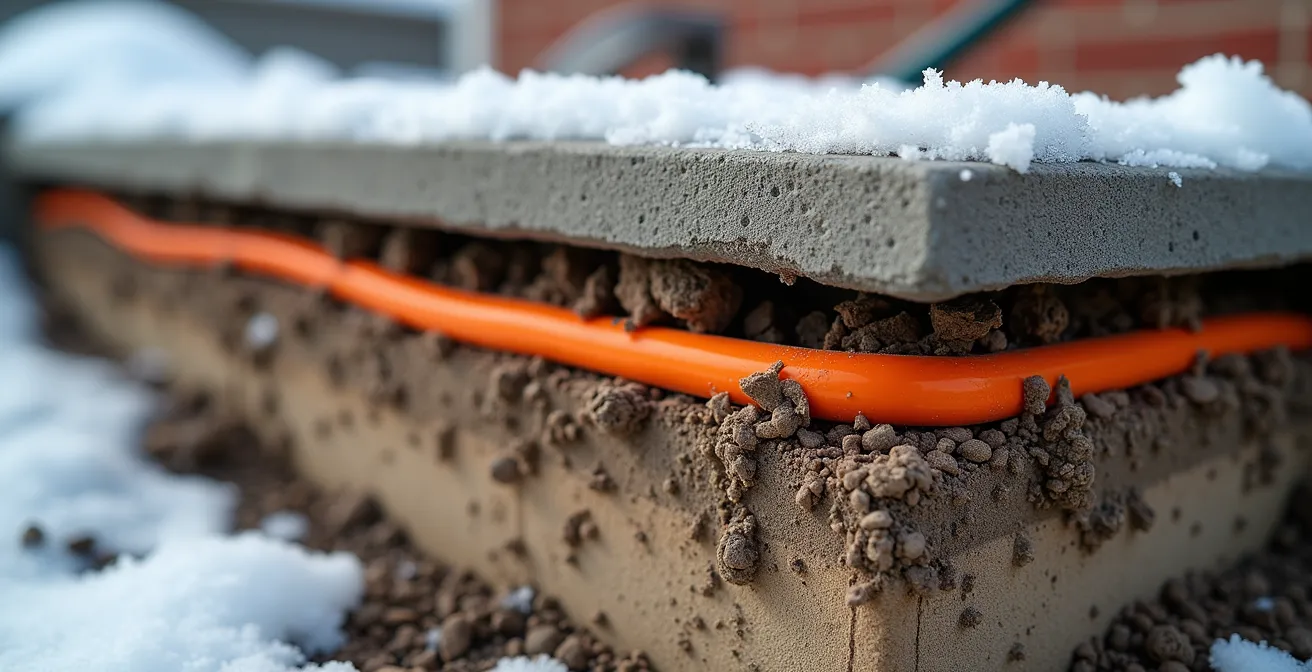
As shown in this diagram, the low-voltage cable is protected in a frost- and thaw-resistant conduit, an essential precaution in Canada. It is positioned well below the frost line to avoid any damage related to ground movement. This approach guarantees a durable and invisible installation, unlike exposed solar cables that degrade with UV rays and bad weather.
2700K or 4000K: Which light color enhances stone vs. vegetation?
The choice of color temperature, expressed in Kelvin (K), is one of the most decisive aspects for creating a successful ambiance. This is a fine-tuning that is the hallmark of quality 12V systems, whereas most solar lamps offer cold and unflattering light (often beyond 5000K) without any customization options. Using the wrong color temperature can completely distort the appearance of your noble materials. Light that is too cold can give a hospital-like and lifeless look to a beautiful warm stone, while light that is too warm can excessively yellow lush green foliage.
The general rule is simple: warm temperatures (2700K to 3000K) are ideal for organic and traditional materials. They create a welcoming and intimate atmosphere. A warm white at 2700K will bring out the rich hues of Western Red Cedar or century-old brick. A slightly more neutral white at 3000K is perfect for enhancing the texture of Ontario limestone or local granite. Conversely, cooler temperatures (4000K) are reserved for very modern architecture, raw concrete, and glass. They give an impression of cleanliness and technicality but should be used sparingly to avoid making the atmosphere feel icy, especially on a snowy landscape.
The following table summarizes the optimal choices based on materials and the desired effect, taking into account Canadian specificities and another essential criterion: the CRI (Color Rendering Index), which must be as high as possible (>85) for faithful color reproduction.
| Temperature | Enhanced Materials | Winter Effect | Recommended CRI |
|---|---|---|---|
| 2700K | Red cedar, century brick | Warm on snow | >90 |
| 3000K | Ontario limestone, granite | Balanced neutral | >85 |
| 4000K | Modern concrete, glass | Cold/Institutional | >80 |
Silhouetting or Grazing: How to give relief to a brick wall
This is where the 12V system demonstrates its most brilliant superiority: freedom of positioning. While a solar lamp must be placed where it can catch the sun, a 12V spotlight can be installed absolutely anywhere. This total freedom is the sine qua non for applying advanced architectural lighting techniques that transform a flat surface into a sculpture of light and shadow.
The “grazing” technique is particularly spectacular on textured materials like brick, cut stone, or wood siding. It involves placing spotlights very close to the wall (15-30 cm) with a narrow beam (10-15°) pointed upwards. The light “grazes” the surface, spectacularly accentuating every relief, every joint, and every imperfection, creating depth and character impossible to achieve with frontal lighting. Conversely, “silhouetting” involves placing the light source behind an object (a twisted tree, a sculpture) and directing it toward the primary viewing point (the terrace, the living room). The object then stands out as a dramatic silhouette against an illuminated background.
These techniques require millimeter-precise positioning, something only a hardwired system allows. As Michel Tremblay of the Association des designers paysagistes du Québec points out:
12V wiring allows for millimeter positioning of fixtures, totally independent of solar exposure. This creative freedom is the key to transforming an ordinary facade into a nocturnal architectural masterpiece.
– Michel Tremblay, Association des designers paysagistes du Québec
Mastering these effects means moving from being a lighting user to being an ambiance creator. It’s the difference between lighting that signals a presence and lighting that tells a story.
How to control your outdoor lighting zones from your phone
The era of single switches or mechanical timers is over. A modern 12V lighting system integrates perfectly into the smart home ecosystem, offering a level of control and customization that solar can barely touch. Thanks to Wi-Fi and Zigbee technologies, transformers and even some fixtures can be controlled from a simple app on your phone, anywhere in the world.
This connectivity transforms the outdoor lighting experience. It is no longer a simple “on/off,” but the creation of dynamic lighting scenarios. You can program a “BBQ Night” scene where the terrace is at 100% brightness and the paths at 40%, creating a festive but safe atmosphere. In winter, a “Winter Mode” scenario can turn on only the entrances and stairs at full power to maximize safety, while turning off purely aesthetic lighting to save energy. The ability to vary intensity (dimming) is fundamental: it allows for adapting the ambiance to the time of evening and reducing light impact to preserve a starry sky.
This remote control is also a major security asset. You can simulate presence when you are on vacation by programming random on and off times, a much more effective deterrent than a single light left on permanently.
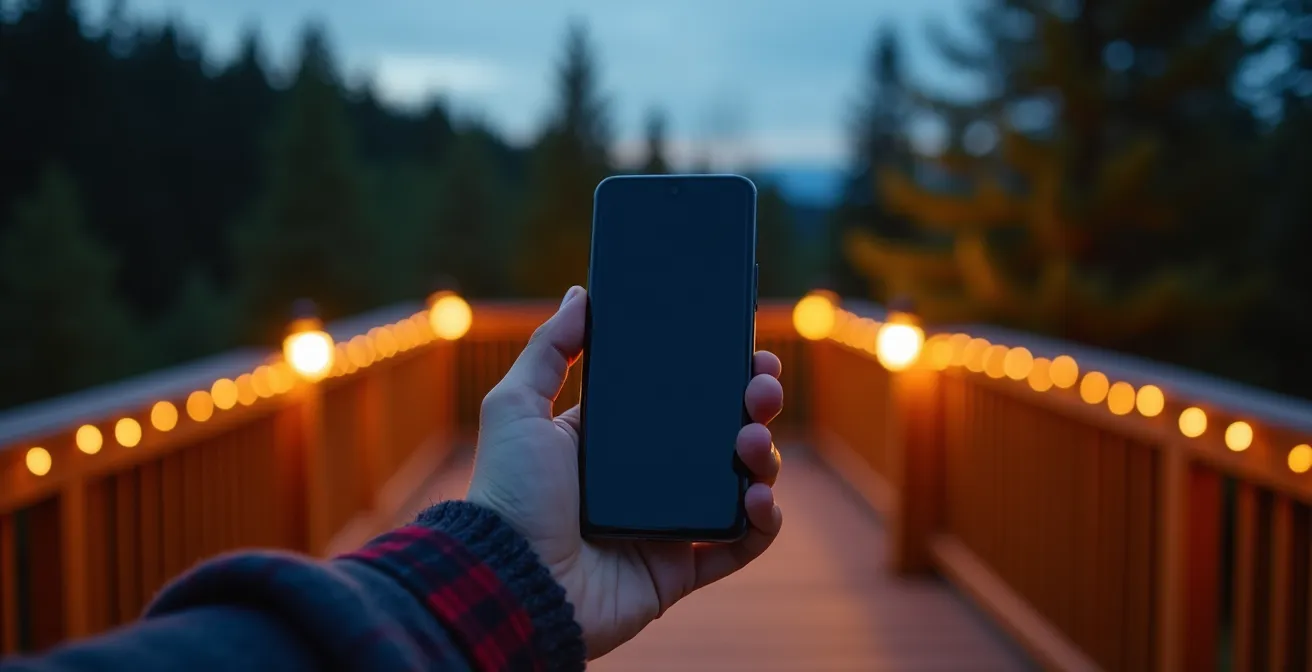
This hand adjusting the terrace ambiance from a sofa perfectly illustrates the fusion between cutting-edge technology and ease of use. A modern 12V system is not just powerful and reliable; it is also intelligent and intuitive, giving you the power to redesign your nocturnal environment with a simple gesture.
The lighting error that makes your outdoor stairs dangerous at night
Lighting outdoor stairs is a safety issue before it is an aesthetic one. A single design error can transform a daily passage into a high-risk zone, especially in the Canadian context. The worst mistake is glare. Placing a powerful spotlight at the top or bottom of the steps, directed toward the person going up or down, is counterproductive. It creates a violent contrast that momentarily blinds, preventing one from clearly distinguishing the edges of the steps. This is particularly dangerous in winter, where black ice can make an already dark surface even more treacherous.
In Quebec, winter safety is not an option. With an average of 80 days of frost per year with ice formation, according to climate data, ineffective stair lighting is an invitation to an accident. The solution lies in indirect, non-glaring lighting. The 12V system excels in this area by allowing the installation of discreet and perfectly integrated solutions. The safest and most elegant technique is to recess small LEDs under the nosing of each riser. The light is thus directed downward, perfectly illuminating the surface of the step without ever hitting the eyes.
Other professional solutions include integrating LED strips directly into handrails for continuous light guidance, or positioning lateral spotlights very low (30 cm from the ground) oriented at 45° toward the steps. These approaches, impossible to achieve with bulky and poorly aimed solar lamps, ensure perfect visibility of potential obstacles like black ice. This is a perfect example of how investing in a hardwired system translates directly into increased safety for you and your guests.
Key Takeaways
- Absolute Reliability: A 12V hardwired system offers constant performance, independent of weather or season, which is crucial during Quebec winters.
- Creative Freedom: Wiring allows for precise positioning of fixtures for architectural lighting techniques (grazing, silhouetting) impossible with solar.
- Sustainable Investment: Despite a higher initial cost, the longevity, performance, and low maintenance costs of 12V make it a more economical solution over 10 years than high-quality solar.
How to light the path to the fire pit without killing the ambiance of the flames
The fire pit is the sanctuary of intimacy and conviviality. Its main appeal lies in the magic of dancing flames and the starry sky. The most common mistake is overdoing it by installing path lighting that “pollutes” this atmosphere. Bollards that are too high, too powerful, or too numerous create light pollution that diminishes the contrast of the flames and erases the stars, ruining the intended effect. The goal is twofold: guide safely to the fire pit, then fade away to let the fire take center stage.
The key is subtlety, a quality that the 12V system, with its dimming options and specialized fixtures, allows you to master perfectly. The best approach is “pools of light.” Use low bollards (pathlights) 30 to 40 cm high, equipped with shades that direct 100% of the light toward the ground. Spaced 2 to 3 meters apart, they create discreet circles of light on the path, just enough to see where you are stepping, without illuminating the surrounding landscape. A cottage in the Laurentians perfectly applied this technique, thus preserving a breathtaking view of the Milky Way while securing access to its fire pit.
Intelligent intensity control (dimming) is essential here. Thanks to a mobile app, you can program scenarios that adapt to the time of evening. The following table illustrates how a simple intensity adjustment transforms the experience.
| Moment | Path Intensity | Perimeter Intensity | Desired Effect |
|---|---|---|---|
| Guest Arrival | 80% | 60% | Safe guidance |
| Fire Lit | 30% | 15% | Intimate ambiance |
| End of Evening | 15% | 5% | Minimal safety |
This dynamic management of ambiance is the ultimate luxury that a 12V system allows. It ensures that technology serves the human experience, and not the other way around.
Is solar lighting effective in Quebec winters or a waste of money?
This is the decisive question that closes the debate for any demanding Quebec homeowner. On paper, solar is attractive. In the reality of a Canadian winter, it turns out to be, for a high-end project, a waste of money and a source of frustration. The performance of a solar lamp depends directly on the amount of sunlight received, a factor that becomes critical from November to March. Indeed, official climate data reveals that Quebec City only benefits from an average of 2.5 hours of sunlight per day in December.
Added to this are aggravating factors: the low angle of the sun decreases charging efficiency, and the solar panel is often covered with frost or snow, reducing its production to almost nothing. An Hydro-Québec fact sheet is definitive: in winter, it is not uncommon for solar production to be only 5 to 10% of the panels’ rated power. In practice, this means that a solar lamp promising 8 hours of autonomy in summer will struggle to stay lit for more than an hour or two on a January evening, and often with a weak light intensity.
In January in Quebec, with less than 9 hours of daylight and a panel often covered in snow or frost, a solar lamp does not even receive 20% of the energy needed for a full night of lighting.
– Hydro-Québec, Technical Fact Sheet on Solar Photovoltaic Energy 2021
Beyond performance, the long-term economic calculation also favors 12V. A comparative analysis over 10 years is enlightening: a quality 12V system costs about $2500 at installation, with minimal maintenance, for a total cost close to $2800. An equivalent solar system in terms of light points (using quality lamps, not gadgets) will cost about $1500 to purchase, but you will need at least three battery replacements ($900) and one complete replacement of the units ($1500) over the decade, for a total of $3900. This is a savings of over $1000 in favor of 12V, without even accounting for superior performance and satisfaction. High-quality solar lighting has its place in specific contexts and mild climates, but to guarantee an impeccable nocturnal signature year-round in Quebec, investing in a 12V hardwired system is not a choice; it is obvious.
To transform your property with lighting that combines design, performance, and reliability, the next step is to move from theory to practice by defining a personalized lighting plan. Evaluate now the most suitable solution for your architecture and your aesthetic ambitions.