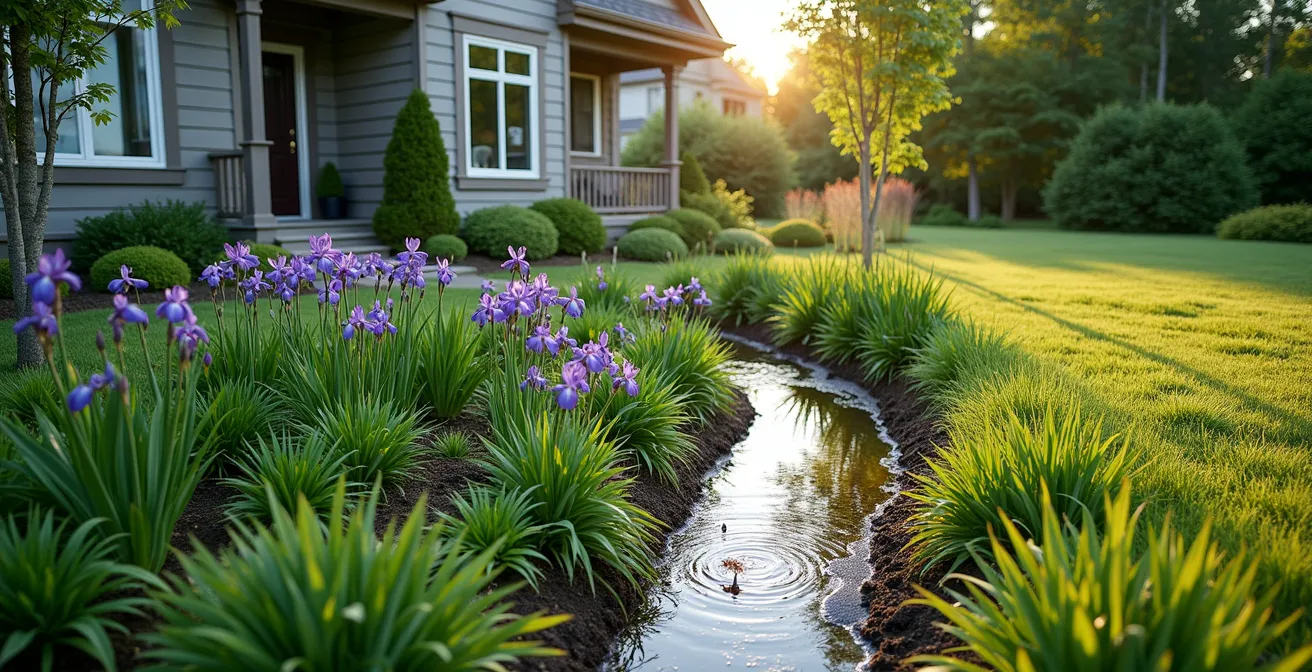
A rain garden is more than just a simple floral arrangement; it is a living infrastructure that solves drainage problems while creating a beneficial ecosystem for your property and your community.
- It uses specific native plants not only to absorb but also to filter pollutants from runoff water.
- Its design is based on a precise calculation to effectively manage water from your roof and must ensure drainage in less than 48 hours to prevent mosquitoes.
Recommendation: First and foremost, assess your soil permeability and disconnect your gutters from municipal sewers (while respecting regulations) to redirect this precious resource toward your new ecological infrastructure.
With every heavy rain, it’s the same spectacle: a part of your yard turns into a marsh, the grass becomes saturated, and the water struggles to drain away. For many homeowners in Canada, managing excess rainwater is a recurring headache. Traditional solutions, such as installing a French drain or regrading the land, are often costly and complex. Many simply resign themselves to living with these soggy areas, hoping the sun returns quickly.
Yet, this abundant water, often perceived as a nuisance, is actually a precious resource. What if the real solution wasn’t trying to evacuate it at all costs, but rather welcoming and valuing it? This is where a radically different approach comes in: the rain garden. Far from being a simple flower bed, it is a true living infrastructure designed to intercept, retain, and filter runoff water. It is a landscape engineering solution that transforms a drainage problem into an ecological and even financial asset.
This article will guide you through the essential steps to design a rain garden that is not only beautiful but, above all, functional and high-performing. We will see which plants act as true natural treatment stations, how to size your garden so it is effective, how to make it profitable through existing aid, and how to avoid design errors that could turn it into a problem rather than a solution.
To navigate through this complete guide, here are the essential points we will cover. Each section will provide you with the technical and practical knowledge to make your project a success, in perfect harmony with the Canadian environment.
Summary: Creating Your Stormwater Management Infrastructure
- Blue Flag Iris and Joe-Pye Weed: Which plants drink the most water and filter pollutants?
- What surface area should your rain garden be to absorb all your roof water?
- Simple barrel or underground cistern: Is it profitable to store water for irrigation?
- The design error that turns your rain garden into a mosquito breeding ground
- Why and how to disconnect your gutters from the municipal sewer (legally)?
- Why extending your downspouts to 6 feet from the house is the most profitable (and cheapest) renovation?
- Which plants to choose for a dry slope that never holds moisture?
- Why replacing your lawn with native plants saves you 40 hours of maintenance per summer?
Blue Flag Iris and Joe-Pye Weed: Which plants drink the most water and filter pollutants?
Choosing plants for a rain garden goes far beyond simple aesthetics or moisture tolerance. The plants you choose are the true workers of your living infrastructure. Their mission is twofold: to absorb large quantities of water and, above all, to act as a biofiltration system, purifying the water before it reaches the water table. Not all plants are equal in this task. Certain Canadian native species are true champions in this field.
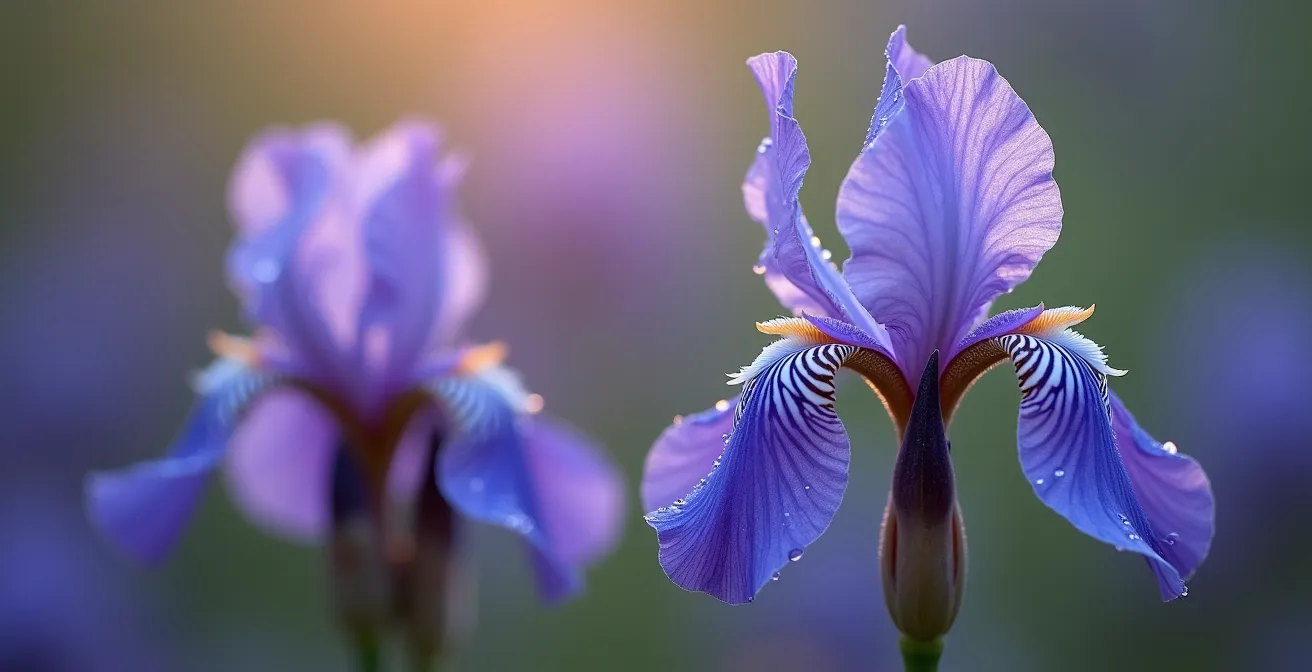
Joe-Pye weed and Blue Flag iris, for example, do more than just “drink” water. Their complex root systems create a network that improves soil structure while capturing sediments and contaminants. Research conducted at the University of Montreal even tested the filtering power of native plants like Joe-Pye weed. The study aimed to evaluate their ability toremove triclosan, a chemical contaminant present in many household products that ends up in runoff water.
To compose your garden, prioritize a combination of plants that work in synergy. Here is a selection of native species particularly suited to rain garden conditions in Canada:
- Blue Flag Iris (Iris versicolor): Ideal for the wettest and sunniest areas of the garden. Its robust roots stabilize the soil, and it even tolerates periods of drought once established.
- Joe-Pye Weed (Eutrochium/Eupatorium): Recognized for its filtering properties, it also attracts a wide variety of pollinators. It is a key plant for the performance and biodiversity of your layout.
- Serviceberry (Amelanchier): This shrub offers vertical structure, and its fruits are a food source for birds. It adapts well to the outer, drier zones of the rain garden.
- Pearly Everlasting (Anaphalis margaritacea): Perfect for attracting butterflies, it adds contrasting texture and color.
- Bloodroot (Sanguinaria canadensis): An excellent option for shadier parts of your garden, offering early spring flowering.
By choosing these species, you are not just creating a garden, but a resilient ecosystem that manages water while supporting local wildlife.
What surface area should your rain garden be to absorb all your roof water?
Designing a rain garden is not done at random. For it to function as a true water management infrastructure, its size must be precisely calculated based on the volume of water it will have to handle. Since the main source of water is your roof, the first step is to determine the amount of water flowing from your gutters during a downpour. This calculation is simpler than it seems and rests on two factors: your roof’s surface area and your soil type.
Generally, it is estimated that a rain garden should have a surface area of about 20% of the drainage area (the portion of your roof feeding the garden). For example, for a roof area of 50 m² (about 540 ft²), a garden of about 10 m² (108 ft²) is a good starting point. However, this figure must be adjusted based on soil permeability. Sandy soil, which drains quickly, allows for a smaller garden, while clay soil, which retains water, will require a larger surface area or soil amendment to improve drainage.
The effectiveness of a rain garden is remarkable. According to WWF-Canada, rain gardens can absorb 30% more water than a conventional lawn of the same size. This significantly reduces the volume of water flowing into municipal sewers. To refine your estimate of the water volume to manage, the type of roofing also matters, as not all surfaces have the same recovery yield.
This table, based on an analysis of loss coefficients, gives you an idea of the potentially recoverable water volume. It illustrates why sizing is a key step in the landscape engineering of your project.
| Roof Type | Loss Coefficient | Recoverable Volume (100m² at 1000mm/year) |
|---|---|---|
| Tiles | 0.9 | 90,000 L/year |
| Corrugated Roofing | 0.8 | 80,000 L/year |
| Flat Roof | 0.6 | 60,000 L/year |
By taking the time to properly calculate the surface area, you ensure that your garden will not overflow during heavy rains and will fulfill its function optimally.
Simple barrel or underground cistern: Is it profitable to store water for irrigation?
Beyond runoff management, a rain garden can be coupled with a recovery system to transform rainwater into a direct financial asset: free water for watering your vegetable garden, flower beds, and even for outdoor cleaning. The question of profitability then arises: should you invest in a simple barrel or a more expensive cistern? The answer depends on your needs and, above all, the incentives available in your municipality.
A simple rain barrel, with a typical capacity of 200 liters, is an inexpensive and easy-to-install solution. Over a summer, a barrel can recover up to 4,800 liters of water, a significant amount that can cover the watering needs of a small garden. The profitability of this investment is even faster because many municipalities in Quebec actively encourage this practice through subsidy programs.
For example:
- The borough of Saint-Laurent in Montreal offers a 50% subsidy (up to $100) for the purchase of barrels, with a bonus for products made in Quebec.
- The city of Laval offers a subsidy of up to $70 per barrel.
- Other municipalities like Mont-Tremblant or Sainte-Catherine have set up discounted distribution programs.
These financial aids make the purchase of a barrel almost immediately profitable. For larger needs, an underground cistern can store several thousand liters. Although the initial investment is much higher, it offers considerable water autonomy and increases your property value. Its profitability is calculated over the long term, taking into account savings on water bills and increased protection against summer watering restrictions. The decision therefore depends on the scale of your project and your ability to take advantage of local aid.
Before investing, systematically check with your municipality. You might be surprised at how much your investment for the planet can also benefit your wallet.
The design error that turns your rain garden into a mosquito breeding ground
The most widespread fear regarding rain gardens is that they will become a refuge for mosquitoes. This fear is legitimate: standing water is the ideal breeding ground for these insects. However, a well-designed rain garden is precisely the opposite of a swamp. The absolute key to avoiding this problem lies in one single rule: rapid drainage. The goal is not to create a pond, but a temporary infiltration zone.
An effective rain garden must be fully drained within a limited time. As highlighted by the columnist for Le Devoir, a successful design ensures that water must not stagnate there for more than two days. Since the mosquito reproduction cycle takes 7 to 10 days, drainage within 24 to 48 hours eliminates any risk of proliferation. If water stays longer, it is a sign of a fundamental design error, usually related to unsuitable soil.
The most common error is digging a rain garden in soil that is too clayey without amending it. Clay, being very compact, is virtually impermeable. Water accumulates on the surface and stays there, creating perfect conditions for mosquitoes. Before even picking up a shovel, it is therefore imperative to test your soil’s permeability. This is the most critical step of the entire project.
Action Plan: Your Soil Permeability Test
- Dig a test hole: At the planned location for your garden, dig a hole about 30 cm (1 foot) deep and wide.
- Saturate the soil: Fill the hole with water and let it infiltrate completely. This first step serves to saturate the surrounding soil, simulating post-rain conditions.
- Measure infiltration: Fill the hole with water again and place a ruler or stick to measure the water height.
- Observe and time: Measure how long it takes for the water level to drop. Good soil for a rain garden should see the level drop by at least 1.5 cm per hour. If drainage is slower, your soil is too clayey.
- Plan the amendment: If the test fails, you will need to replace part of the soil with a more draining mix (typically 1/3 compost, 1/3 sand, and 1/3 original soil) to ensure the success of your infrastructure.
By respecting this principle of rapid drainage, your rain garden will not only be an effective ecological solution but also a healthy layout without nuisances.
Why and how to disconnect your gutters from the municipal sewer (legally)?
One of the most impactful actions for the effectiveness of your rain garden is the strategic disconnection of your downspouts from the municipal storm sewer network. In many constructions, roof water is directly channeled into this network. By redirecting it to your land, you transform “waste” into a resource and relieve collective infrastructure that is often overloaded.
Why is this so important? As Sabine Vanderlinden from the Yamaska Watershed Organization (OBV) points out, “climate change will bring us more and more episodes of intense rain, and parallelly, urbanization is increasing impermeable surfaces.”
Climate change will bring us more and more episodes of intense rain, and parallelly, urbanization is increasing impermeable surfaces.
– Sabine Vanderlinden, OBV Yamaska
Every new built or asphalted surface prevents water from infiltrating, increasing the volume of water rushing into sewers. During torrential rains, these networks can overflow, causing floods and discharging untreated water into waterways. A rain garden acts like a giant sponge on your property’s scale. The impact is significant: a study conducted in Burnsville, Minnesota, demonstrated that such an installation could lead to a 90% reduction in runoff volume.

How to proceed legally? Disconnection is simple: it involves sawing the downspout about 30 cm from the ground, capping the part leading to the sewer, and adding an elbow and extension to direct the water toward your garden. However, it is imperative to check your municipality’s regulations. Some cities encourage this practice, while others may have specific requirements, particularly regarding distance from foundations or neighboring properties. A simple call to the urban planning department will confirm the procedure to follow.
By disconnecting your gutters, you become a key player in your neighborhood’s resilience against climate hazards.
Why extending your downspouts to 6 feet from the house is the most profitable (and cheapest) renovation?
Whether you have a rain garden or not, there is a golden rule for stormwater management: keep water away from your foundations. A simple downspout extension, costing a few dozen dollars, can save you thousands of dollars in repairs for cracks, basement water infiltration, and humidity problems. It is undoubtedly the renovation with the highest cost/benefit ratio you can undertake.
When rainwater flows directly at the foot of the house, it saturates the soil against the basement walls. In winter, this water freezes and creates immense pressure on the concrete (hydrostatic pressure), favoring the appearance of cracks. In summer, it can seep in and cause mold. The solution is simple: ensure the water is directed far enough away. The City of Montreal, in its recommendations for barrel installation, specifies that the overflow must be channeled at least 1.5 m from foundations, which is about 5 feet. A distance of 6 feet (nearly 2 meters) is an ideal safety margin.
The profitability of this action is not just individual. On a collective scale, poor runoff management has a huge cost. Quebec municipalities must maintain often century-old water systems. As an analysis by EcoTime highlights, pipe breaks, often aggravated by soil saturation, “lead to costly emergency interventions mobilizing entire teams.” By managing water on your own land, you help reduce pressure on this aging infrastructure.
Installation is within everyone’s reach: just buy a downspout extension (flexible or rigid) and attach it to your existing gutter to direct water toward a permeable area of your yard, such as a flower bed, a gently sloping lawn, or ideally, a rain garden. It’s a small gesture that protects a major investment: your home.
Think of it as the cheapest and most effective insurance policy for the long-term health of your building.
Which plants to choose for a dry slope that never holds moisture?
Expertise in water management on a property is not limited to wet areas. Knowing how to landscape the driest zones, like a slope in full sun where water just passes through, is just as important. These difficult spaces, often neglected or covered in yellowed grass, can become biodiversity gems with the right plants: xerophytic species, champions of drought resistance.
The secret is to choose native plants adapted to these extreme conditions. Rather than fighting nature by constant watering, we work with it. These plants have developed deep roots to seek moisture far underground or foliage adapted to minimize evaporation. The result is a nearly maintenance-free landscape that thrives where everything else fails. Here are some Canadian native plant suggestions perfect for a dry slope:
- Black-Eyed Susan (Rudbeckia hirta): With its yellow flowers and black center, this “orange daisy” is a sure bet that blooms all summer and reseeds easily.
- Pearly Everlasting (Anaphalis margaritacea): Its white flowers with a paper-like texture are not only beautiful but also hold up very well in dried bouquets.
- Goldenrod (Solidago): Although it can be invasive if poorly chosen, some horticultural varieties are more behaved and offer a yellow explosion late in the season, attracting a host of pollinators.
- Yarrow (Achillea millefolium) and Creeping Thyme (Thymus serpyllum): These groundcovers are extremely resistant to foot traffic and drought, forming a dense carpet that chokes out weeds.
A critical criterion when choosing your plants, whether for dry or wet soil, is the hardiness zone. This system classifies regions based on their minimum winter temperature. It is crucial to choose species adapted to yours, for example, zones 3-4 in the Laurentians, to ensure their survival from year to year.
By adopting this approach, even the most ungrateful corner of your yard can become a vibrant, resilient space full of life.
Key Takeaways
- A rain garden is an infrastructure: its design must be based on roof surface area and soil nature, not aesthetics alone.
- The key to success is rapid drainage: water must infiltrate in less than 48 hours to prevent mosquito proliferation. A soil test is mandatory.
- Native plants are workers: they don’t just absorb water, they filter it of pollutants through their complex root systems (biofiltration).
Why replacing your lawn with native plants saves you 40 hours of maintenance per summer?
A lawn is a true monoculture that demands a colossal investment in time and resources: weekly mowing, watering, fertilization, weed control… It is estimated that an average homeowner spends about 40 hours per summer maintaining their lawn. By replacing all or part of this green carpet with native plants, whether in a rain garden or a dry flower bed, you are not just creating an ecosystem; you are giving yourself the most precious luxury: time.
Native plants, once established, are almost autonomous. Adapted to the local climate, soil, and rainfall, they need neither additional watering (except in cases of extreme drought) nor fertilizer. Their density and vigor naturally limit the growth of unwanted weeds. Companies like Horticultures Indigo have understood this well by offering groundcover collections like Indigo Eco-lawn. This mix of creeping species creates a diversified plant carpet that resists drought and pests without ever needing mowing.
Adopting this type of gardening also means changing philosophy. We stop trying to dominate nature and instead collaborate with it. It means accepting a slightly “wilder” look, but one that is infinitely more alive. As Espace pour la vie wisely reminds us, this transition requires one essential quality.
This type of gardening also allows for cultivating… patience, because plants and animals will not settle there overnight.
– Espace pour la vie, Basic Principles of Ecological Gardening
The initial investment in planning and planting turns into a lasting gain of time for years to come. You spend less time behind a mower and more time observing the bees, butterflies, and birds that have made your garden their home.
To put these tips into practice, the next step is simple: start by observing your yard, identify the most suitable area for a rain garden, and perform your soil test. This is the first concrete step toward transforming your property into a haven of biodiversity and tranquility.