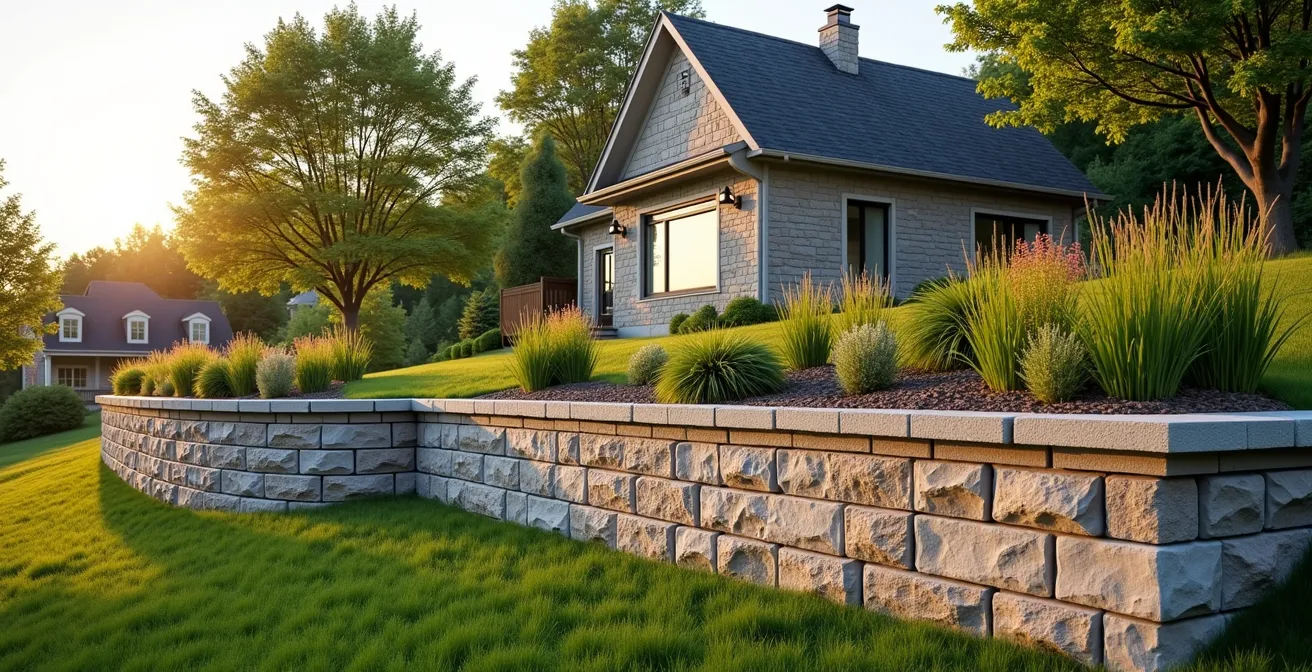
Building a retaining wall in Quebec is less a masonry project than a battle against the physics of the northern climate.
- The absence of a foundation below the frost line guarantees shifting and structural failure.
- Inadequate drainage transforms the soil into a hydraulic force capable of shattering concrete.
Recommendation: For any wall over 1.2 meters (4 feet) or one holding a critical load, hiring an engineer is not an option, but a legal and safety obligation dictated by the Ordre des ingénieurs du Québec.
Considering the construction of a retaining wall on one’s property is a common step for any homeowner in Canada wishing to optimize their space, correct a slope, or create aesthetic tiers. Spontaneously, the project seems to fall under landscaping or masonry: we choose pretty blocks, think about plant arrangements, and imagine the final result. However, this approach overlooks the essential, invisible, and implacable enemy that dictates the rules in Quebec: the freeze-thaw cycle.
Usual advice often focuses on the choice of materials or installation techniques. But the real question is not whether one block is more beautiful than another. The key is understanding the colossal forces that water-saturated soil and frost exert on your structure. To ignore this physical reality is to build a structure whose lifespan will be counted in seasons, not decades. The question is no longer “how do I build my wall?” but “how do I build a wall that will not collapse under pressure?”
This article adopts the perspective of a structural safety engineer. We aren’t just going to list steps; we are going to dissect the physics that makes each step non-negotiable. From the foundation that must counter soil heaving to the management of hydraulic thrust, you will understand why a retaining wall is primarily a civil engineering work, and at what precise moment an engineer’s expertise becomes an absolute necessity to guarantee the safety, compliance, and longevity of your investment.
To navigate through the critical aspects of your project, this article is structured to guide you from physical foundations to aesthetic and legal considerations. Explore the sections below to build on solid ground.
Summary: Building a Durable Retaining Wall in Quebec
- Why a wall without a compacted gravel foundation will collapse at the first thaw
- The mistake of omitting a drain behind the wall that turns earth into fatal hydraulic thrust
- Gabions, concrete blocks, or wood: which solution is the most durable for a 4-foot wall?
- Why must the wall lean backward during construction?
- How to plant in a retaining wall to soften the “concrete” look?
- How to prepare the foundation soil to prevent any movement for 20 years?
- Riprap or geotextile: which technique prevents your new slope from sliding onto the neighbor’s property?
- How to modernize the exterior of an 80s bungalow to “fit” with contemporary landscaping?
Why a wall without a compacted gravel foundation will collapse at the first thaw?
The most fundamental mistake in building a retaining wall in a northern climate is underestimating the power of the soil itself. In winter, the water present in the earth freezes and expands. This phenomenon creates ice lenses that exert a phenomenal vertical force, capable of lifting tons: this is known as frost heave. A wall built directly on the surface soil, without an adequate foundation, is a guaranteed victim of this process. At the first thaw, the soil retracts unevenly, leaving the wall without stable support. It cracks, tilts, and eventually collapses.
The only way to counter this force is to build the base of the wall (the footing) below the “frost line.” This is the maximum depth to which the soil freezes in your region. In Quebec, this depth is far from negligible. Winter measurements can reveal a recorded frost depth of 2.35 meters in downtown Montreal, demonstrating the scale of the phenomenon. Building above this line exposes the foundation to cycles of heaving and settling that destroy the structure.
A compacted gravel foundation plays a dual crucial role. First, 0-¾” gravel (MG-20) is a material that does not retain water, thus preventing the formation of ice lenses directly under the footing. Second, compaction in successive layers creates a solid, dense, and stable base that distributes the wall’s load uniformly and resists minor movements of the surrounding soil. Omitting this step is like building a house on quicksand: failure is not a possibility, but a certainty.
The mistake of omitting a drain behind the wall that turns earth into fatal hydraulic thrust
If frost is the vertical enemy, water is the horizontal enemy. A retaining wall does not just hold back soil; it also holds back all the water that soil contains or receives (rain, snowmelt). Without an efficient drainage system, the soil behind the wall becomes saturated with water. This accumulation transforms simple earth pressure into hydrostatic pressure, an immensely more powerful and destructive force. It is the same principle that exerts pressure on the walls of a dam. A wall designed to hold 10 tons of dry soil can easily face a pressure of 20 or 30 tons once the soil is waterlogged.
Installing a drainage system is therefore not an option, but a structural component of the wall. This system must capture the water and evacuate it away from the structure before it can build up pressure.
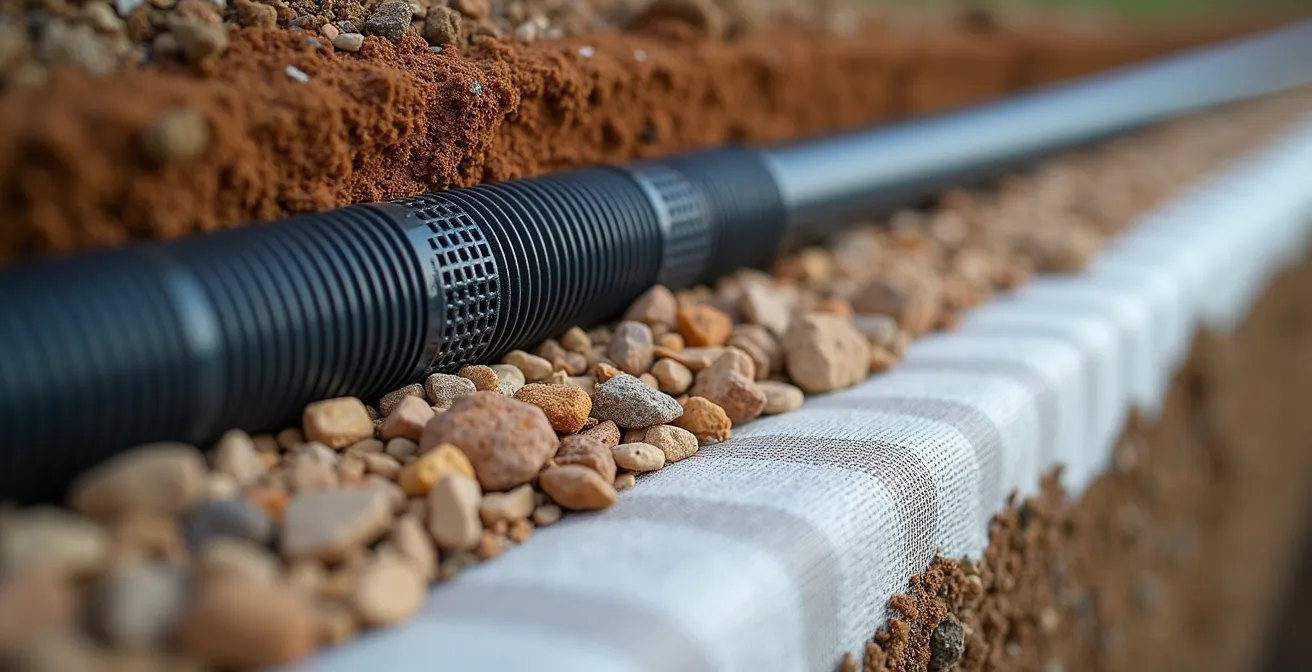
As shown in this technical diagram, a high-performance drainage system, especially in Quebec, consists of several key elements. The installation of a perforated French drain at the base of the wall, wrapped in clean gravel and protected by a geotextile membrane, is crucial. The geotextile prevents soil and sediment from clogging the drain, ensuring its long-term functionality. This precaution is particularly vital during the spring thaw, where a colossal volume of water is released in a short time. Without this system, water accumulates, hydraulic pressure reaches its peak, and the wall cracks, bulges, or collapses.
Gabions, concrete blocks, or wood: which solution is the most durable for a 4-foot wall?
For a wall of moderate height (about 1.2 meters or 4 feet), the choice of material has a direct impact on durability, maintenance, and budget, especially facing harsh Canadian winters. While aesthetics is a personal factor, technical performance against the freeze-thaw cycle is an objective criterion. The cost of a retaining wall project can vary considerably, generally ranging between $20 to $160 per square foot, including labor, depending on materials and complexity.
Here is an objective comparison of the most common options for the Quebec context, to make an engineer’s choice.
| Material | Cost in Quebec (sq. ft.) | Lifespan | Freeze/Thaw Resistance |
|---|---|---|---|
| Concrete Blocks | $20-$50 | 50+ years | Excellent |
| Gabions | $25-$40 | 75+ years | Excellent (self-draining) |
| Treated Wood | $15-$30 | 15-20 years | Medium (maintenance required) |
| Natural Stone | $40-$60 | 100+ years | Excellent |
Concrete blocks specifically designed for retaining walls are a very popular and reliable solution. Their uniformity facilitates installation and their engineering ensures excellent resistance. Gabions, those metal cages filled with stones, offer a solution that is both aesthetic and technically superior: their structure is inherently permeable, which almost completely eliminates the risk of hydrostatic pressure. Treated wood is the most economical option in the short term, but its lifespan is limited and it is more susceptible to rot in contact with moist soil. Finally, natural stone is the most durable and prestigious choice, but also the most expensive and demanding in terms of skilled labor.
Why must the wall lean backward during construction?
A perfectly vertical retaining wall is a wall working against itself. Earth pressure is exerted perpendicularly to the wall surface. On a vertical wall, all this force pushes directly outward, seeking to tip it over. To counter this force more intelligently, engineers use a simple but highly effective technique: the tilt, or “batter.”
By leaning the wall slightly toward the slope it retains, the physics is modified to its advantage. Part of the weight of the retained earth now rests on the wall itself, contributing to its own stability. The weight of the structure and that of the backfill work together to resist the thrust. This is the principle of the “gravity wall,” which uses its own mass and that of the soil to ensure stability. This tilt allows the redirection of thrust forces downward into the foundation, rather than directly outward.
This tilt is not left to chance; it must respect precise ratios to be effective. According to Quebec construction standards, it is recommended to provide a minimum tilt of 1:10, which means a setback of 1 centimeter for every 10 centimeters of height. For a 1.20-meter (120 cm) wall, this represents a total setback of 12 cm between the base and the top. Many modern retaining block systems integrate this tilt directly into their design, with a locking system that ensures a constant setback at each row. To ignore this tilt is to give up a precious physical ally and subject your wall to much higher stresses than necessary.
How to plant in a retaining wall to soften the “concrete” look?
Once the structural solidity of your wall is ensured, the question of its aesthetic integration into the landscape arises. A wall of concrete blocks or gabions, although functional, can appear massive and austere. Vegetation is the best method to soften its appearance and blend it into the garden. Planting directly into the interstices of the wall or on its top allows for cascades of greenery and colors that break the monotony of the structure.
The choice of plants is critical. Living conditions on a retaining wall are extreme: full sun exposure, rapid drainage, little soil, and high temperature fluctuations. One must therefore opt for hardy, drought-resistant plants that require little maintenance. Alpine plants and creeping perennials are ideal candidates.

Sedums (or stonecrops), with their varied textures and ability to survive in difficult conditions, are perfect for colonizing cavities. Creeping thymes, wall bellflowers, or phlox subulata (moss phlox) will create magnificent colorful carpets. As highlighted in Mjardiner’s guide to resistant perennials, “succulent plants are in! We love them for their ease of maintenance and their high resistance to heat and drought.” During construction, plan for “planting pockets” by filling certain interstices with quality substrate rather than draining backfill. This will give your plants the best possible start to transform your engineering work into a lush vertical garden.
How to prepare the foundation soil to prevent any movement for 20 years?
The longevity of a retaining wall over several decades does not depend on its blocks, but on what happens underground, where no one sees it. A foundation preparation executed with engineering rigor is the only insurance against differential movements that, slowly but surely, doom a structure. The first non-negotiable step in Canada is to excavate below the frost line. In the Montreal area, for example, this means digging to a depth of between 1.2 and 1.8 meters.
Once the excavation is complete, the nature of the original soil must be evaluated. Clay soils, very common in the St. Lawrence Valley, are particularly problematic. They swell with humidity and contract when drying, creating constant ground movement. If you are on such soil, the intervention of an engineer to recommend a professional soil study is a wise investment that can prevent much more costly repairs. The width of the foundation is also crucial and must correspond to a fraction of the total wall height (generally between one-third and one-half) to ensure a stable bearing base.
The base itself must be built with stable and draining materials. Forget soil or sand. A layer of 0-¾” gravel (net gauge) of at least 30 cm (12 inches) is the minimum standard. It is not the total quantity of gravel that counts, but how it is placed: it must be mechanically compacted in successive layers not exceeding 15 cm (6 inches) in thickness. This methodical compaction ensures maximum density and eliminates air pockets, creating a monolithic and stable base that will not sag over time. This meticulous process is what distinguishes an amateur foundation from a professional foundation designed to last 20 years or more.
Your Action Plan for a Frost-Free Foundation
- Determine the local frost depth: Consult Environment Canada’s frost degree-day maps or your municipality’s standards to find the minimum depth required.
- Excavate to the correct depth: Systematically dig below the determined frost line (e.g., min. 1.2 m in Montreal, 1.8 m in Quebec City).
- Install the gravel layer: Lay a draining gravel footing with a minimum thickness of 30 cm under the base of your wall.
- Compact in layers: Use a vibrating plate to compact the gravel in successive layers of 15 cm maximum to achieve optimal density.
- Verify the seating: Ensure the first row of blocks is perfectly level. Any imperfection at the base will be amplified over the height of the wall.
Riprap or geotextile: which technique prevents your new slope from sliding onto the neighbor’s property?
When modifying a slope, responsibility does not stop at the property line. A landslide, even a minor one, can have serious consequences for your neighbor, engaging your legal liability. To stabilize a new slope or a significant embankment, two technical approaches are often considered: riprap and reinforcement by geotextile. Riprap is a form of gravity retaining wall where large rocks are arranged to hold back the earth. It is a robust and aesthetic solution, but it can be expensive.
The technique of reinforcement with geogrids (a type of structural geotextile) is a more modern engineering approach. Instead of simply holding back the earth from the front, it consists of creating a reinforced and coherent soil mass. Layers of geogrid are spread horizontally in the backfill at regular intervals and anchored into the wall face. The soil compacts through the openings in the grid, creating a composite block (soil + grid) that has much greater internal strength. This technique is commonly used in Canada for large structures because it allows for building higher walls with fewer materials.
It is precisely in this type of project that the question of the engineer becomes crucial and non-negotiable. A retaining wall is not a decorative low wall. As specified by the Ordre des ingénieurs du Québec:
Retaining walls are considered structures within the meaning of the Engineers Act, since they support a load.
– Ordre des ingénieurs du Québec, Publication on Retaining Walls
This definition has a direct implication: as soon as a wall exceeds a certain height (generally 1.2 meters or 4 feet) or holds back a critical load (such as a slope threatening the neighboring property, a driveway, or a house foundation), plans signed and sealed by an engineer who is a member of the OIQ are legally mandatory. The engineer will calculate the loads, determine the most appropriate technique (riprap, geogrids, reinforced concrete wall), and provide the specifications for a safe construction that complies with the Building Code.
Key Takeaways
- The foundation of any retaining wall in Canada must imperatively be built below the local frost line to prevent failure by heaving.
- A complete drainage system (drain, gravel, geotextile) behind the wall is as critical as the wall itself to counter hydrostatic thrust.
- For any wall over 1.2 m (4 feet) or holding a significant load, Quebec law requires the intervention of a structural engineer.
How to modernize the exterior of an 80s bungalow to “fit” with contemporary landscaping?
A retaining wall is not just a technical solution to a slope problem; it is a major architectural element that can radically transform a property’s appearance. For a typical 80s bungalow, often characterized by low and horizontal lines, contemporary landscaping with a well-thought-out retaining wall can create a spectacular transition and add considerable value to the home.
The goal is to break with the dated aesthetic and create clean, modern lines. For this, the choice of materials and the wall design are paramount. Forget small textured blocks and sinuous curves. The contemporary trend favors:
- The use of large-format smooth concrete blocks, in neutral shades like charcoal, light gray, or off-white.
- The creation of strong horizontal lines and well-defined tiers that visually lengthen the facade and create outdoor living spaces level with the house (patios, relaxation areas).
- The integration of linear LED lighting directly into the wall structure, under copings or in stair risers, for a dramatic and functional effect in the evening.
- Combining concrete with warm materials like local thermally modified wood for the house cladding or the construction of an adjacent deck.
By designing the retaining wall not as an isolated object but as an integral part of a global landscaping plan, you can use it to sculpt the terrain and create a dialogue between the house and the garden. The tiers created by the wall become terraces, raised planters, or soft transitions to a pool. This project then becomes an opportunity to completely rethink the exterior of your bungalow to anchor it in the 21st century, making the wall the backbone of your new landscape design.
Finally, building a retaining wall is a project where technical rigor takes precedence over any other consideration. Each step, from foundation preparation to water management, is a direct response to the forces of nature. Consulting an engineer is not a superfluous expense, but the assurance that your project will be safe, durable, and compliant with the laws that protect you. Evaluate the complexity of your project now and call upon the necessary expertise to build with confidence.