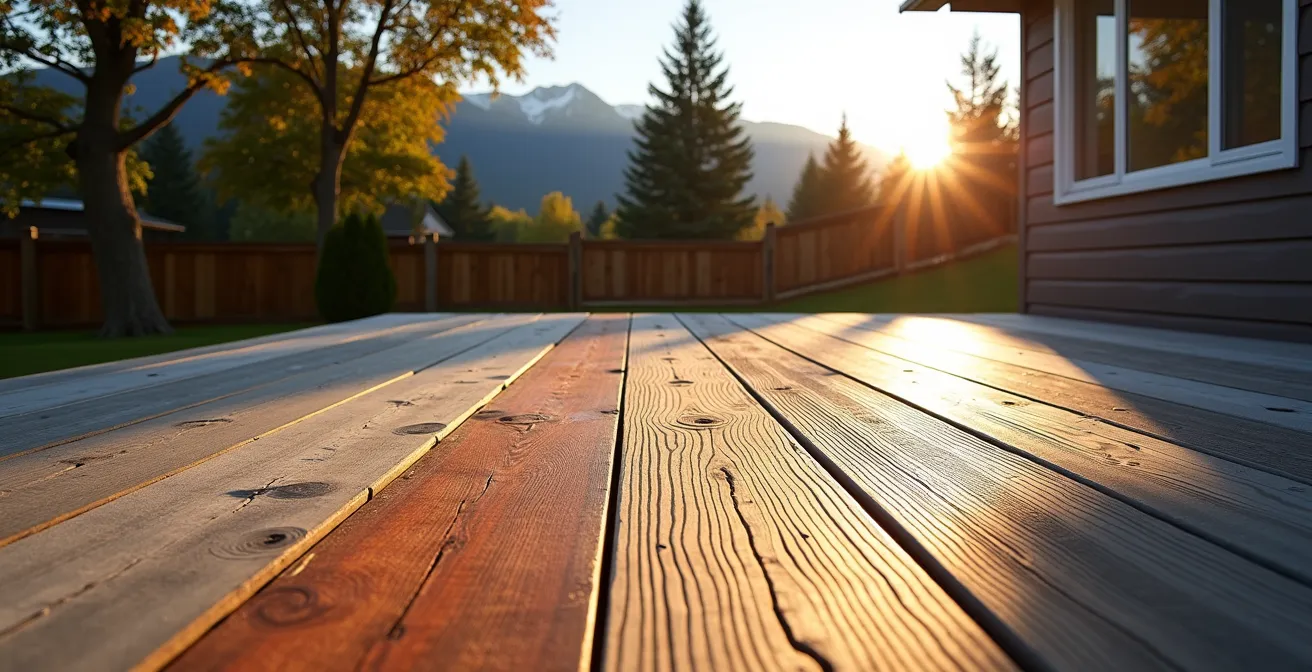
Contrary to popular belief, treated wood is not the most economical long-term option once all costs are integrated.
- The 20-year Total Cost of Ownership (TCO) of treated wood catches up to, or even exceeds, that of composite due to annual maintenance and replacement costs.
- Hidden costs, such as poor installation or disposal fees at recycling centers, transform the initial savings into a financial and environmental liability.
Recommendation: Before any purchase, perform a 20-year TCO calculation for your specific project; it is the only reliable indicator of your investment’s profitability.
When choosing a material for a new deck, Canadian consumers are often faced with an economic trade-off that seems simple: the low initial cost of treated wood versus the more significant investment of cedar or composite. This decision, generally motivated by the price per square foot displayed in stores, is based on an incomplete analysis. We compare the purchase price, vaguely mention the need to “stain the wood every two years,” but overlook a large part of the financial equation.
The discussion is often limited to surface advantages and disadvantages, without quantifying their real impact over a time horizon relevant to a homeowner. The real question is not which material is the cheapest today, but which represents the best investment over the life of the mortgage. What if the most significant cost wasn’t the purchase, but the invisible cost of degradation, time lost in maintenance, and end-of-life management?
This article proposes to move beyond this short-term vision. By adopting the rigor of a construction economist, we will break down the Total Cost of Ownership (TCO) of each option over 20 years. We will integrate not only maintenance but also hidden costs related to the Canadian climate, critical technical errors, and the environmental and financial liability represented by the disposal of these materials. The goal is to provide you with a complete financial analysis grid to transform your choice of deck into an informed and profitable investment decision.
To guide you through this in-depth analysis, this article breaks down the real cost calculation into several key factors. Each section addresses a facet of the investment, from the initial financial comparison to ecological impacts and alternative material choices, offering you a 360-degree view.
Summary: The Complete Economic Analysis of Your Future Deck
- Is composite wood really worth 3 times the price of treated wood in terms of longevity?
- Treated wood on-grade or above-grade: the purchase error that rots your posts in 5 years
- Which materials keep their black color without turning gray or whitening after 5 summers?
- What is the carbon footprint of an imported Ipe deck vs. local Larch?
- Can treated wood or composite be recycled when the deck is demolished?
- Why is local limestone more resistant than sandstone imported from Asia?
- How to recognize synthetic wicker that will crack in the sun from high-end resin?
- Natural stone or precast concrete: which frost-resistant material to choose for a 50-year lifespan?
Is composite wood really worth 3 times the price of treated wood in terms of longevity?
The initial financial trade-off between treated wood and composite often seems deterrent. At first glance, the numbers speak for themselves: a comparative analysis of deck costs in Canada places composite in a range of $63 to $92 per square foot, including installation, compared to only $30 to $50 for treated wood. This substantial difference pushes many homeowners to opt for the cheapest option, considering maintenance a minor inconvenience. However, this perspective ignores the fundamental economic concept of Total Cost of Ownership (TCO), which includes not only the purchase but also all expenses incurred during the product’s life.
To visualize this trade-off over the long term, it is essential to model expenditures over a 20-year horizon. The following table, based on Quebec market data, highlights a very different reality.
| Material | Initial Cost/sq. ft. | Lifespan | Annual Maintenance | 20-Year TCO |
|---|---|---|---|---|
| Treated Wood | $35-65 | 10-15 years | $200-400 | $14,000 |
| Cedar | $39-60 | 15-20 years | $150-300 | $16,000 |
| Composite | $63-92 | 25-30 years | $50-100 | $18,000 |
This calculation reveals that the gap narrows considerably. The TCO of treated wood, including a probable replacement after 10-15 years and annual maintenance costs (products, time, labor), brings it dangerously close to the cost of cedar. Composite, although more expensive initially, presents a much flatter cost curve thanks to its superior durability and near-zero maintenance. This projection is confirmed by field analysis: a case study on return on investment in Quebec demonstrates that a high-quality composite deck generates a value gain and cumulative cost savings of 15 to 20% over 25 years compared to wood, transforming the initial surcharge into a profitable investment.
Treated wood on-grade or above-grade: the purchase error that rots your posts in 5 years
One of the greatest financial risks associated with treated wood comes not from maintenance, but from a fundamental technical error during purchase: using wood unsuitable for ground contact. In Canada, treated wood products are classified according to precise standards from the Canadian Standards Association (CSA). Ignoring this classification can lead to premature rot of structural posts, a costly replacement, and the total cancellation of initial savings. A treated wood post designed for “above-ground” use (UC3.1) will begin to degrade in just a few years if buried, as its treatment is not deep enough to resist constant humidity and soil microorganisms.
The soil-air interface, that critical zone a few centimeters just above and below ground level, is particularly vulnerable. This is where oxygen, moisture, and pathogens combine to attack the wood. For posts and any structure in direct and permanent contact with the earth, it is imperative to use wood classified as UC4A (ground contact) or, ideally, UC4B (heavy duty/severe conditions). This choice ensures that the preservatives have penetrated deep into the wood, providing durable protection against rot.
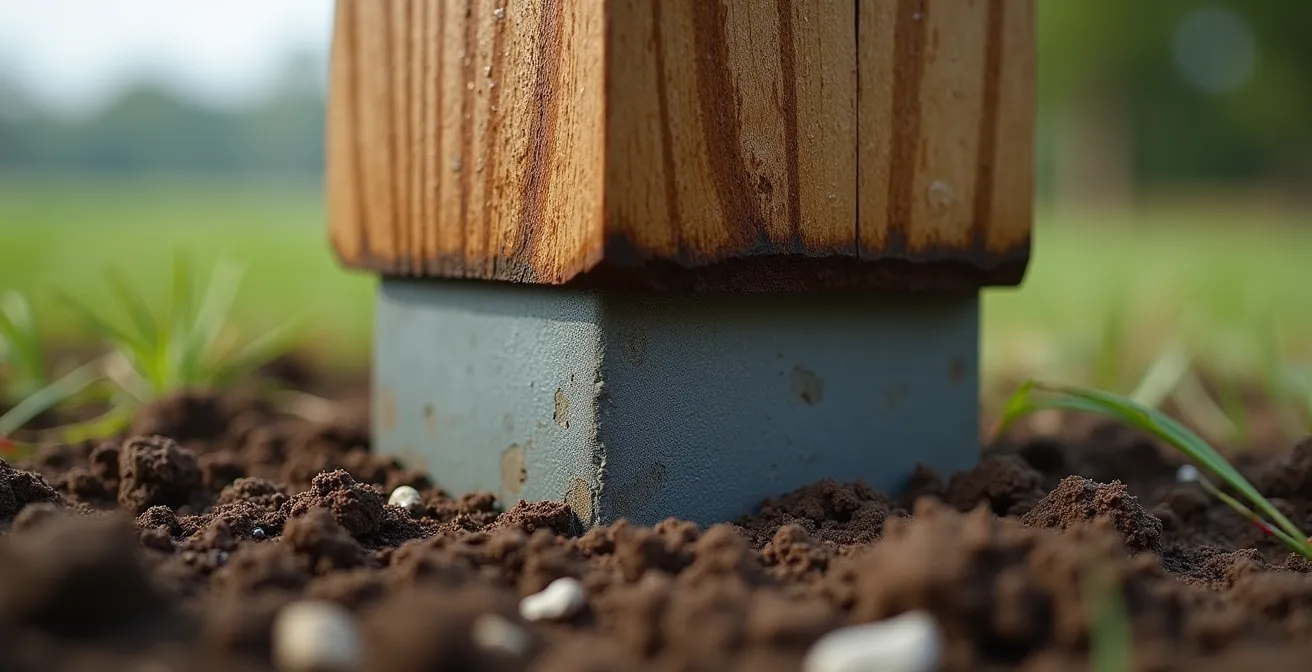
As shown in the image, protecting this transition zone is paramount. A material selection error at this stage is not a simple aesthetic defect; it is a construction defect that compromises the integrity and safety of the entire deck, transforming an economical project into a major repair site in less than 5 years. To avoid this financial liability, a rigorous material audit before purchase is indispensable.
Your Checklist for Buying Structural Treated Wood
- Identify the Use Code: Locate the tag on the wood and check the classification code (UC). Demand UC4A or UC4B for any post or structural piece coming into contact with the ground.
- Inspect the Cuts: If possible, examine a fresh cut of the wood. The treatment should be visible deep inside and not just on the surface.
- Demand the Right Treatment: For support posts, UC4B treatment to the core of the wood is the only guarantee of longevity. Do not compromise on this point.
- Treat Jobsite Cuts: Ensure that any new cuts made during construction are immediately sealed with a brush-on preservative to avoid exposing untreated wood.
- Install Physical Protection: For maximum durability, consider adding post protection sleeves at the soil-air interface. They create a physical barrier against moisture.
Which materials keep their black color without turning gray or whitening after 5 summers?
The depreciation of a deck is not only structural; it is also aesthetic. Loss of color, particularly visible on dark shades like black, is an indirect cost factor. A material that whitens or turns gray under the effect of UV rays and weathering decreases the perceived value of your outdoor landscaping and may require costly treatments to revive its hue. Wood, even treated and stained, is subject to this natural graying phenomenon. First-generation composites were as well. However, modern technologies have radically changed the game.
Current composite boards, known as “co-extruded” or “capped,” feature an external protective layer that acts as a shield. This high-performance polymer shell contains powerful UV inhibitors. Consequently, Canadian climate resistance tests confirm that composites with UV polymers retain their color for more than 25 years, with minimal, if not imperceptible, fading. A deep black will remain so, summer after summer.
Beyond UV rays, the choice of polymer is crucial for performance in the Canadian climate. As pointed out by a technical expert from EVODEK in the “2024 Composite Material Selection Guide”:
Virgin HDPE maintains its flexibility down to -40°C while PVC becomes brittle, an essential criterion for the Canadian winter.
– EVODEK Technical Expert, 2024 Composite Decking Selection Guide
This point is fundamental: a poor-quality resin (often based on PVC or low-grade recycled HDPE) can crack under the effect of freeze-thaw cycles. Choosing a composite based on virgin HDPE (high-density polyethylene) is therefore an investment in the stability of not only the color but also the material integrity of the board against the rigors of the Canadian winter. It is the assurance of a deck that does not visually depreciate over the seasons.
What is the carbon footprint of an imported Ipe deck vs. local Larch?
The economic analysis of a construction project can no longer ignore environmental and social externalities. The choice of material has repercussions that go far beyond your wallet and your property. Comparing an exotic wood like Ipe, renowned for its exceptional density and durability, to a local species like Larch (Tamarack), highlights a major economic and ecological trade-off. Ipe, while high-performing, carries a heavy carbon burden related to its transport. Indeed, life cycle analysis demonstrates that Ipe travels over 8,000 km from Brazil to Canada, generating 2.4 tonnes of CO2 per average-sized deck. This environmental cost, although not directly billed to the buyer, is a liability for the community.
Conversely, opting for a local species like Larch, from the Quebec boreal forest, transforms the project into an investment in the regional economy. Larch is naturally resistant to rot and insects, offering good durability without chemical treatment, which further reduces its ecological footprint. Its economic cost is then measured not only in dollars but also in jobs and vitality for local communities.
Case Study: Local Economic Impact of Quebec Larch
An economic impact analysis reveals that purchasing Larch from the Quebec boreal forest generates three times more local economic benefits than importing Ipe. Every 200 sq. ft. deck built with local Larch supports the equivalent of two weeks of employment in the forestry and processing sectors of rural Quebec communities, strengthening the local economic fabric instead of financing complex and opaque international supply chains.
From an economist’s perspective, the choice is clear. Local Larch has a much lower “social cost” and a much higher “local return.” The trade-off is therefore not just between two types of wood, but between two economic models: one globalized and high-carbon, the other local, sustainable, and beneficial for the home economy.
Can treated wood or composite be recycled when the deck is demolished?
The real cost of a deck does not end with its maintenance; it includes its demolition and disposal. This is the “end-of-life cost,” a liability often forgotten at the time of purchase. In Canada, the management of this construction waste is strictly regulated and comes at a price. Treated wood, because of the chemicals it contains (such as ACQ – alkaline copper quaternary), cannot be burned or composted. It is classified as construction waste and must be taken to an ecocentre (recycling center). Disposal fees vary, but expect to pay between $50 and $150 per tonne. For an average deck, this represents a significant cost added to the final balance.
What about composite wood? The situation is complex. Although some North American manufacturers like Trex or Fiberon integrate a high percentage of recycled materials into their new products, they do not currently offer structured post-consumer recovery programs in Canada. Consequently, an old composite deck usually ends up in the same place as treated wood: the landfill. The cost is therefore similar. According to Quebec ecocentre rates, landfill fees add $500 to $800 to the total cost of ownership of a treated wood or composite deck over 20 years.
The only option offering a positive “residual value” is non-treated natural wood, such as cedar. Once deconstructed, an old cedar deck can be repurposed. The boards, even if grayed, can be cleaned, sanded, and reused for secondary projects: planter boxes, garden fences, rustic outdoor furniture. This reuse not only avoids ecocentre fees but also saves between $200 and $500 on the purchase of new materials for these other projects. Cedar thus transforms from potential waste into a reusable asset.
Why is local limestone more resistant than sandstone imported from Asia?
When extending the analysis to paving materials, the same principle of adapting to the local context applies with even more force. The Canadian climate, with its intense freeze-thaw cycles, is a ruthless test of resistance for natural stone. A common mistake is choosing a stone for its aesthetics or attractive import price, without considering its geological composition and, above all, its porosity. Sandstone, particularly that imported from regions with milder climates like Asia, can prove to be a very poor investment in Quebec.
The mechanism of degradation is simple and implacable. A porous stone like certain types of sandstone absorbs rainwater. When temperatures drop below freezing, this water turns into ice. As it freezes, water increases its volume by about 9%, exerting enormous pressure inside the stone. This phenomenon, called “frost weathering” or “gélifraction,” creates micro-cracks. Repeated dozens of times each winter, this cycle weakens the structure of the stone until it shatters, peels (delamination), or crumbles. A porous sandstone patio can thus be ruined in just a few winters.
In contrast, Canadian limestones, such as those from Ontario (Wiarton, Eramosa) or Saint-Marc-des-Carrières limestone in Quebec, are sedimentary stones formed under conditions that made them much denser and less porous. Their low water absorption rate makes them intrinsically frost-resistant (ingélif). They have literally evolved to withstand our climate. Choosing a local limestone means investing in durability proven by geology and history, guaranteeing a terrace that will span decades without degrading.
How to recognize synthetic wicker that will crack in the sun from high-end resin?
For the outdoor furniture that completes the deck, the same investment logic applies. Synthetic wicker is a popular choice for its look and ease of maintenance, but there is a massive quality gap between entry-level products and high-end furniture. A cheap resin patio set may seem like a bargain, but it risks cracking, fading, and disintegrating after only two or three Canadian summers, becoming a liability to be replaced quickly.
The fundamental difference lies in the chemical composition of the resin fiber. High-quality resin is made from virgin high-density polyethylene (HDPE). This material is solution-dyed, meaning the color is uniform throughout the fiber, making it immune to scratches. More importantly, it is treated with superior quality UV inhibitors that protect it from degradation caused by the sun. It retains its flexibility and color for years. Conversely, low-end resin is often made of PVC or poor-quality recycled HDPE, with a simple layer of color on the surface and minimal UV protection. Under the summer sun, it hardens, becomes brittle, and eventually cracks, revealing the base color of the plastic underneath.
Three indicators help distinguish quality:
- Weave Density: A tight, dense, and even weave is a sign of quality. A loose and irregular weave is often used to save on material.
- Underlying Structure: The frame should be made of powder-coated aluminum. Aluminum is lightweight, sturdy, and does not rust. Steel structures, even if painted, will eventually rust when in contact with moisture, causing stains on your deck and weakening the piece of furniture.
- Manufacturer’s Warranty: A manufacturer offering a 5-year or longer warranty on fading and cracking of its resin is confident in its product’s quality. A one-year warranty is a red flag.
Key takeaways to remember
- Purchase price is a poor indicator; the 20-year Total Cost of Ownership (TCO) is the only reliable calculation for comparing deck materials.
- “Hidden costs” (technical errors, maintenance, disposal fees) can transform an initially economical material into a long-term financial burden.
- For the Canadian climate, the durability of a material (wood, stone, resin) depends more on its composition (density, UV treatment, use class) and its local origin than its price.
Natural stone or precast concrete: which frost-resistant material to choose for a 50-year lifespan?
For projects aiming for maximum durability spanning several decades, the choice often narrows down to local natural stone or high-end precast concrete products. Both options, when high quality and correctly installed, can offer a lifespan of 50 years or more, far exceeding that of wood or composite. The economic trade-off then shifts toward the initial investment, aesthetics, and very long-term residual value.
Paving experts confirm that excavation below the local frost line guarantees 80% of the total durability of the installation, regardless of the surface material. It is the foundation cost, often significant, that forms the basis of the investment. Once this foundation is secured, the choice of cladding becomes a matter of performance and added value.
To clarify this final trade-off, the following table puts the two materials into perspective based on key criteria for a very long-term investment.
| Criterion | Local Natural Stone (e.g., Limestone) | High-End Concrete Pavers (e.g., Techo-Bloc) |
|---|---|---|
| Aesthetics | Unique and timeless, every slab is different | Uniform, wide choice of modern colors and textures |
| Initial Cost (Material) | High to very high | Moderate to high |
| Resistance to De-icing Salt | Variable, some limestones are sensitive | Very high, designed for Canadian winters |
| Ease of Replacement | Difficult to find an identical slab | Easy, products are standardized |
| Resale Added Value | Very high, perceived as a luxury | High, perceived as modern and worry-free |
Natural stone represents a heritage investment, offering a unique character that improves over time. High-end concrete pavers are the pragmatic investment, offering consistent technical performance and great design flexibility. Both are excellent choices for the long term, provided the initial investment in an adequate foundation is made. The final choice will depend on the alignment between budget, the property’s architectural style, and the owner’s vision for their real estate asset.
Ultimately, choosing the material for your deck transcends the simple question of the displayed price. It is a long-term investment decision that must be guided by a rigorous analysis of the total cost of ownership. To apply this analysis grid to your project and obtain a precise estimate taking all factors into account, the next step is to consult a professional who can assess your specific needs and calculate the investment over the long term.