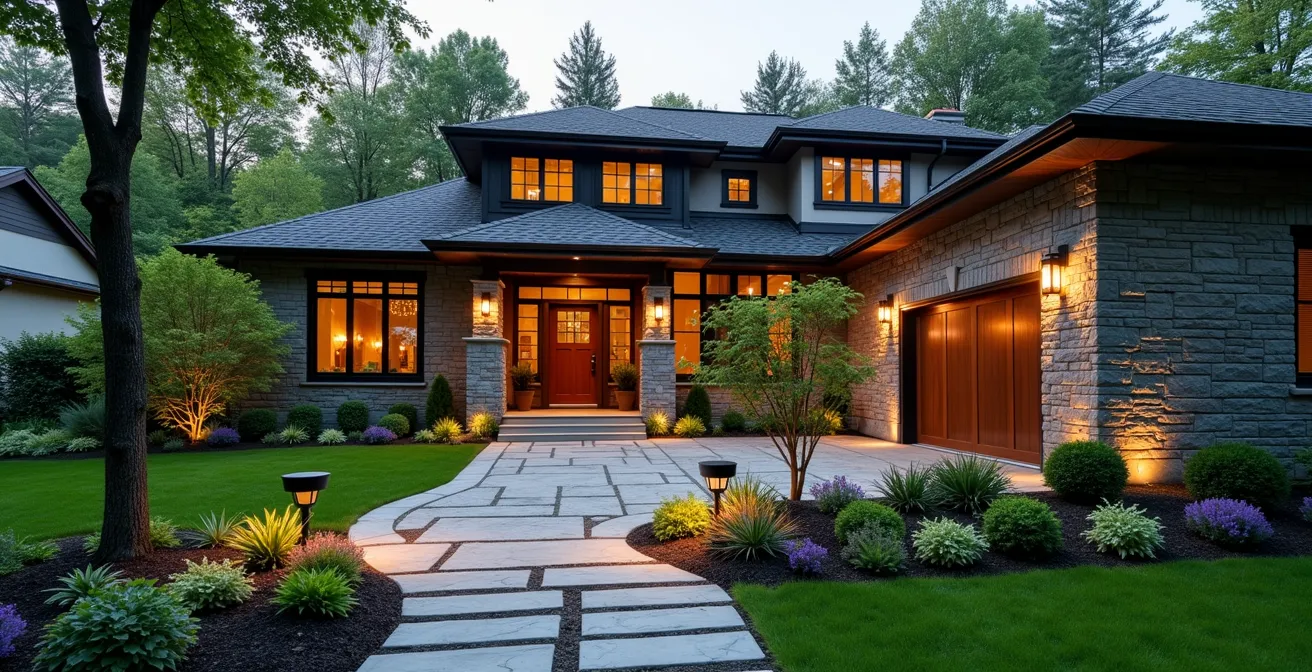
Contrary to popular belief, the best return on investment (ROI) for outdoor landscaping doesn’t come from the most expensive addition, but from removing the buyer’s doubts.
- Small investments (under $1,000) on the front facade have a disproportionate psychological impact, creating a perceived value up to 5 times higher.
- Major projects like a swimming pool or a paver driveway have a limited financial return (10-50%) and can even deter some buyers.
Recommendation: Prioritize creating an impeccable first impression and building a complete property file (invoices, permits, warranties) that justifies your price and reassures the buyer about long-term maintenance.
As a homeowner in Canada, you likely view the sale of your property not as an imminent event, but as a strategic horizon over 2, 3, or 5 years. The question then becomes: where should you invest outdoors to maximize added value? The common answer often focuses on aesthetics—the famous “curb appeal.” You’ll be advised to plant flowers, paint the door, or add a deck. This advice is valid, but it only scratches the surface of a rigorous financial analysis.
The mistake is considering landscaping as a simple decorative expense. A certified appraiser analyzes it as a portfolio of assets. Every element—a cedar hedge, an asphalt driveway, a drainage system—carries an acquisition cost, maintenance cost, depreciation rate, and, most importantly, an impact on market perceived value. Some assets, like an inground pool, can even become liabilities for a large segment of potential buyers, despite their high initial cost.
This article adopts the appraiser’s perspective. We aren’t just going to list “profitable” landscaping projects; we will dissect the *why* behind their yield. We will analyze buyer psychology when faced with a neglected entrance, the capital importance of a documented property file to justify a higher price, and the hidden costs that can turn a good project into a financial pit. Our goal is to provide you with an objective analysis grid to transform your outdoor spending into strategic investments that will pay off at resale.
This guide is structured to accompany you through this strategic reflection, analyzing each potential investment area. From quick wins to major projects, you will discover how each decision influences the final value of your real estate.
Summary: Evaluating the financial return of your outdoor landscaping
- Why investing $1,000 in front landscaping can increase perceived value by $5,000?
- Inground pools: why will you never recover 100% of the cost at resale?
- How a mature hedge can make the difference between a quick sale and a stagnating house?
- Redoing asphalt or pavers: is it necessary to sell or does the buyer not care?
- Why keeping invoices and plans for your landscaping reassures buyers and justifies the price?
- Which hidden costs cause landscaping budgets to explode by 20%?
- The final checklist for accepting the site before making the final payment
- Designing a coherent master plan to enhance property value
Why investing $1,000 in front landscaping can increase perceived value by $5,000?
The concept of “first impression” is a powerful psychological lever in real estate. A potential buyer forms an opinion about your property within the first few seconds, even before crossing the threshold. This initial perception, positive or negative, will color the entire visit. This is where small, targeted investments on the facade generate a disproportionate return. It’s not about structural renovations, but about signals that communicate care, maintenance, and quality. According to APCHQ data, a well-thought-out landscape can generate up to 75% of the work’s cost in ROI, and this effect is maximal on the most visible elements.
The goal is not to redo everything, but to correct visual “red flags” and add touches of modernity. An outdated house number, dim lighting, or neglected flower beds are details, but they project an image of negligence. By investing a modest sum, you aren’t just improving aesthetics; you are eliminating silent objections and creating a “wow factor” that makes the buyer less likely to negotiate the price aggressively.
For a budget under $1,000, it is entirely possible to radically transform this perception. Here are high-impact, immediate improvements:
- Install solar outdoor lighting along the walkway ($200 to $300) to create a welcoming and safe ambiance, especially for evening viewings.
- Replace the house number with a modern, highly legible design ($100 to $150) that catches the eye and eases identification.
- Add frost-resistant perennials to front flower beds ($400 to $500) to ensure year-round visual appeal with minimal maintenance—a key selling point in Canada.
These simple actions change the narrative of your home: it goes from a “fixer-upper” to a “move-in ready,” well-maintained home. It is this change in perception that justifies a higher sale price and accelerates the transaction.
Inground pool: why will you never recover 100% of its cost at resale?
The inground pool is the archetype of a “pleasure” feature often mistaken for a financial investment. While synonymous with unforgettable family moments, its analysis as a real estate asset reveals a more nuanced reality. From an appraiser’s point of view, a pool is a high-depreciation asset with a segmented market. Contrary to popular belief, Quebec experts estimate that a pool only returns 10% to 40% of its initial cost in ROI. A $60,000 project will, at best, only add $24,000 to your home’s value.
The main reason for this low yield is that a pool divides the customer base. For a young family with small children, it represents a major safety risk and a source of anxiety. For a retired couple, it is perceived as a costly and physical maintenance burden (opening, closing, water treatment, repairs). Thus, far from being a universal asset, it can actively deter a significant portion of potential buyers, reducing the pool of acquirers and lengthening the time on market.
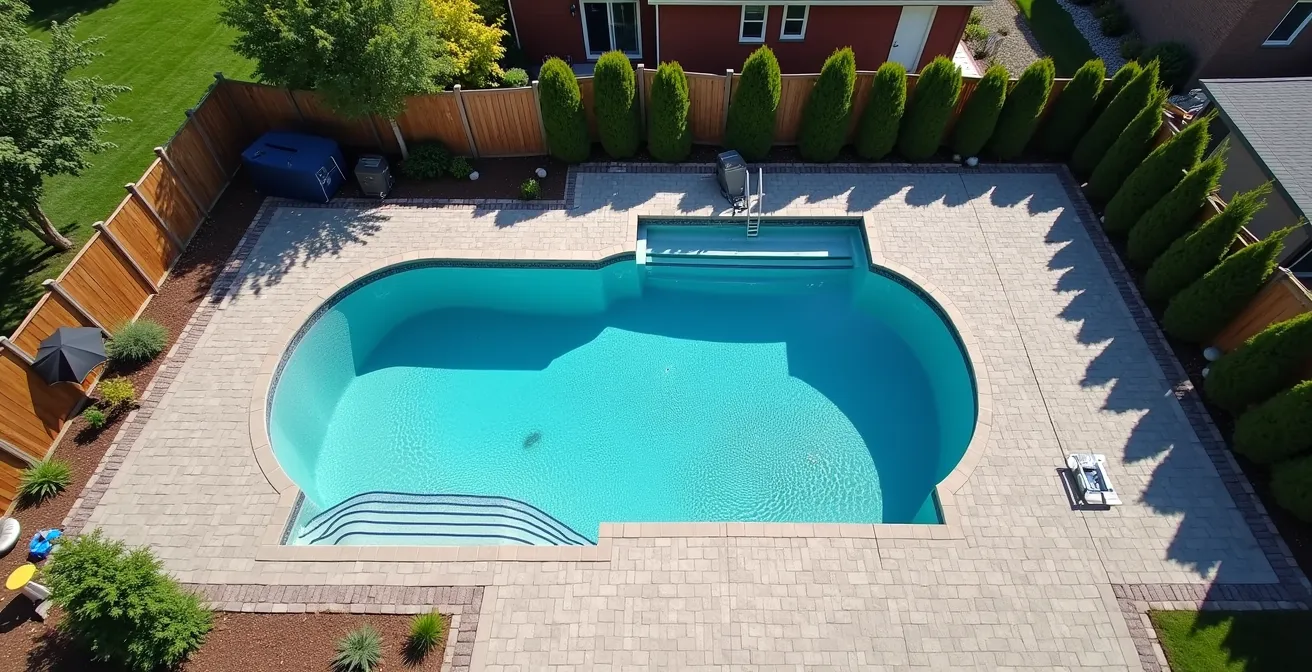
Geographical impact is also a determining factor in Canada. As analysts point out, ROI is directly linked to the length of the usage season. In Quebec or Manitoba, with a swimming season of three to four months, the perceived value is much lower than for a property in British Columbia. Potential buyers perform a simple calculation: is the annual maintenance cost (heating, chemicals, insurance) justified for such limited use? For many, the answer is no. Consequently, if you install a pool, do it for your personal enjoyment, without ever viewing it as a driver of real estate value.
How a mature hedge can make the difference between a quick sale and a house that stagnates?
Privacy is one of the most sought-after criteria for buyers, particularly in suburban areas where lots are close to one another. A mature cedar hedge isn’t just a decorative element; it’s a strategic asset that directly meets this fundamental need. Unlike a wood or PVC fence which offers an immediate but often sterile solution, a dense, well-maintained hedge creates a natural visual and sound barrier. It transforms a simple yard into a private oasis, a sales argument of considerable power.
The main advantage of a mature hedge lies in its perceived value, which grows over time. While a fence depreciates from the moment it is installed, a hedge appreciates. A young hedge costs less to buy, but an 8 or 10-foot hedge, which has required years of growth and maintenance, represents immediate and hard-to-replicate value for the new buyer. They are buying time and “turnkey” privacy, a luxury for which they are willing to pay a premium. This can translate into a faster sale and a better price, as the house stands out from competitors that only offer a view of the neighbors.
The choice between a hedge and a fence should be analyzed objectively, beyond simple aesthetic preference. The following table compares both options based on key financial and functional criteria.
| Criterion | Cedar Hedge | Modern Fence |
|---|---|---|
| Initial Cost | $15-$25 / linear foot | $40-$60 / linear foot |
| Annual Maintenance | $200-$400 | $50-$100 |
| Lifespan | 30+ years | 15-20 years |
| Privacy | Excellent (dense) | Variable |
| Perceived Value | Natural, classic | Modern, urban |
While the annual maintenance cost of a hedge is higher, its lifespan and the quality of privacy provided make it a more judicious long-term investment for property valuation. It is an element that reassures and projects the buyer into a peaceful use of their future outdoor space.
Refaire l’asphalte ou le pavé : est-ce nécessaire pour vendre ou l’acheteur s’en fiche ?
The driveway is more than just a functional surface; it is the buyer’s first physical interaction with your property. A cracked, sagging, or oil-stained driveway acts as a powerful “red flag.” In the buyer’s psychology, this state of degradation doesn’t just signal a future repair. It suggests a general lack of maintenance and prompts them to look for other hidden problems in the house. As Quebec real estate broker David Fournier-Laforest explains, in a buyer’s market, a neglected entrance can be enough for a visitor to move straight to the next property on their list.
The question is not so much whether the buyer “cares,” but what message the state of your driveway sends them. Investing in redoing this surface is not a luxury, but a defensive maneuver to preserve your property’s value. A new or freshly sealed surface communicates the exact opposite: a home that is cared for and maintained, where things are done correctly. This establishes a climate of trust from the start. In terms of yield, a concrete paver driveway offers a return of 25% to 50%, but its true value is in avoiding downward negotiations based on a visible and quantifiable defect.
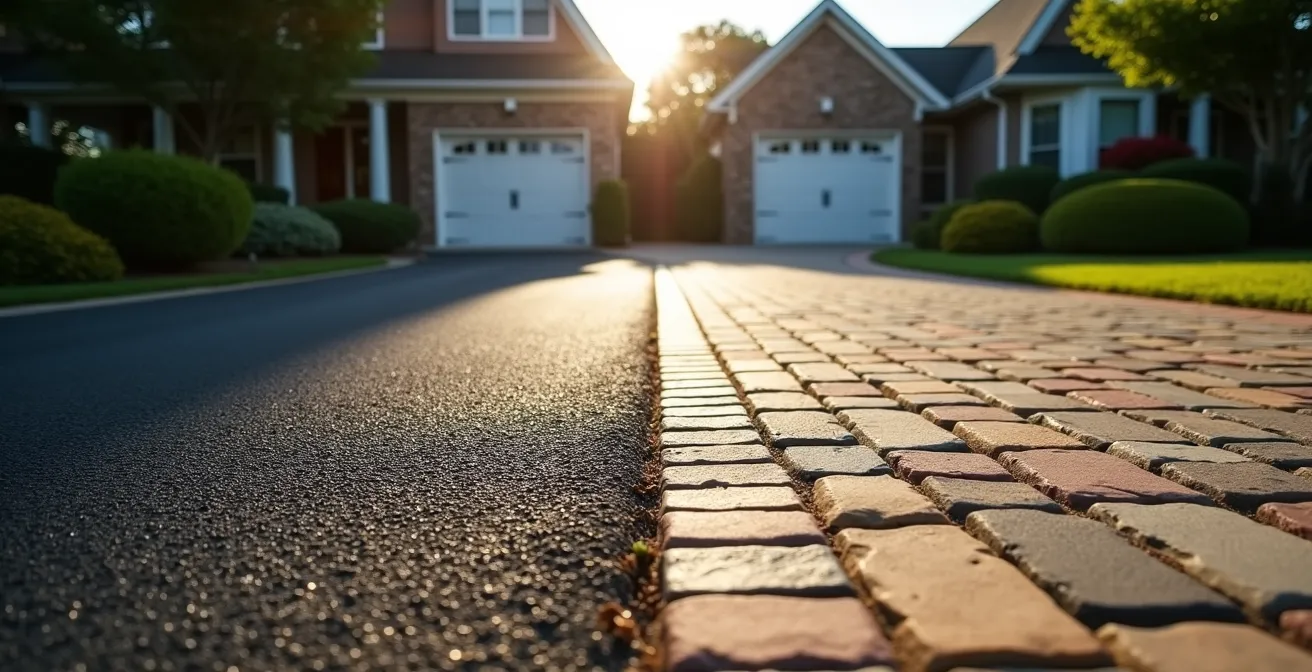
The choice between asphalt and pavers depends on the style of the house and the neighborhood. Asphalt, especially if freshly sealed, offers a clean look and lower installation cost. Pavers, while more expensive, offer a more high-end aesthetic and superior durability, which can be a strong argument for prestige properties. In any case, a simple repair of cracks and the application of a sealant on existing asphalt can be a low-cost, high-impact solution to neutralize this potential friction point before viewings.
Why keeping invoices and plans for your landscaping reassures buyers and justifies the price?
The value of landscaping does not reside solely in what is visible. It also lies in the proof of its quality and compliance. A savvy buyer, or their home inspector, will not just admire your patio; they will want to know how it was built, by whom, and if it meets standards. This is where the “property file” becomes a formidable tool for negotiation and price justification. Every invoice from a certified landscaper, every municipal permit obtained, and every drainage plan kept transforms a verbal claim (“it’s good work”) into tangible and verifiable proof.
This file has a dual psychological effect on the buyer. First, it reduces the perception of risk. Knowing that the drainage system was planned by professionals or that the pool was installed in compliance with municipal bylaws eliminates the fear of latent defects and unforeseen expenses. Second, it justifies a higher sale price. You are no longer just selling a house with a nice yard, but a house with landscaping whose quality is documented, whose materials may still be under warranty, and whose value is objectively demonstrable. As broker David Fournier-Laforest points out, although the numerical ROI of some improvements is modest, they may be necessary simply to successfully sell the house in a competitive market.
Building this file must be a rigorous discipline throughout the life of your projects. It’s not about finding old papers at the last minute, but building a history of the property.
Action Plan: Your Proof File for Outdoor Landscaping
- Permits and Compliance: Keep a copy of all municipal permits obtained for your work (patio, fence, pool, shed). This is irrefutable proof of the legal compliance of your installations.
- Proof of Professionalism: Meticulously archive detailed invoices from contractors, especially if they are members of recognized associations like APPQ in Quebec or Landscape Ontario.
- Technical Documentation: Document invisible but crucial work, such as plans for the drainage or irrigation system, ideally accompanied by photos taken before, during, and after the work.
- Transferable Warranties: Compile all warranties on materials (e.g., 25-year warranty on pavers, treated wood) or labor. This is direct added value for the future owner.
- Maintenance History: Keep invoices for professional maintenance (e.g., pruning of mature trees, pool opening/closing) to demonstrate rigorous and preventive follow-up.
Which hidden costs cause landscaping budgets to explode by 20%?
Planning a budget for landscaping based solely on the cost of materials and the initial quote is a frequent error that leads to bad surprises. An appraiser knows that the total cost of a project includes a series of ancillary fees and contingencies that can easily drive the bill up by 20% to 30%. Ignoring these hidden costs doesn’t just reduce your available budget; it can completely wipe out the expected ROI.
The first often underestimated expense item is taxes. In Quebec, for example, one must never forget that provincial and federal taxes add nearly 15% to the budget (GST 5% + QST 9.975%). On a $20,000 project, that represents $3,000 extra to plan for. Then come municipal permits, whose costs vary but are non-negotiable to ensure the legal compliance of your work.
However, the most unpredictable costs are often related to the nature of your land itself. An analysis of several projects in Quebec shows that site characteristics are a major factor in cost explosions. The following elements are common sources of additional spending:
- Topography: Steeply sloped or uneven ground requires leveling, earthwork, or the construction of retaining walls, which requires additional labor and machinery.
- Natural Obstacles: The presence of large rocks to be excavated or roots from mature trees to manage can considerably complicate and slow down the site.
- Soil Nature: Clay soil with poor drainage will require the installation of a more complex and expensive French drain system to avoid stagnant water problems.
- Site Access: In dense urban environments, traffic restrictions, lack of parking space for trucks, or the inability to use heavy machinery force slower and therefore more expensive manual solutions.
A good practice is to always provision a buffer of 15% to 20% of the total quote budget to cover these contingencies. This financial prudence is key to completing a project without compromising its quality or profitability.
Key Takeaways
- The value of landscaping lies more in its ability to reassure the buyer and project an image of maintenance than in its initial cost.
- Small investments (facade, lighting) have the best psychological impact-to-cost ratio, while large projects (pools) segment the market and can deter buyers.
- A documented property file (invoices, permits) is a more powerful negotiation tool than expensive but unproven landscaping.
The final checklist for accepting the site before making the final payment
The excitement of seeing a landscaping project finish can lead to a hasty approval. However, the final payment is your most powerful leverage to ensure the work is not only aesthetically pleasing but also technically compliant and durable. Performing a rigorous final inspection before releasing the final payment is a crucial step to protect your investment. This verification must be systematic and factual, based on contractual documents and approved plans.
This final inspection is not a confrontation, but a collaboration with the contractor to ensure everything is in order. It should be done during the day and, if possible, after rain to validate certain aspects like drainage. The key is to compare the final result with what was promised in the quote and plans. Any deviation must be noted, photographed, and discussed before payment. Don’t forget that permit fees, though often perceived as a mere administrative formality, are linked to technical requirements your installation must meet.
The table below, based on regulations from municipalities like Montreal, illustrates how permits are linked to specific documents and costs that must be reflected in the final work.
| Type of Work | Permit Cost (Indicative) | Required Documents |
|---|---|---|
| Residential Parking Space | $164.20 minimum | Landscaping plan, quote |
| Curb Cut/Driveway Modification | $11 / $1,000 of work | Civil plans if required |
| Landscaping Included | $9.80 / $1,000 of work | Material data sheets |
Before signing the final check, systematically go through the following points to validate site quality and compliance:
- Compliance with Plans: Do the shed positioning, fence height, and patio dimensions match the plans approved by the municipality exactly?
- Drainage Validation: After heavy rain or intensive watering, does water flow away from the house foundations? Are there areas of stagnant water?
- Material Quality: Are the installed materials (type of paver, wood species, etc.) exactly those specified in the quote?
- Site Cleanliness: Have all construction debris been removed? Have areas adjacent to the site (lawn, driveway) been restored?
- Certifications and Documents: Demand the delivery of all relevant documents, such as a certificate of compliance from a provincial body (ACPP, APPQ) if applicable, as well as equipment manuals and warranties.
Designing a coherent master plan to enhance property value
All previous analyses on hedges, pools, or driveways converge on a central conclusion: outdoor landscaping should not be a series of isolated decisions. To truly maximize your property’s resale value, every element must be part of a coherent and well-thought-out master plan. This plan is the strategic roadmap for your outdoor space. It ensures that different zones (relaxation, play, circulation) are harmonious, that the style matches the house’s architecture, and that the budget is allocated to the most profitable items.
Developing such a plan, ideally with a landscape architect or technologist, may seem like an initial expense, but it is actually a saving. As landscape architect Marie-Andrée Joncas points out, early professional involvement prevents costly mistakes and ensures a long-term vision. According to her expertise, a well-planned and maintained project can increase a house’s value by 15% to 30%. The role of the plan is to create a whole that is greater than the sum of its parts.
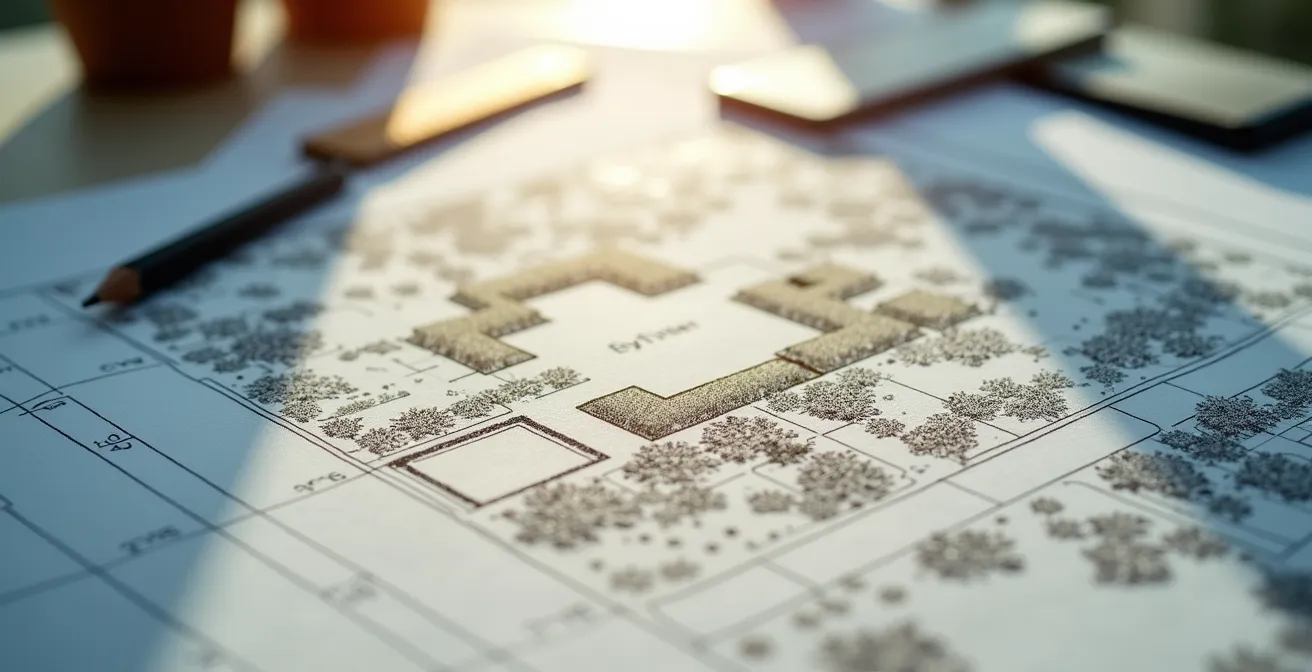
This master plan must also be financially realistic. As a general rule, experts recommend investing between 10% and 30% of the property’s market value in overall landscaping for a significant impact. A master plan allows for phasing this investment over several years, starting with structural elements (earthwork, drainage, major plantings) and then moving to finishes. It guarantees that even if work is done in stages, the final result will be unified and professional, projecting an image of quality and reflection that will seduce buyers and fully justify your price.
Ultimately, the greatest value of outdoor landscaping is not measured in square feet of paving or the number of plants, but in the coherence and quality of the overall vision. It is this vision, materialized by the master plan, that transforms a simple lot into a true extension of the home—a high-value asset.
To put these analyses into practice and evaluate the best options for your property, the next step is to consult a certified appraiser or a certified landscaper who can help you develop a master plan tailored to your budget and resale goals.